

BaianaSystem will make Europe dance
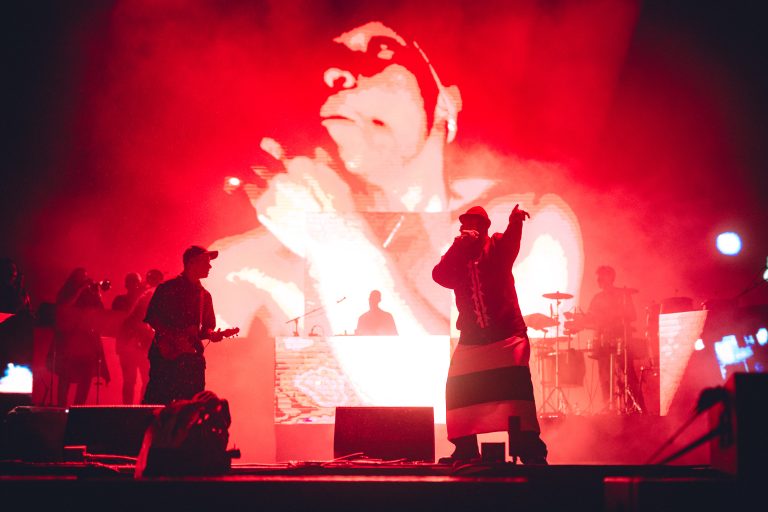
09 September, 2025Maybe in the last 15 years, BaianaSystem have become one of the biggest music movements in Brazil. This is just a guess because there aren’t any studies to prove it. But there is no way to ignore what the band from Bahia, led by Roberto Barreto and Russo Passapusso, together with Seko Bass, Filipe Cartaxo, and Claudia Manzo (in addition to frequent collaborators João Meirelles, Junix, maestro Ubiratan Marques, Ícaro Sá, and VANDAL), has done during this period. This goes far beyond their album recordings. Wherever they go, Baiana move people of all social classes, genders, styles, and ages. It is plural. One example is the [BaianSystem’s] Navio Pirata trio elétrico, which at Carnival in Salvador or São Paulo will bring together a crowd that will be carried away by the wave caused by an energy and rhythm that cannot be put into specific boxes, because it fits into all of them and, at the same time, none of them.
This characteristic allows them to connect with different audiences. Not that this is something revolutionary in form. It is more of a transformation of sounds that were already part of Brazilian music. “We’re playing samba-reggae, frevo, reggae… we’re playing everything that’s already been there,” says one of the creators and guitarist Roberto Barreto. “We’re just packaging it, so to speak, and bringing in other collaborations. But it’s not new. And then the guy says, ‘but it’s kind of rock.’ It’s rock too.
“But there’s something kind of guitarrada about it.” There is. There’s a lot of reggae. So it’s hard to think of us as a band structured within a style, because of the things that move us.” One of the influences is the diversity provided by Carnival, a popular Brazilian festival where artists experiment and test their creations. “Then, suddenly, you’re immersed in this Afro-Bahian, Afro-percussive universe, which is one layer. But it’s also become heavier rock because of Junix’s presence, the way the guitars end up dialoguing there. So it’s rock, it’s ijexá, it’s pagodão, it’s a little bit of everything.”
The same impact caused at concerts and festivals in Brazil can be felt by Europeans during the Eurotour in September. It starts in Dublin on the 9th, passes through Here at Outernet in London the next day (10th), and then makes stops in Portugal, Spain, the Netherlands, and Germany, ending in Berlin on the 21st. The format of these performances will be the “Lundu Rock Show,” which is a fusion of songs from various albums by the band, including the current O Mundo Dá Voltas. As each show is unique, and in the case of Baiana, no two are alike. But on this return to Europe, Roberto says they will adapt them to the places they will play, some of which are already familiar to them.
“We’ll be returning to some venues we played last year, so we already know how they work, how they behave, and that way we can be explosive at the beginning, then play other things,” he says. “Or we’ll open with ijexá, because that will be more of a celebration. That’s kind of part of the Baiana process. It’s unlikely that the show will be set in stone or that the repertoire will be repeated. We are always adapting… in the case of Europe, well, in the end, they often end up being more similar, but we manage to leave some more open to play around and make them grow.”
This playfulness is what makes all the difference in BaianaSystem’s concerts. Based on his observations, Russo manages to take the show in different directions. This depends on the audience’s reaction. It follows a characteristic of jazz that opens space for improvisation in unexpected moments. That’s where things came from that were applied in performances and even on albums, such as PLAYSOM, Saci, and Balacobaco. Improvisation also happens naturally because there is a connection between the musicians. A note can be the beginning of a journey into a musical universe that would not be accessible otherwise. “Russo has this in a very quick and sensitive way,” says Barreto. “He glances at the stage and already has a circle, something is already happening, let’s stay with this song because it’s flowing.” These moments are escape-points so that they don’t just stick to the basics. However, everything depends on the audience’s reaction to what is being presented.
“I think Russo’s ability helps people understand Baiana and the sound, and thus shape this thing, let’s say, almost like a slogan that he plays around with,” he points out. “Our culture first and foremost was a slogan that he came up with, and people (especially Brazilians) can understand that. He finds slogans and things that people begin to understand, such as: ‘Brazilian, you were never American.’ When he finds this slogan and points to a place, people can understand: we are Latin Americans. The album Futuro não demora talked a lot about Latin America, its importance to us, how it happens, that we are South Americans.”
The slogans help reinforce the richness of what is produced culturally in Brazil. When he says “our culture first,” he is reaffirming and valuing who he is. It also makes the audience itself put Afro-Brazilian and indigenous culture first as the matrix of all the music that is developed in the country. It shows what Brazilian culture is like and that it is necessary to look at Latin America with more affection and respect. In this way, in addition to making people dance and have fun, it also makes them think and reflect on necessary causes, ranging from political (mainly) and social issues to environmental and gender issues. Having this influence was something they did not expect at first, but it happened through consistency and resistance.
“We somehow moved the audience, let’s say, in the formation of what we did in Pelourinho and at Carnival as well. We always wanted to occupy this space in Carnival, but we didn’t because there was a market that didn’t allow it and it didn’t happen that way,“ he observes. ”But Carnival is very important to everyone, and we managed to be in Carnival in a way that was solidified through Navio Pirata. I think there are several elements within that, but we didn’t have time to realize it, but we were able to realize it later with people who are references for us translating that: BNegão (Planet Hemp), producer Daniel Ganjaman, Gilberto Gil. People identifying with that is something that has a representativeness, let’s say, of our culture, especially in Bahia. That’s the sum of everything.”
Here are the full dates for the European tour:
9th Sep – DUBLIN / BUTTON FACTORY tickets 10th Sep – LONDON / HERE AT OUTERNET tickets 12th Sep – PORTO / HARD CLUB tickets 13th Sep – ALMANCIL / FESTIVAL PÉ NA TERRA tickets 14th Sep – LISBON / MONSANTOS OPEN AIR tickets 16th Sep – BARCELONA / SALA APOLO tickets 17th Sep – AMSTERDAM / MELKWEG tickets 18th Sep – GENEVA / ALHAMBRA tickets 20th Sep – ZURICH / ROTE FABRIK tickets 21st Sep – BERLIN / ASTRA tickets
Follow Sounds and Colours: Facebook / Twitter / Instagram / Mixcloud / Soundcloud / Bandcamp
Subscribe to the Sounds and Colours Newsletter for regular updates, news and competitions bringing the best of Latin American culture direct to your Inbox.