

Beyond the Surface: An Interview with Frailejón
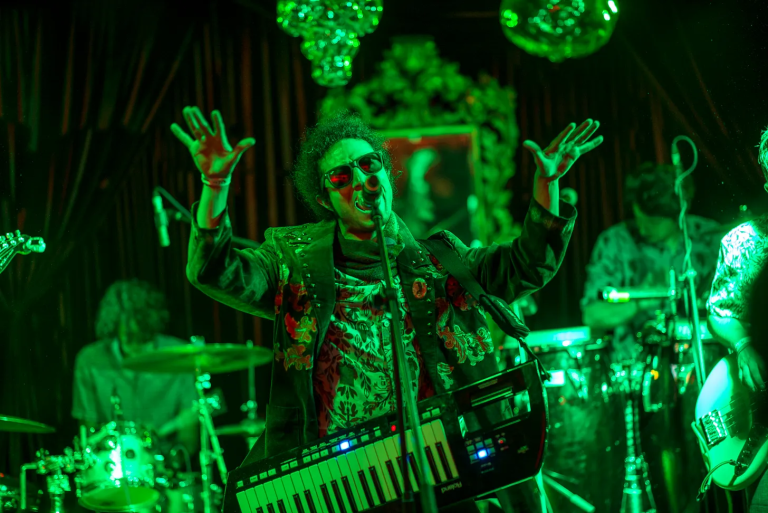
01 April, 2026We recently met up in person with Alejandro Loaiza and his project Frailejón through Bogotá’s ever-expanding network of experimental folk music. What initially appeared as yet another psychedelic fusion project quickly revealed something deeper: a musical philosophy rooted in Colombia’s ecosystems, ancestral sounds, and global sonic exploration.
The project moves fluidly between Caribbean heritage and traditions that lean towards the country’s mountainous range. Psychedelia, progressive rock, electronic textures, jazz, and world music, all guided by what Loaiza calls a “retrospective futurism of sound”. The project has taken him from Bogotá’s alternative circuits to international stages, including a performance at the World Intellectual Property Organization (WIPO) headquarters in Geneva, representing Colombia’s avant-garde musical landscapes.
Before Frailejón became a stage project, a Rock al Parque presence, a COP16 participant, or a WIPO representative in Geneva, it was an idea Alejandro had been carrying for years — long before public TV network Señal Colombia created a homonymous animated environmental character known as “Ernesto Pérez”.
What began as a personal alias for compositions eventually evolved into a fully articulated sonic universe. One rooted in Colombian territory yet expansive enough to hold psychedelia, classical training, funk, jazz, New Orleans grooves, and the ritual consciousness of water.
In our conversation, Alejandro reflected on the origins of Frailejón, the symbolism of water and the páramos, the influence of Latin American rock icons, and how a project born in the Andes is now connecting with audiences across Brazil and beyond. In our conversation, we traced the origin of Frailejón — from coincidence to concept, from progressive rock to tropicalia and much more.
Let’s start with something fascinating — the coincidence around “Ernesto Pérez”.
Yes, that’s wild. I come from a deeply Colombian family, from Manizales on one end and Boyacá on the other. My grandfather was named Luis Ernesto Pérez. And long before that animated character existed, I was already using the name as a kind of alias for some of my compositions.
Frailejón as a project officially begins around 2017, but the seed was older. So when the character “Ernesto Pérez” appeared later, around 2019, people thought there was some direct connection. But no — it was coincidence. Though I do believe coincidences don’t really exist.
That’s crazy indeed. So when did Frailejón truly begin as a musical project?
The project had different names in my head at first. I didn’t want to release music under “Alejandro Loaiza”. I wanted something conceptual, more tied to territory. The frailejón is this plant that captures water from the clouds and channels it into the earth.
That metaphor became everything. Above us, clouds carry drops of water from Africa, Europe, Oceania, America — information moving constantly across the planet. The frailejón gathers that water and roots it in Colombian soil. That’s what I wanted my music to be: global influences, but planted in Colombian ground.
That’s powerful. And this concept of PsyColombian — where does that come in?
I don’t see it as a genre. I actually resist genres. I wanted to create something “degenerate” — in the literal sense — without a fixed genre. I didn’t want to marry one format. I love too many currents to fixate on just one of them.
But if I have to define it, PsyColombian is psychedelic music made in Colombia. It’s also psychedelia not as escapism, but as an altered state of consciousness. For me, music is like a stimulus. It’s a trip in which you don’t really need any substance intake. You can experience that state in the páramo, in the jungle, in ritual. That’s very connected to magical realism too — this idea that reality itself is already magical.
You mentioned realismo mágico. Was literature also an influence in the project?
Absolutely. García Márquez, of course, but not just him — the whole current of magical realism. Latin America as a whole is pretty surreal. Our landscapes, our history, our contradictions. I think I internalized that narrative richness, and wanted to translate that into sound.
I must say that song “El Negro Adán” blew my mind at first listen and is still my favorite. How does it connect to those influences you mentioned?
It connects deeply. “El Negro Adán” was a real figure who became a kind of popular troubadour within the Caribbean coast’s collective memory. His story sits precisely at that intersection where history begins to blur into legend. So in that sense, his influence mirrors the logic of magical realism itself—where the extraordinary emerges not from fantasy, but from the way reality is told, remembered, and shared. So I wanted my music to become another vessel for keeping those narratives in motion.
There’s also a strong progressive rock thread in your background. You’ve referenced influences such as Emerson, Lake & Palmer.
Yes! I’m a pianist, classically trained. I studied at Bogotá’s Fundación Juan N. Corpas. Stuff like classical music, composition, counterpoint, chorus writing. But I always loved genres like rock, jazz, salsa, cumbia, funk bands. I also lived in New Orleans for two years. That city changed my perception of groove.
So yes — I once thought: what would a Colombian version of Emerson, Lake & Palmer sound like? Progressive structures, but rooted in cumbia, Pacific rhythms, Andean textures. Frailejón became that experiment.
You’ve worked around some amazing local projects like Romperayo, Malalma, and also connected with Aterciopleados’ Héctor Buitrago through Canto al Agua. How did that relationship form?
Yes, I connected with Héctor through Canto al Agua, which is this beautiful initiative that comes together every March 22nd — World Water Day — where people gather at rivers and water sources to sing. We connected through that sort of environmental consciousness. Later we’ve shared stages, invitations, events. I think when it comes to Frailejón, the theme of water isn’t branding, but rather a foundational element of the project.
There’s of course a strong Latin American rock lineage in your formation. How did that current enter your sound?
Those artists were sacred for me. Spinetta, Charly, Fito, Cerati — they represent a way of thinking about song as literature, as philosophy. Also the album Re by Café Tacvba blew my mind. You can hear 50 genres inside that record— bolero, heavy metal, Mexican folk, progressive structures — and it still felt cohesive.
That freedom marked me. I never wanted to “marry” a single sound. Latin America has always been eclectic. And on another note, even British bands like Queen were doing something similar — blues, opera, progressive rock, pop — all in one record. That hybridization felt natural to me.
Frailejón became a place where that multiplicity could coexist without apology.
You also mentioned spending some time in New Orleans. What did that city give you?
I would say Groove. New Orleans changed my relationship with rhythm. Jazz, second line, the deep pulse of that city — it’s impossible to leave untouched.
At that time, I was also absorbing Brazilian music. A friend started sending me records from the greats: Gilberto Gil, Caetano Veloso, Milton Nascimento. Artists who combine tropical roots with rock, psychedelia, political consciousness.
This became a revelation for sure. They sing their folklore, but they electrify it. They experiment. They protect their roots but aren’t afraid of distortion.
That resonated deeply with what I was trying to do with Colombian music.
Now that you mention it, Brazil has become a key territory for Frailejón, hasn’t it?
Yes! And that surprised me. Brazil is historically very self-sufficient culturally. They consume their own music. The language barrier makes it a closed ecosystem. But something has shifted in recent years. There’s been more South–South openness, and especially between Colombia and Brazil. There’s lots of political and cultural affinity. Bogotá–São Paulo connections have increased. More direct flights, exchanges. It’s funny because they actually contacted me from Foz do Iguaçu’s FIMS music market around September of last year. At first thought I thought it was some kind of spam, but then they sent me this lengthy e-mail a few weeks later saying “Hey we’ve been trying to reach out about Frailejón.” It was an important step in my career for sure.
When I began performing in Brazil, I adapted. I sing in Portuguese and Spanish. The languages share maybe 70–75% affinity, but the vowels, the rhythm of speech — those details matter. And Brazilian audiences care deeply about lyrics. Narrative matters there. That opened doors. I’ve now done multiple tours, lived three months in São Paulo, recorded collaborations there. More than a new market, it’s become a dialogue.
Yes, I caught that interview you did at FIMS and your Portuguese is on point! It’s really cool to see these bridges being built
Exactly. I don’t see it as exporting Colombian music to Brazil. I see it as two very rich currents finally meeting. Brazil has historically influenced Colombia — but mostly at a distance. Now there’s more direct exchange. Artists, producers, collaborations. It’s lateral. Not mediated by the North. That excites me.
Your format has evolved significantly — from full band to more electronic, dance-oriented configurations. Why the shift?
Mostly for mobility. With a large progressive band, logistics become heavy. Festivals like Rock al Parque were perfect for that format. Back then (2023) we even got recognition as one of the best local bands of that edition. Gibson (or was it Fender?) awarded a guitar to our guitarist for being the standout local act.
But certain stages, like the WIPO gig we did, require another approach. That space wasn’t a rock festival. It’s diplomatic, institutional. I had to rethink the format: more electronic, more modular, more adaptable.
Later, the electronic language began opening new circuits — especially in Brazil. It’s closer to dance culture, easier to move between clubs and festivals.
But it’s not abandonment. The progressive band still exists. The electronic configuration is another current of the same river.
Tell us more about your WIPO performance.
Standing at WIPO as an experimental Colombian artist was surreal. I believe we were selected because they saw it as innovative, and also linked to environmental consciousness. But it also made sense. Psychedelia, folklore, innovation — these are not opposites. They exist inside legal and institutional frameworks too.
Fortunately this was a stage curated by WIPO directly, and not the more bureaucratic scenario most people would picture when thinking about Geneva. So even though it was quite formal, it was more focused on the creative side of things.
Water seems to be a recurring theme throughout your work.
Yes, water is central to the project. Beyond the ecological aspect, it’s also spiritual and symbolic. Humans are about 70% water, and so much of our culture revolves around rivers, oceans, and rain.
That’s why I often participate in events related to World Water Day on March 22, including gatherings where musicians perform by rivers or natural water sources.
These are moments where music becomes a form of gratitude toward nature.
There’s also a sense that collaboration, in your case, isn’t just feature-based—it’s more like dialogue. How do you approach working with artists like Pernett or others in your circle?
Exactly, it’s dialogue. I’m not interested in collaborations as decoration. With Pernett, for example, there’s a shared understanding of where Colombian electronic music comes from, but also where it can go.
And that extends to other artists too. I’ve been working with people from different spaces—classical, electronic, experimental. Each one brings a different language. The idea is not to unify everything into one sound, but to let those differences coexist.
That’s also very Latin American, I think. We’re used to hybridization. It’s not forced.
There’s a moment where you spoke about Brazil, language, and adapting your performance. Did that experience reshape how you think about your music?
Definitely. Brazil changed a lot for me. Not just musically, but in terms of how I communicate. Singing in Portuguese, for example—it’s close to Spanish, but the phrasing, the vowels, the rhythm of the language… all of that shifts the way you write and perform.
Brazilian audiences also listen very carefully to lyrics. There’s a deep attention to narrative. That pushed me to be more conscious of what I’m saying and how I’m saying it.
At the same time, it reinforced this idea of connection. It’s not about exporting Colombian music—it’s about exchange. About building something between places.
At this stage, with so many formats—band, electronic set, international circuits—what keeps Frailejón grounded?
I think it’s the concept itself. The idea of the frailejón as something that absorbs and redistributes. That hasn’t changed.
Everything else can shift—the format, the collaborators, the context—but the core remains. It’s always about taking in different influences and rooting them in Colombian territory.
And also staying open. Not fixing the project into one identity. Letting it evolve.
One of your recent tracks with Humberto Pernett explores the symbolism of the Southern Cross constellation.
Absolutely. Humberto was key in that one. I’ve had many mentors and great references who I’ve worked with such as Romperayo’s Pedro Ojeda and Malalma’s Sergio Arias, who I’ve mentioned before, but for me Humberto is one of the pioneers of electronic music in Colombia—someone who already did that work of bridging the Caribbean with electronic language. So collaborating with him wasn’t just aesthetic, it was symbolic too. We had connected around the pandemic and recorded this track “Caña La Flecha Perdida”, about the plant used for the traditional sombrero vueltiao here in Colombia.
So after the whole pandemic’s mess calmed down a bit I reconnected with Humberto and told him about this demo I was working on. “Canto Caribe Cruz del Sur” is built around the idea of the Southern Cross constellation. Historically, it’s been used for navigation in the southern hemisphere. I liked that metaphor—a shared sky connecting Latin America. Something that’s always there, guiding movement, even if you don’t see it directly.
Musically, we worked with that idea as an axis to orbit. We did the chorus, the female voices which we recorded with our girlfriends on the spot at La Colmena Records. You know Pernett is a genius, so he just wrote the spoken word section you hear on the track in a matter of minutes. And then everything else moves around it. You get traditional elements like gaita, but also electronic textures, choirs… it’s almost like a constellation in sound.
That’s a great story. And so I’m assuming now you’re looking forward to keep touring this one and the rest of your repertoire, correct?
Yes for sure. There are new dates shaping up in Brazil later this year, and also an upcoming show at Acto Latino, just a few blocks away from here in Chapinero. Right now the purpose is presenting our latest work, which follows up tracks like “NQS”.
Right! That’s the one about Bogotá’s NQS Avenue, right?
Yes, and it also means Never Quit Silence. I did that one back in 2023 with Lucille Dupin. It was actually aired as the song of the week on Radiónica back in the day.
Good stuff! Right now Lucille is one of the city’s most renowned singer-songwriters for sure.
Absolutely. She added tons of value to that recording. Thematically that one also revolves around the theme of rain, and more specifically the goddess of rain, who is depicted in ancestral elements of Bakatá (the indigenous root of the city’s name). Another interesting aspect about that release is the video, which we did with Sharpball. Those guys do some amazing stuff.
I’m not familiar with them but will check it out for sure.
You should! They’re unofficially known as the Wachowskis of Bogotá’s underground scene.
Will do! For the time being, I really wish you the best for the upcoming leg of your tour, and will be aware to catch you guys live sometime soon.
Thanks! It’s been great talking to you.
As our conversation came to an end, one thing was clear: Frailejón is not just a musical project, but rather a whole ecosystem of ideas.
From Andean páramos and Caribbean rhythms to psychedelic rock, electronic experimentation, and Latin American literary traditions, Alejandro’s vision continues to evolve across borders and formats. And like the plant that inspired its name, Frailejón functions as a kind of cultural conduit—absorbing influences from across the world, filtering them through Colombian roots, and releasing them back into the global musical landscape.
For listeners seeking music that bridges ancestral memory and futuristic sound, this PsyColombian journey is only just beginning.
Follow Sounds and Colours: Facebook / Twitter / Instagram / Mixcloud / Soundcloud / Bandcamp
Subscribe to the Sounds and Colours Newsletter for regular updates, news and competitions bringing the best of Latin American culture direct to your Inbox.