

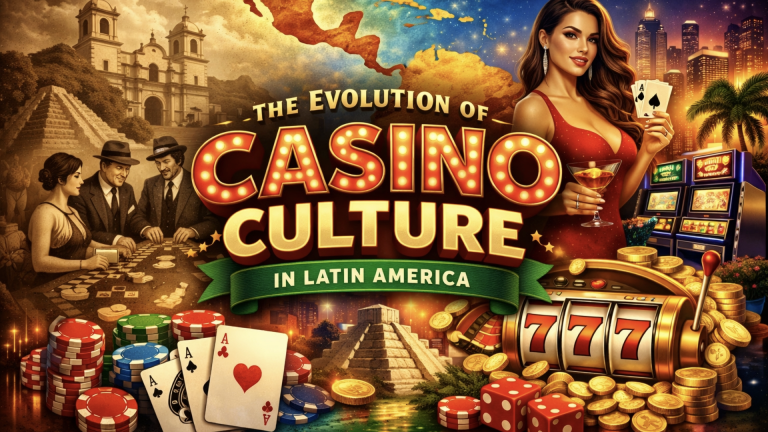
The Evolution of Casino Culture in Latin America
09 March, 2026Latin America has always moved to a rhythm shaped by passion, sociability, and collective experience. From public plazas to late-night gatherings filled with music and debate, entertainment in the region is rarely solitary. Within this cultural framework, games of chance did not emerge as isolated financial pursuits. They developed as social rituals embedded in everyday interaction.
Over the past several decades, casino culture across Latin America has undergone structural transformation. What once operated discreetly in private circles has matured into a regulated, capital-intensive industry influencing tourism, employment, and digital infrastructure.
To understand this evolution, one must examine both its cultural foundations and its economic acceleration.
Informal Gaming Traditions and Cultural Foundations
Before legalization expanded across the region, games of chance were already woven into community life. Spanish-origin card traditions, including Truco and Mus, adapted organically to local environments. These games were played in cafés, homes, and neighborhood clubs, where psychological strategy and social signaling often outweighed monetary stakes.
Victory carried prestige, yet participation itself reinforced social bonds. Bluffing functioned as performance. Storytelling enhanced competition. The table served as a microcosm of regional communication style: expressive, strategic, relational.
This informal gaming culture normalized calculated risk within a communal context. When formal casinos later entered the public sphere, they were not introducing unfamiliar behavior. They were institutionalizing an existing one.
Legalization and the Emergence of Integrated Resorts
The regulatory shift of the late twentieth century marked a decisive turning point. Governments in Argentina, Uruguay, Colombia, Panama, Chile, and Peru began viewing casino gaming as a fiscal instrument. Licensing systems formalized operations, taxation mechanisms generated public revenue, and oversight frameworks improved transparency.
This process transformed casinos from isolated gambling venues into anchor institutions within broader entertainment economies. Coastal destinations expanded integrated resorts that combined gaming floors, luxury accommodation, gastronomy, and live performance venues. Urban centers incorporated casinos into hospitality corridors tied to tourism strategies.
The result extended beyond gambling revenue. Employment opportunities expanded across hospitality management, event production, surveillance, compliance, and service sectors. International capital entered local markets. Casino districts contributed to urban redevelopment initiatives.
Public perception shifted accordingly. Casino attendance no longer signaled marginal activity. It represented participation in mainstream leisure culture.
Gaming Floors as Social Performance Environments
Latin American casinos reflect the region’s expressive social identity. Gaming floors function not merely as wagering spaces but as performance environments. Live music, curated dining, and high-energy atmospheres integrate seamlessly with table games.
Participation often unfolds collectively. Groups attend together, celebrate wins publicly, and treat the casino visit as a social outing rather than a solitary financial exercise. Conversation remains constant across hands. Emotional expression is visible rather than restrained.
Strategic sophistication has also increased. Digital literacy has expanded access to educational resources, enabling players to arrive at physical venues with foundational knowledge already established. Platforms including Blackjack Insight contribute to this informed participation by clarifying rule structures, probability mechanics, and decision frameworks. As player awareness grows, casino ecosystems become more analytically competitive.
Digital Expansion and Market Convergence
The acceleration of mobile connectivity has reshaped the regional landscape. Online casino platforms have extended access beyond metropolitan hubs, allowing participation from secondary cities and rural regions.
Digital gaming serves multiple functions. It introduces rules in a low-pressure environment, familiarizes players with pacing, and reduces psychological barriers associated with entering large physical venues. In turn, land-based casinos benefit from a customer base already comfortable with mechanics and terminology.
This convergence does not signal substitution. Instead, it reflects ecosystem integration. Online platforms expand reach, while physical casinos preserve experiential intensity.
Regulatory adaptation continues in parallel. Some jurisdictions have established comprehensive digital licensing systems, whereas others maintain partial restrictions or evolving frameworks. Despite policy differences, participation trends remain upward across both physical and online segments.
Economic Scale and Regional Differentiation
Market maturity varies significantly across the continent. Argentina maintains one of the largest networks of licensed casinos. Uruguay leverages high-end tourism branding to position gaming within a luxury context. Colombia has implemented structured regulatory oversight for both land-based and digital operators.
Smaller economies continue gradual development influenced by demographic growth, digital adoption, and foreign investment. Currency stability, tourism cycles, and political conditions contribute to performance fluctuations.
What remains consistent is institutionalization. Casino culture in Latin America has transitioned from informal pastime to regulated economic sector with measurable fiscal impact.
The journey reflects cultural continuity rather than rupture. Informal card tables provided the psychological groundwork. Legal frameworks supplied structural legitimacy. Digital expansion amplified accessibility.
Casino culture did not appear suddenly under neon lights. It evolved from community ritual into structured entertainment economy.
Frequently Asked Questions
Which country has the most mature casino infrastructure in the region?
Argentina is widely recognized for its extensive network of licensed establishments and longstanding regulatory presence, particularly in major urban and resort areas.
How has online gaming influenced land-based casinos?
Digital platforms have increased rule familiarity and reduced entry barriers. Many players now approach physical casinos with prior strategic understanding, enhancing overall engagement levels.
Is casino growth driven primarily by tourism?
Tourism plays a central role in markets with strong resort positioning, while larger economies also rely heavily on domestic participation to sustain revenue streams.
Do traditional card games still hold cultural relevance?
Yes. Informal games remain embedded in social life and coexist alongside regulated casino environments, preserving continuity between past and present gaming traditions.
Follow Sounds and Colours: Facebook / Twitter / Instagram / Mixcloud / Soundcloud / Bandcamp
Subscribe to the Sounds and Colours Newsletter for regular updates, news and competitions bringing the best of Latin American culture direct to your Inbox.