

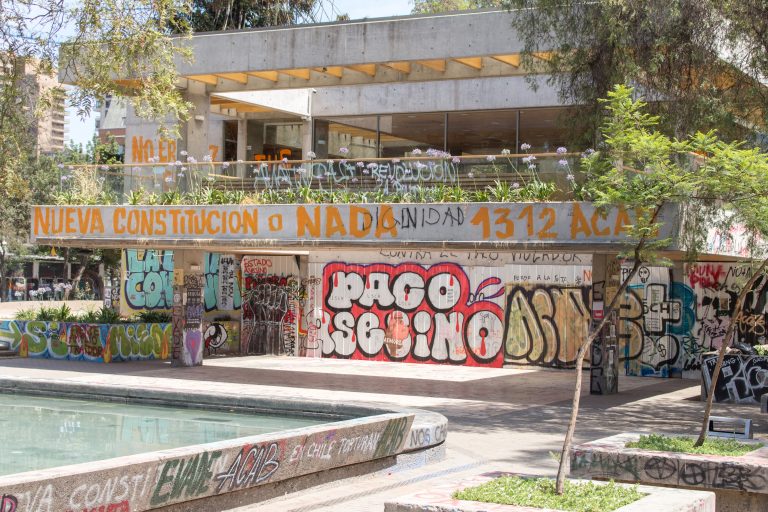
The Power of Latin American Street Art
13 April, 2026Step into Bogotá’s La Candelaria and the walls don’t just sit there — they push back. Layers of paint carry arguments, memories, and names that refuse to disappear. A faded ad gives way to a face that shouldn’t be forgotten. Patterns crawl over cracked plaster. Nothing is decorative for the sake of it. Every surface says something.
This isn’t random spray. It’s a public record.
Latin America didn’t jump on the street art wave — it helped shape it. Long before stencil culture went global, walls here were already doing heavy lifting. Over the past couple of decades, cities like São Paulo and Mexico City have turned into reference points for what street art can be when it stays raw, political, and grounded in real life rather than polished for visitors.
From the Revolution to the Streets
The foundation was laid nearly a century ago. In Mexico, artists like Diego Rivera, David Alfaro Siqueiros, and José Clemente Orozco turned walls into platforms for ideas that couldn’t be ignored. Their work wasn’t subtle and it wasn’t meant to be. It spoke directly to people walking past it.
That mindset still carries through today:
- art as something public, not locked behind doors
- a direct line into politics and social issues
- scale that forces attention rather than asking for it
- imagery tied to local identity and lived experience
The setting changed. The intent didn’t. Murals moved out of institutions and into streets where the conversation is less controlled and far more immediate.
Clean Lines, Digital and Concrete
The strongest murals don’t overwhelm. They guide the eye, hold attention, and cut out anything that doesn’t need to be there. That same principle shows up in well-built digital spaces.
Brands such as Royal Reels pokies prove this by leaning into clean layouts and responsive mechanics that never pull focus away from the experience. A Royal Reels online casino treats visual structure the way a muralist treats composition — every element has a job and sits exactly where it should.
The best Royal Reels casino interfaces understand that clutter kills engagement, whether it’s on a wall or a screen. Royal Reels online platforms strip things back so the core experience stays front and centre, much like a mural that lets a single image carry the weight without competing noise around it.
São Paulo’s Open-Air Gallery
In Brazil, the streets operate like a living canvas. São Paulo’s Batman Alley doesn’t rely on permanence — it thrives on change. Pieces overlap, disappear, reappear in new forms. Styles collide without trying to resolve into something neat.
Os Gêmeos started out in that exact environment in the 90s. Their work now travels globally, but it still carries the same energy it had on local walls. It hasn’t been softened or repackaged. It still feels like it belongs outside, not under gallery lighting.
Colombia’s Painted Resistance
Colombia’s scene shifted sharply after the 2016 peace accords. Spaces that once carried warnings now carry stories. Faces of farmers, activists, and communities that lived through violence take up space in a way they couldn’t before.
What sets it apart:
- direct confrontation with recent history
- deep influence from indigenous and Afro-Colombian culture
- projects shaped by communities, not just individual names
- an undercurrent of repair, not just protest
Medellín’s Comuna 13 shows how far that shift can go. Once defined by conflict, it now draws people in to see how art reshaped the narrative of the place itself.
Mexico City’s Ever-Changing Canvas
Mexico never stepped away from mural culture — it just evolved. The new wave operates faster, looser, and without waiting for approval. In neighbourhoods like Roma and Condesa, walls become statements overnight.
A protest goes up. It gets covered. Something else replaces it hours later. The surface keeps moving, and so does the conversation. Nothing settles for long.
Why the World Is Watching
This isn’t a passing phase. It’s a system that keeps adapting without losing its core. Artists who started on the street now show in major institutions, but the centre of gravity hasn’t shifted. The most important work still happens outside.
That’s where urgency lives. That’s where things stay honest.
What’s coming next:
- closer collaboration with indigenous communities
- murals that shift through augmented reality layers
- crossover into architecture and spatial design
- surfaces that react to light, weather, and time
Walls across Latin America have always carried stories that don’t make it into official narratives. The difference now is that more people are paying attention — not because the message changed, but because it’s become impossible to ignore.
Follow Sounds and Colours: Facebook / Twitter / Instagram / Mixcloud / Soundcloud / Bandcamp
Subscribe to the Sounds and Colours Newsletter for regular updates, news and competitions bringing the best of Latin American culture direct to your Inbox.