

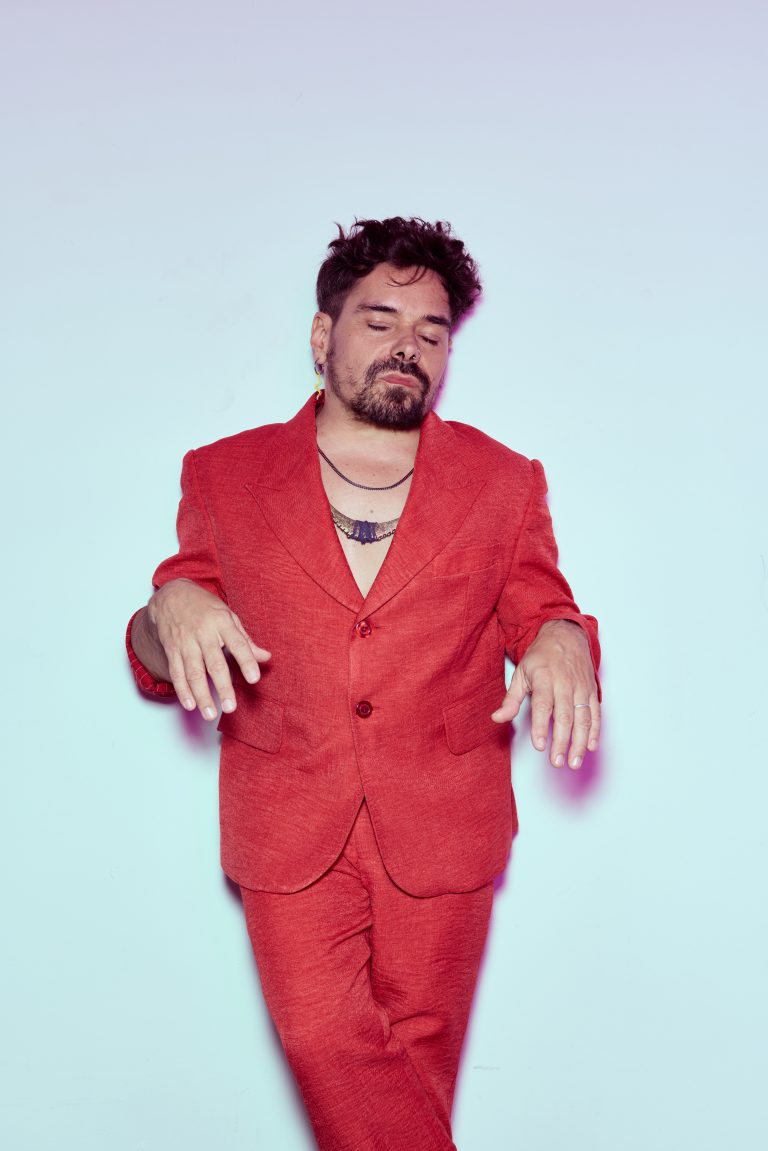
Jonas Sá – A Monster Unleashed
26 January, 2026Jonas Sá is a musician and producer whose career began in 2003 and who has worked with a range of artists from Caetano Veloso to Ava Rocha to Ricardo Dias Gomes on the critically acclaimed Muito Sol. His latest album _MNSTR_ is a multi-genre grab-bag of musical idioms, taking in ’50s rock’n’roll, ’80s new pop, experimental guitar techniques and even a Latin crooner to the tune of a bolero. It’s an intriguing album and well worth delving into. I caught up with him for a long, fascinating chat about the album, but we also talked about Brazilian politics and streaming, and there are some great insights into the modern wave of MPB.
AC: When did you start writing the album?
JS: The songwriting process for these songs stretched across different phases of Brazil and of my personal life. 2018 was a presidential election year, and we were coming out of a series of political injustices such as the parliamentary coup suffered by President Dilma Rousseff, the hijacking of the 2013 protests by the far right, the rise of Bolsonarism, and Lula’s imprisonment in a baseless process, without evidence. My friends and I were pissed off—it was inevitable to write about these things. I recorded four explicitly political songs, but I realized I didn’t want to make a conceptual political record, especially because other aspects of our lives—such as the body, love, sex, and culture—had also become political subjects in themselves.
I invited Ricardo Dias Gomes, one of my best friends since our teens and my longest-standing musical partner, to co-produce the album with me. The guitar solos happened in a totally spontaneous way, with no overdubs or written arrangements. I liked the warmth of the recordings so much that I completely inverted the original idea: I kept the tracks as they were, even when they were long, even with small mistakes. I did very little creative editing.
Once we had the basic tracks, we recorded the keyboards and synths in my studio in Rio de Janeiro, some in Ricardo’s studio in Lisbon, and the backing vocals by Gabriela Riley and Sahlence in New York, at Mauro Refosco’s studio. Mario Caldato Jr. [renowned for his work with the Beastie Boys] delivered the final mix of the album in the middle of the pandemic, and I chose to wait for that period to pass before releasing the record.
AC: The sounds created on the album are very different from the new wave of Neo-MPB which is fashionable at the moment.
JS: It wasn’t something I thought through consciously; I simply made the music that emerged from within me. The way I see is that, in the 1960s and ’70s, when the Brazilian Tropicalismo happened, it was the result of a global, anthropophagic reverberation—something that eventually led to the internet, to World music, to all the transcultural miscellany we live in today, and that makes it possible, for example, for K-pop to become a global phenomenon. Our funk carioca is called “funk” because it came from dance parties where soul-funk was played!
When I see my dear friends from Bala Desejo making music in such a deeply connected way to the incredibly vast MPB—ranging from Jobim’s fantastic Brazilianism to Rita Lee’s feminist sarcasm—it naturally inspires me. But I grew up following a large part of the careers of the gods of Brazilian popular music; I saw them build a kingdom and become our mainstream. And my generation may have been the last to carry the counterculture of the 1960s in its DNA.
It’s also important to understand that my brother and I are the sons of the guys from the band CINEMA, a group from the mid-1980s that made independent and experimental music at the time and was only rediscovered a few years ago [Ronaldo Tapajós and Tetê Sá; their eponymous 1985 album was re-released by Discos Nada a few years back and is a mixture of dark ambient and Afro-Brazilian rhythms]. Friends of mine and of my brother—the children of many like Caetano Veloso, Moraes Moreira, and others—would come over to our house, and all of us would end up understanding both sides of the coin.
So we sought out other paths, especially by joining forces with slightly older artists from my brother’s generation—the first children of MPB—who rejected the burden of explicit continuity that the industry and the press tried to force down their throats. I guess Moreno (Veloso) now understands that this needs no longer exist, but at the time, Music Typewriter, by Moreno +2 (2001), was a strange album for Brazil. Back then, we embraced the music of our giant artists while rejecting the obligation to choose one of them to replicate.
Returning to the core of the question, my artistic intuition is anthropophagic and hedonistic at its core. As I make music with artists such as Sessa, Zé Ibarra, Biel Basile, and others, I also develop my own paths within this landscape of new old Brazils. I feel this happening with my friends as well—Ricardo in Muito Sol, Alberto Continentino and his Cabeça à Mil e o Corpo Lento, and so on—but I don’t feel this in _MNSTR_, and I like that it’s that way ‘cause it was how I felt creatively at the time.
AC: There are lots of contributors on the album, how do you choose who to work with?
JS: (Thiago) Nassif is one of my best friends; during the pandemic he and Pedro Sá lived with me, Geraldine, and our daughter, Kim. Nassif is a very interesting artist — we’ve produced many records together, and he’s one of those people with whom I have studio telepathy. Alberto (Continentino) is another very dear friend. We’ve written many songs together. Our first composition, “Casca”, was recorded by Gal Costa!
Over the last few years, the line separating the Rio de Janeiro and São Paulo scenes has become increasingly blurred. We’re constantly going back and forth and exchanging a lot among ourselves. Risco, the label releasing my records, for example, is based in São Paulo. It’s the same label for other Rio artists like Ana Frango Elétrico and Alberto. My brother released his album through Balaclava, another São Paulo label. This miscellany is turning into a single scene, with people who live between these two cities but who come from all over Brazil.
AC: On the chorus of “Quanto + idiota melhor” (The title of Wayne’s World in Brazil) you name specific politicians from the far-right in Brazilian politics; why be so specific?
JS: Far-right governments have been promoting a cult of ignorance and sophistry, defending hatred and prejudice in the name of freedom of expression. This is a global phenomenon, a calculated one. Here in Brazil, the strongholds of disinformation are the Bolsonaros. So the song talks about that. But it also addresses the aesthetic crisis proposed by the Brazilian far right and the hypocritical attempt to normalize fascism in the name of tradition, religion, and family. When I saw Milei for the first time, I told my Argentine friends that he would be their next president, and they laughed at the absurdity of what I was saying.
AC: And with Lula 2.0? Have things improved?
JS: Absolutely! First of all, Lula seeks allies among his supposed enemies, and that’s precisely what doing politics is all about if you want to promote a democratic environment.
Secondly, Brazil has been taken off the hunger map, the minimum wage has increased and there is an automatic raise already scheduled. Starting in 2026, the super-rich will begin to be taxed; there has been a record increase in employment rates as well as in the trade surplus, an appreciation of the Brazilian real, and a serious handling of the attempted coup. All of this has been restoring Brazil’s position as a country of great importance on the international stage. What a relief!
AC: Do you struggle with the music market nowadays?
JS: I do struggle. It’s a shame that such an impressive and intelligent tool like Spotify, with its amazing radios, is in the hands of savage, ill-intentioned technocrats. They don’t share profits fairly with artists, they don’t promote them, they have no real cultural commitment, and they treat them as if they’re doing them a favour while actually exploiting artists. It’s extremely frustrating for someone who lived through the promise of the democratization of cyberspace in the 2000s, who has spent years developing their work to get here now, and has to deal with the algorithms and technocracy of Big Techs.
I know there’s a huge amount of great music out there that never reaches people because of a new cultural standardization defined by artistically irrelevant data and characteristics, such as social media follower counts and harmless, inoffensive sound aesthetics.
The press and legacy media — newspapers, radio stations, and TV channels — fearful of losing even more importance and market share in the 21st century, bet on big artists and fail to acknowledge new artistic scenes or independent ongoing careers.
When this happens, it becomes much harder for an artist’s cult (personality, aesthetics etc.) to become part of everyday popular consciousness and culture, as Prince, Michael Jackson, or even Gilberto Gil did — and still do — for example. Bob Dylan would never stand a chance to be a part of our culture as he is nowadays.
AC: You’ve worked with many experimental musicians – Ava Rocha, Ricardo Dias Gomes, yet the album is quite pop, why is that?
JS: It’s curious that you mention this, because when I released my first album, people labeled my sound as “strange-pop”, “experimental” etc. I’ve come to understand that the idea of “experimental” in music is a contradiction. If we’re able to label a type of sound as experimental, that means this sonority has already adapted itself to a model. What could be less experimental than that? I see musical experimentalism much more as a means than as an end.
I consider, for example, that much of what has already been done in so-called “noise” music is less experimental than Billie Eilish’s approach on many of her tracks — and she is widely regarded as a pop artist. If we think about the formal challenge to the rules of popular music, Odelay, by Beck, is an album that is quite experimental and super pop at the same time. I see that happen in the works of other artists too, like Lucrecia Dalt and Julia Holter, as well.
_MNSTR_ does not set out to be experimental in its purpose, but in the process there were moments of complete freedom of form — even a song like “Escada Rolante”, where we created an experimental base that was totally spontaneous and unpredictable, and which later, with the lyrics and vocals, ended up sounding more like a rock-inflected hip-hop track. Mario Caldato told me that he preferred the instrumental version perhaps precisely because of the structure that the vocals imposed on what was originally an experimental base. But I’m also interested in what an experimental base can do for a more traditional song. Perhaps the records by Ricardo Dias Gomes and Ava Rocha wouldn’t sound so experimental if they were sung with more conventional vocal timbres and styles.
AC: What was the experience of working with Ava Rocha on Nektar and Ava Patrya like?
JS: Ava is my artistic and heart sister. Ava Patrya was the first album I produced entirely on my own. That’s where I learned a lot about listening to the artist and recording a band playing together.
NEKTAR was more complicated, because we were right in the middle of the pandemic, searching for a completely new language for Ava — more electronic, more dancefloor-oriented—something she proposed to us in the very beginning. Most of the instruments were played by (Thiago) Nassif and me: MPC beats, old synths, the upright piano in the living room at home, even a clavichord. The three of us were coming off a long period of listening to When I Get Home by Solange and Sin Miedo (Del Amor Y Otros Demonios) by Kali Uchis, and those records were a huge inspiration for us.
AC: What’s next for you?
JS: My next album I’m producing together with Biel Basile and Sessa (on tape!). There are several new friends involved, like Carol Maia, a wonderful singer and songwriter who’s been playing with me for a year and a half now; Zé Ibarra, who has become a great friend and with whom I love making music; and Charles Tixier, who has already been playing live with me since the PUBER shows. We’re doing O Jonas MNSTR Show on March 12th at Manouche, Rio De Janeiro, and we’re in the process of locking in new dates in São Paulo and Buenos Aires. Now we’re waiting for good European invitations, so guys…?
(Thanks to Fernando Young for the photo of Jonas Sá .)
Follow Sounds and Colours: Facebook / Twitter / Instagram / Mixcloud / Soundcloud / Bandcamp
Subscribe to the Sounds and Colours Newsletter for regular updates, news and competitions bringing the best of Latin American culture direct to your Inbox.