

5 Latin American Films that Explore Inner Journeys of Growth and Self-discovery
22 July, 2025
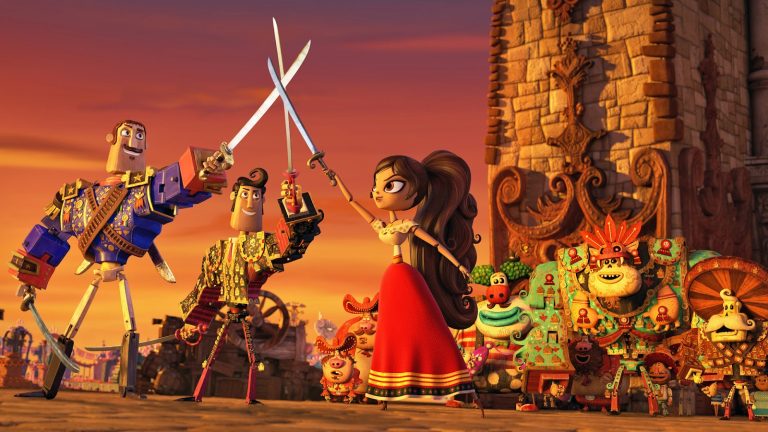
A still from the film “The Book of Life” by Jorge R. Gutierrez (2014), showing Joaquin (left), Manolo (center), and Maria (right) banding together to fight their enemies.
Latin American films often explore more than just external conflict. They take a deep dive into the hidden emotional landscapes of their characters.
Whether crossing physical borders, resisting political oppression, or grappling with generational expectations, these films reveal characters uncovering essential aspects of themselves that had long been buried, denied, or forgotten.
Below is a selection of films where the protagonist’s journey is not just about the world around them, but the one within.
Neruda
- Year: 2016
- Director: Pablo Larraín
- Country of Origin: Chile
Neruda is a stylized “anti-biopic” following the life of poet and communist senator, Pablo Neruda.
Set during the late 1940s in Chile, the plot spotlights his journey as he becomes a fugitive from the anti-communist government.
What makes this film interesting is that the story unfolds from the perspective of the police inspector sent to capture him.
The real transformation occurs not only in Neruda, but in his pursuer, Inspector Óscar Peluchonneau, who gradually becomes obsessed with understanding Neruda’s myth.
Through this cat-and-mouse dynamic, Neruda rediscovers his identity as more than just a politician or poet. He becomes a symbol, a legend, and a provocateur in the battle of ideas.
As he treads his inner self beyond the facets of poetry and politics, Neruda embraces theatricality and mystery, shaping his own legend to inspire others.
He learns that his role in society is larger than him as a man, and he leans into that myth-making to fight repression.
The Book of Life
- Year: 2014
- Director: Jorge R. Gutiérrez
- Country of Origin: Mexico/USA
In this animated tale inspired by Día de los Muertos, young Manolo Sánchez must choose between following his family’s legacy as a bullfighter or embracing his passion for music.
Additionally, Manolo must choose between acting on his undying love for his childhood friend Maria or remaining loyal to his friend Joaquin (who also has his eyes set on Maria).
After a tragic twist, Manolo journeys through the Land of the Dead to win back his love and discover his true self.
In the afterlife, Manolo faces a challenge that no one in his family has ever conquered: confronting death without violence.
This violence takes shape in the form of a bullfighting arena. In an intense horn-locking of the soul, he refused to kill.
Manolo chose compassion instead and let the souls of the bulls he had maimed previously finally rest in peace.
By choosing love and integrity over legacy and tradition, Manolo defines his own identity. He breaks the cycle of violence passed down by generations, showing that courage can be peaceful, personal, and rooted in love, not just combative.
In some way, Manolo’s revelation echoes how Filipino players approach digitized Tongits matches.
For instance, winners of the most recent GTCC tournament highlighted that their resolve to win hinged on their love for their families.
In turn, they discovered grit, resilience, and perseverance—facets that they now embody in their daily actions beyond playing competitively.
La Jaula de Oro
- Year: 2013
- Director: Diego Quemada-Díez
- Country of Origin: Mexico
La Jaula de Oro, or The Golden Cage in English, is a semi-fictional account of immigrants crossing borders to find their Promised Land.
Set in a poverty-stricken community in Guatemala, three teenagers—Juan, Sara (disguised as a boy), and Chauk—journey north to the United States in search of a better life.
The film’s alternate English name, The Golden Dream, paints a grim and unflinching portrayal of the migrant experience.
On the other hand, it also shows that glimmer of hope—like a shimmer on a golden surface—that crossing the border successfully brings.
As their journey progresses, Juan slowly confronts his selfishness and mistrust—especially in his treatment of Chauk, who speaks a Mayan language and is culturally distinct.
When tragedy strikes, Juan is left alone; his isolation paves the way for him to reevaluate his actions and reform any twisted or toxic beliefs he held.
Through painful loss and observation, Juan softens, shedding his arrogance and learning empathy.
In the end, as he looks through a fence at the U.S. he fought so hard to reach, he realizes that what truly matters may not lie beyond borders, but within the people they lost along the way.
Los Colores de la Montaña
- Year: 2010
- Director: Carlos César Arbeláez
- Country of Origin: Colombia/Panama
Set in a rural village in the Colombian Andes, Los Colores de la Montaña follows Manuel, a curious and hopeful 9-year-old boy with a passion for soccer.
He dreams of becoming a goalkeeper and spends his days playing with his friends. However, their lives are quietly surrounded by an escalating conflict between guerrilla forces and the military.
When Manuel’s new soccer ball lands in a field riddled with hidden landmines, his childlike determination to retrieve it becomes an emotional focal point of the story.
What begins as a simple adventure—retrieving a ball—evolves into a powerful metaphor for the loss of innocence and the limits of youthful optimism.
Manuel, in particular, starts to understand that the forces shaping his world are not just outside his control—they’re also slowly dismantling the only life he’s known.
His inner transformation is subtle but profound: he learns that courage isn’t always about facing danger, but also about recognizing when hope must be redefined, and when it’s time to move forward despite loss.
As families begin to flee the village, Manuel is left grappling not only with the minefield in the literal sense, but with the emotional minefields of abandonment, grief, and forced maturity.
In this way, Los Colores de la Montaña presents a powerful narrative about resilience forged in silence, and how, in war-torn places, the act of letting go becomes a rite of passage.
Las Niñas
- Year: 2014
- Director: Jorge R. Gutiérrez
- Country of Origin: Paraguay
Set in 1992 Zaragoza, the film follows Celia, an 11-year-old girl attending a strict Catholic school.
When a new girl, Brisa, arrives, Celia starts to question her education, her family, and the silence surrounding her father’s death.
As she forms a deeper bond with Brisa, Celia begins to sense the limitations and hypocrisies of the world around her—especially the suffocating silence of her mother and school.
Celia gains agency by embracing curiosity and defiance, even in small ways—by sneaking out, wearing makeup, or asking forbidden questions.
Her journey is quiet but powerful, marking the emergence of critical thinking and personal autonomy.
Final Take: Why are these films worth watching?
In these films, self-discovery is a form of resistance—against tradition, silence, expectation, or injustice.
The protagonists may be children, poets, or dreamers, but they all share one thing: a moment when they are forced to look inward and find something new, raw, and real.
Overall, Latin American cinema, with its emotional intensity and cultural specificity, shows us that the most powerful journeys aren’t just about changing your surroundings—but transforming your soul.
Follow Sounds and Colours: Facebook / Twitter / Instagram / Mixcloud / Soundcloud / Bandcamp
Subscribe to the Sounds and Colours Newsletter for regular updates, news and competitions bringing the best of Latin American culture direct to your Inbox.