

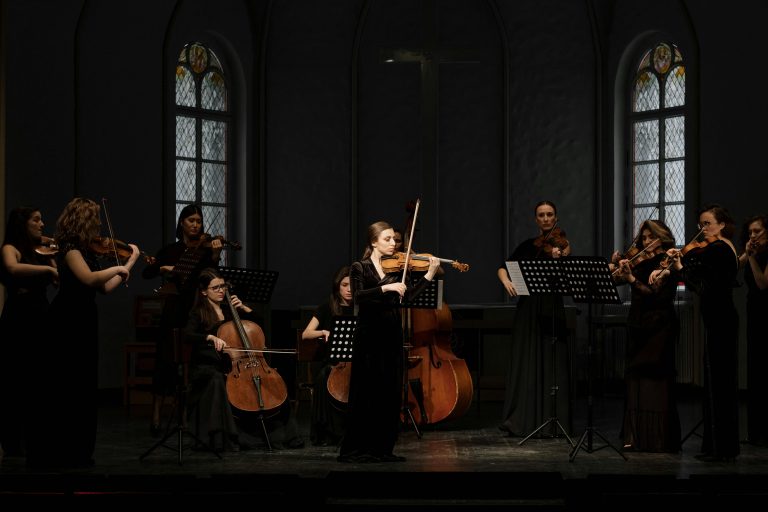
Gabriella Di Laccio is Championing Women in Music Through the Donne Foundation
04 March, 2026Have you ever sat through a beautiful symphony, or perhaps a sweeping film score, and wondered why the program’s name almost always belongs to a man?
It’s a question that many of us might brush off as a relic of the past. But for Gabriella Di Laccio, an award-winning soprano with a voice like spun gold and a heart set on revolution, it became a call to action.
If you haven’t heard of Gabriella Di Laccio yet, prepare to be inspired. She is named one of the BBC’s 100 most influential women in the world.
Through her nonprofit, the Donne Foundation, she has become a tireless champion for women in music. Her goal is to ensure that the silent half of musical history finally gets its time in the spotlight.
In this article, we’ll walk you through her remarkable journey, her bold advocacy work, and the powerful impact of the Donne Foundation. Dive in, then!
A Chance Discovery that Changed Everything
The story of the Donne Foundation doesn’t begin in a boardroom; it begins under the Southbank bridge in London.
Gabriella was browsing the famous outdoor second-hand book stalls when she stumbled upon a copy of the International Encyclopedia of Women Composers by Aaron Cohen. Inside, she found a staggering 6,000 names of women composers.
Gabriella was stunned. As a professional singer who had spent her life in the industry, she realized she only knew a handful of these names. She wondered why she hadn’t heard of most of these women or why their works weren’t being performed in our great concert halls.
This realization sparked a fire. Gabriella didn’t just want to sing these songs; she wanted to change the system that had buried them. In 2018, she founded Donne, Women in Music (now the Donne Foundation), named after the Italian word for “women.”
The Power of Data and the Big List
One of the most impactful things the Donne Foundation does is provide cold, hard facts. The Foundation’s annual research reports often tell a different story.
In recent years, reports have shown that over 90% of the work performed globally was written by men. Even more startling, the data revealed that works by just 10 well-known white European men were performed nearly 4 times more than all the works by women composers combined.
This serves as a wake-up call for artistic directors and record labels, showing them exactly where they are failing to represent the world we live in.
To provide a solution to this problem, Gabriella created The Big List. This isn’t just a spreadsheet; it’s an ever-growing database that currently features over 5,000 women composers spanning from the medieval era to the 21st century.
This approach is similar to how people fight for justice in other fields, like the legal battles over vaginal mesh implants. TorHoerman Law notes that women who got mesh implants reported suffering infection, organ perforations, and urinary problems.
The women in the vaginal mesh lawsuit claimed the products weren’t tested properly and that doctors and patients weren’t warned about the possible dangers. Just like in the music world, these legal fights use data, documentation, and collective voices to demand better standards and force a broken system to change.
Breaking Records and Making History
Gabriella doesn’t just talk the talk; she puts on the show. In fact, her foundation literally broke a Guinness World Record to prove its point.
In early 2024, the Donne Foundation organized the “Let HER MUSIC Play” marathon. This wasn’t an average concert. It was a 26-hour, 18-minute, and 57-second live-streamed event featuring exclusively music by women and non-binary composers.
With 96 musicians performing works by over 140 composers, the event shattered the record for the “Longest Acoustic Music Live-Streamed Concert.”
It was a joyful, exhausting, and triumphant demonstration of the sheer volume of incredible music that has been waiting in the wings. It sent a clear message, and that is, the talent is there, the passion is there, and the audience is definitely there.
A Mission of Inclusion and Intersectionality
What makes the Donne Foundation so special is its commitment to intersectionality. Gabriella is very clear that the fight for equality isn’t just for some women, but it’s for all women.
The Donne Foundation’s research now specifically tracks the representation of Black, Asian, and Global Majority composers. It also highlights composers from the LGBTQ+ community and those with disabilities.
The latest reports have introduced a time metric. That is, not just how many women are programmed, but how many minutes of music they are given. This is important because data shows that men composed 89.9% of the music played and women only 8.6% of those minutes.
Gabriella is pushing for meaningful space, the kind of stage time that allows a composer’s voice to truly settle into the hearts of the audience.
Gabriella Di Laccio and the Donne Foundation are doing more than just documenting history. They are ensuring that the soundtrack of our future is richer, more diverse, and more honest.
Through grit, grace, and some very high notes, Gabriella is making sure that the next time a young girl walks into a bookstore or a concert hall, she doesn’t just see the statues of men. She sees a world of possibility where her voice, too, can be heard.
It’s a beautiful song she’s singing, and honestly, it’s about time we all joined in the chorus.
Follow Sounds and Colours: Facebook / Twitter / Instagram / Mixcloud / Soundcloud / Bandcamp
Subscribe to the Sounds and Colours Newsletter for regular updates, news and competitions bringing the best of Latin American culture direct to your Inbox.