

Beyond the Surface: An Interview with Piangua
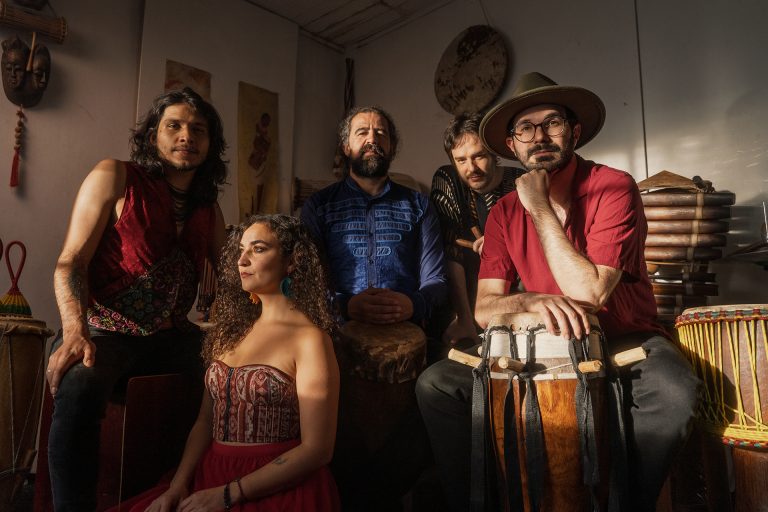
19 November, 2025There’s a distinct kind of alchemy running through Piangua’s music: one where rock, folk music and psychedelia meet the pulse of Colombia’s Pacific mangrove forests. Nearly a decade after emerging from Bogotá’s underground with their debut Las Brujas, the band returns reenergized and reimagined. Their new single, “Gaita Espacial”, marks both a continuation and a rebirth: a song that bridges the Pacific and the Caribbean, reconnecting their “Groove del Manglar” spirit with fresh textures and a renewed sense of purpose.
Back in July, their set at Rock al Parque stood out as one of the festival’s most pleasant surprises — a band given a privileged slot, and one that lived up to it in full rhythm and colour. Their mix of precision and spontaneity, rooted percussion and electric energy, made for one of those rare moments where tradition and groove collide naturally. Even more delightful was crossing paths with the group a few weeks later at the Bogotá Music Market (BOmm) in September, where we hit it off and sat down with band members Felipe Behlok (guitar), Giovanni (bass) and John Mario (percussion) to talk about this new chapter in their journey.
Here are some of the highlights from this recent conversation:
Tell us about how Piangua began.
Giovanni: It goes back to around 2014. Me and some other folks were looking for a way to explore traditional Colombian rhythms, particularly from the Pacific coast, but without copying or packaging them. We wanted to play with the groove, with what happens when you experiment and put seed-based instruments or a traditional marimba next to an electric guitar and a set of drums.
The name always struck me — it’s got a deep sense of place. Also it’s amazing how you guys were already exploring with those sounds from the Pacific early on.
G: Right, and it’s not random. La piangua is a mollusc that lives in the mangroves of the Pacific littoral in Colombia. It’s what people there go out to harvest in the mud. It can be used as food, but also a symbol of survival and community. We really liked that: something small but widespread, earthy, and rooted in the mangrove forests. That became our metaphor. We started calling what we did Groove del Manglar, because that’s where our sound lives.
The story of how Felipe joined the band is actually a good one. We were playing at a small house show in northern Bogotá. One of those DIY gigs where everyone’s half musician, half audience. This guy was in the crowd enjoying our tunes, really vibing with the set. That was when things clicked. In time connecting with him is what gave the project some of its distinctive elements: the powerful presence of the guitar, the arrangements. We started to really sound like a band.
Felipe: Yes, I was already familiar with the project, and I think what really made us click was this shared idea that Colombian traditional music could groove. That you could make it move like funk or soul without losing its roots.
For sure. There’s still a clear rock foundation under your sound, right?
F: Yes of course. That’s the school for many of us. We listened to rock n’ roll and bands like the Red Hot Chili Peppers, But when we started working on Piangua, it wasn’t about copying those sounds. It was more about applying that same rock energy to the more traditional sounds that we were exploring.
John Mario: Totally. I must say I’ve got a lot of friends who still belong in Bogotá’s metal and hard rock circuits, and I totally respect that. But as of recent times, what really moves me is something else. The pulse of an alegre, the possibilities that fusing those rock elements with grassroots instruments like a marimba or a guasá, the deep vibration of instruments that were almost forgotten. There’s something raw and ancient there that rock can’t touch, and this is really the direction we were looking forward to exploring with Piangua. It’s a shame that our drummer isn’t here, because he could also give us some insight about this point.
Tell us a bit about the first record and what were some of your first landmark performances from that period?
G: Las Brujas was done around 2016. Once again we were searching for something that was equal parts tradition and reinvention. That was when we started realizing this could go somewhere. Suddenly we were on the same lineup as artists we admired, such as when we played Féte de la Musique alongside Monsieur Periné. People were responding to what we did.
F: The cover art was another key element of that record. The design was done by Manuela Saavedra (Caras Raras). You can see these figures in yellow, half human, half spirit. They could be witches or some sort of guardians. And there are these faces, almost masks, that feel pre-Columbine, like echoes of something that was always there. They’re a reminder that there’s an older world beneath our modern layers, and that’s the world we were trying to listen to.
As far as concerts, I think another landmark performance was the one we did for the release of the album. We played at Academia de Artes Guerrero, and it really helped us find an identity. Back then our lead singer was Valentina Blando, who has a great trajectory in traditional music. Also the song “El Almejal” was a standout. For that number there was a feature by Yonny Buenaños, who’s also been doing some amazing work for years. He was a stellar guest that night. By the end the energy was wild. That’s when we realized Piangua wasn’t only a band, but rather a sort of ritual.
J.M.: Exactly. I think that era and the release show was where our theatrical part got more consolidated. From that night on, we treated the show as performance. Not just playing songs, but staging something. The lighting, the movement, the visuals. We wanted people to feel like they were entering a whole world and not just a set-list.
That also ties back to the elements of the Pacific tradition we were discussing before. The ritual, the performative nature of music. Those traditions aren’t made to be consumed quietly. They’re participatory. You don’t watch this kind of music, you enter it. So for us, that’s the blueprint. Making something that’s immersive, rooted, and alive.
And so, what exactly happened between then and this new phase? How did you guys go from that era to playing that massive show at Rock al Parque a few months ago?
G: During and after the pandemic, everyone got caught up in different projects. Piangua was always alive on the back burner, but it was definitely not very active. So earlier this year, we decided to apply for a spot at Rock al Parque, and that lit the fire again. It was a matter of a couple rehearsals before the audition, and the spark came back in full force.
Amazing! And about the new single, “Gaita Espacial”. How did that come about?
G: It was very spontaneous. Luna Hernández, our new singer, was experimenting with some gaitas during rehearsal. This is an instrument we’d never really used before. Suddenly there was this melody, and everything clicked organically. It was like our sound now met the Caribbean.
We recorded the track at Audiovisión with a few arrangements at my studio. This time we were looking for a tighter, more compact sound. Something that captured the immediacy of the groove without losing that organic warmth. It’s a step forward in terms of our production and identity.
F: Right. The gaita brought a totally new colour to our sound. It opened the door to the Caribbean side of Colombia, which we hadn’t explored in much depth before. It made sense conceptually too. If we’ve always been about the mangrove, then the next step was to follow the river toward the sea.
The song is like a small preview of what’s coming. We’re working toward a new full-length release at the start of 2026 and of course playing it live. Something that expands this idea of Groove del Manglar into new territories. This one is just the first signal from that next chapter.
With “Gaita Espacial”, Piangua sound like a band rediscovering their own current: tighter, warmer, and more exploratory than ever. It’s a track that opens the path toward their upcoming 2026 full-length release, promising new waves in their ongoing journey through Colombia’s ancestral and contemporary sounds.
Dive into “Gaita Espacial” and let the groove pull you in, now streaming across digital platforms.
Follow Sounds and Colours: Facebook / Twitter / Instagram / Mixcloud / Soundcloud / Bandcamp
Subscribe to the Sounds and Colours Newsletter for regular updates, news and competitions bringing the best of Latin American culture direct to your Inbox.