

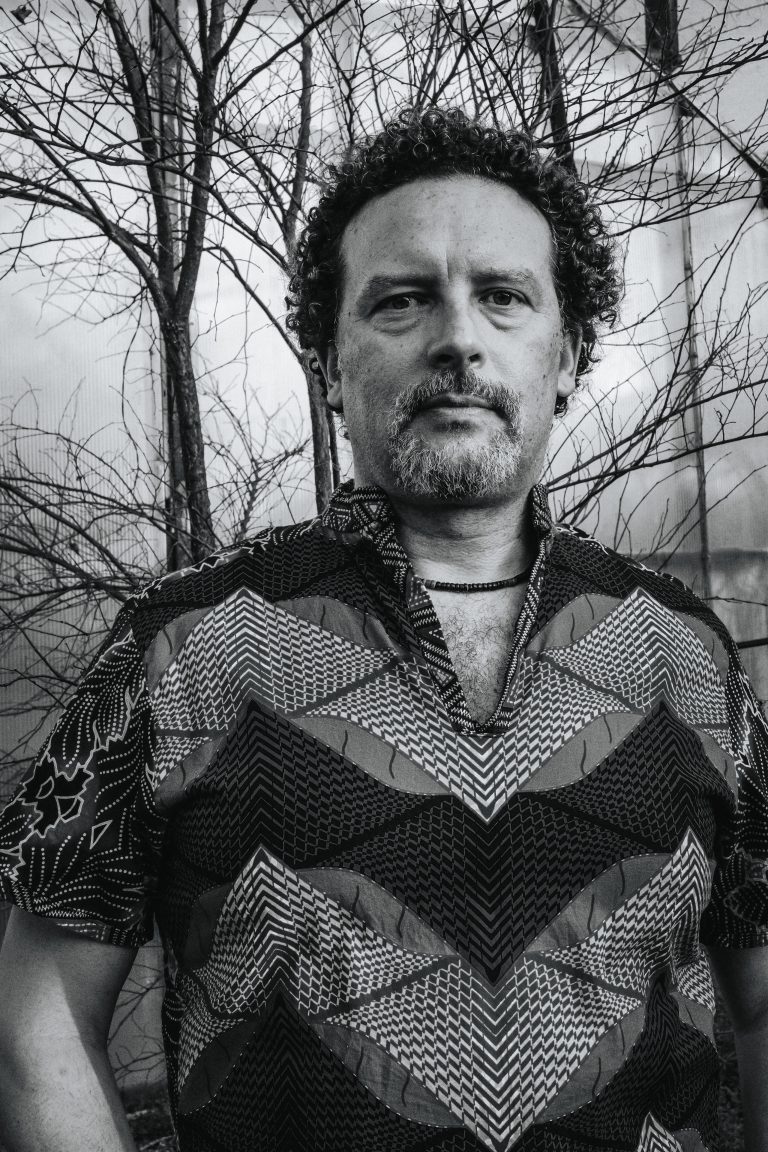
Jaime Ospina: Feeding Our Souls
03 December, 2025Lead singer and flute player with Austin’s Latin big-hitters, Superfónicos, Jaime Ospina’s solo debut, The Vessel, is one of my albums of the year. So I was delighted to catch up with him on Zoom on Thanksgiving Day for a chat about his music, the musician’s life and his goal of worthwhile world domination. To preface it, I asked him about The Vessel.
MS: “Did you set out to do something different to what you’re doing with Superfónicos?”
JO: “Yes, really The Vessel is a collection of songs that I’ve had in my computer for years. They’re more introspective and “loungey”, if you want, while Superfónicos is more like full-on party music. This is more introspective, more reflective, more jazzy. But jazz, right from its beginnings in New Orleans, was always a music about dancing – which is what I wanted to do with The Vessel. In the end African music is for the body, not for the intellect. So I really wanted to keep that quality. When I got the grant [from the city of Austin], I felt that this is the time to put out these songs. That got the ball rolling.”
MS: “And remind me, how many of the instruments did you play on the album?”
JO: “So… I play all the flutes except one [a conventional flute on the track “Abandon”]: I play the gauta, which is the hybrid I created between a conventional European flute with a Colombian mouthpiece, and the straight gaita from Colombia. Then on three of the songs I play electric bass, which was really my first instrument. Although really my first instrument was the whistle [demonstrates]. I don’t consider myself a master in any instrument, but I do consider myself a master whistler [laughs]. When I was three years old, I started whistling, and then I was on the recorder. When I was a teenager, I sang in a band until my voice changed. And at 18, that’s when I started playing bass. For a few years only a bass player, but then I fell in love with Caribbean-Colombian music and that’s when I started playing percussion and the native Colombian flutes. With Superfónicos, I play gouta and gaita and the shaker, the Colombian maracon. Some of the songs I write myself and some I co-write with Nicolas Sanchez, the bass player, and now we have a great new guitar player, Mauro Lopes, and we just wrote the new single with him.”
MS: “And are you writing new material for another solo album eventually?”
JO: “Eventually! If I show you my hard drive, it’s like full of ideas, melodies. I never claim they’re my melodies; it’s magical; I never know where the music is coming from. You know, I might be washing dishes and the melody just comes – and I whistle it. And if I like it, I record it. I was listening to an interview with David Gilmore, and he’s the same. Sometimes it’s a melody, sometimes a riff, sometimes a bass line; you never know what’s going to come. So yes, I could do at least five or six records with stuff that I have.”
MS: “So it’s the music of the spheres that inspires you? You’re a vessel!”
JO: “A vessel, yes! That’s it. I’ve been reading a lot about quantum mechanics and it’s crazy how it connects with music, because the music is there. All the music from all places and all times, it’s there. You just collapse it and it happens. When you are doing it for the right reasons, it’s like you can’t stop it, you know.”
We moved onto his “Feeding Souls” initiative. Here’s Jaime to introduce the concept briefly.
MS: “So tell me, how did it all start? Was it your own idea?”
JO: “Well, it’s not my idea – even though I’ve thought about making music for children for a long time. I was a teacher for 15 years in the American school in Bogotá. That’s actually where I met the woman, now my wife, who brought me to Austin. It was a very unconventional music programme. Most music education in the States is based on the band: horns, trumpets, band music from the jazz tradition, but I started a programme there which was way more open to other traditions. Basically, the kids were choosing their own repertoire. We were always playing the music that they love, which completely changes things because the motivation is there.
“I was basically a band coach, putting on quarterly performances, bringing the music that we were cooking together into the community, into the schools. These kids were 15, 16 years old and they were sounding like professionals. So I was a witness of the impact that music was having on little kids – especially on elementary school kids, who were really on it. For many, it was the first time they were witnessing live music, like a rock concert right there in their school. And it was just wonderful.
“And I did that for years. Then I moved to Austin and I heard about Campbell Elementary School where they were doing lunchtime concerts: bringing musicians in to play for the kids while they’re having lunch. It was completely aligned with what I was bringing from Colombia. So we went there and played for these kids. It wasn’t really a concert: they didn’t have to sit still and be quiet; they were just having lunch while these Colombians were singing on the stage of the ‘cafetorium’ [what they call a space that doubles up as auditorium and cafeteria]. And I could see at first hand the joy of the kids as they come up after their lunch and see what’s going on – and they find the connection between movement and sound. Music is not something sterile that comes from speakers; there are actually humans involved in its creation. It got me thinking how great things like this should happen as often as possible, especially in these times when horrible things are happening, and not only in this elementary school.
“So I went back to Campbell solo. I have this looping station and I bring my flutes and drums and start creating layers, and it’s all improvisation, it’s all jazz. Once again, I saw kids loving it, kids banging on chairs, kids dancing. It was amazing. And that’s when I really started thinking about ‘Feeding Souls’. At a certain point, I’m like I’m just gonna have to start a non-profit and I’m gonna find a way to get funds: grants and donations to pay the musicians. And they can go to schools during lunchtime and play; not only elementary schools, I want to take this to middle schools, high schools as well. Every soul needs to be fed, especially in these times. We need to foster the good.
“And then I met this woman [I couldn’t catch her name, but maybe not necessary] and she loved the idea, and she invited me to give a concert at her school, and everyone loved it, so she said ‘Oh my God, let’s do one in a month at Ridgtop Elementary School!’ But a week before I was due to perform, on the last day of the school year, this terrible, horrible massacre happened at Uvalde, a Texas elementary school that everyone’s heard about. I set up for the concert and I can see the sadness, I can feel it. And then I start doing my thing and little by little the energy starts shifting. I think, I need to do more, and I have a bag full of hand percussion, so I start giving out little shakers and stuff, and of course they start making a racket out of it and people start dancing and a girl wants to start singing a song from the movie Encanto, which is about my country, so I gave her the mic… I mean, it went from sombre and dark to happy and joyful in a matter of two hours. And Cara Schulz, who is the principal, is witnessing this and she completely falls in love with the idea and I tell her my vision, which is like: Friday means live music in schools in every town and city in this country. It could take 20 or 30 years – but not only in the States; this is something I would love to see growing all around the world, you know. Because the other thing is it’s getting harder and harder to be a musician…”
MS: “In what sense, economically?”
JO: “Yes! Austin is supposed to be the live-music capital of the world, based on the number of venues per capita, but with all the gentrification and change over the last 10 years the rents are going up and venues are closing and musicians are unable to pay the rent, so more and more are moving out of the city or quitting music altogether. We can’t keep on relying on playing for hipsters during night time, or playing big festivals. I mean, I can’t rely on playing with Superfónicos to feed the family, so I also have the WACHE [Colombian roots] band to play my music and then my solo act that I can take to art shows, as well as a teaching job and another job making deliveries three afternoons a week.”
MS: “And a little income from streaming perhaps?”
JO: “Let’s not even talk about streaming because what Spotify is doing for the industry is atrocious. I don’t even want my record on Spotify. So I need to find another strategy to improve the income of musicians, and I’m thinking ‘Feeding Souls’ isn’t just about musicians feeding the kids’ souls, but musicians’ souls as well. It goes both ways. You create a network of stages for working class musicians to work – in lunchtimes, so it doesn’t interfere with other stuff. I want Austin to be a pilot, but I want this to be everywhere: Nashville, Chicago, London.
“Think about it: how many spaces are there for sharing music with kids around the world? So it’s an everybody-win situation. Instead of bringing people to a venue to listen to the music, I want to take the music to the neighbourhood. We bring the music and then you bring the crowd. Bring your neighbours, your family – the way it used to be before recordings. It’s crazy, there are people on Spotify who know your music, but your neighbour doesn’t even know that you’re a musician! Everybody wants to be huge in the virtual world, but what about the real world? Sharing a space, listening and dancing and seeing how music comes from real humans.
“And I pay [the other musicians involved] well: like $250 for a lunchtime concert, and there are now 15 elementary schools around Austin that we have performed for, with about five or six musicians on the roster. I’m pre-funded for the next semester and I might get another grant. The more money I can get from donors and grants, the more musicians I can access. And remember, every soul needs to be fed. I want to go to prisons, I want to go to psychiatry wards, I really want to bring live music to all the individuals that are under-served in the community. Live music more and more is a privilege – for people who can afford the ticket prices that get more and more expensive. Live music should be a right and not a privilege for a tiny percentage of the population.
“At the same time, we have all these problems with mental health of kids and adolescents, with like suicide rates going up. Americans find it so hard to talk about spirituality and ‘mental health’ is like a masquerade for what I think is a huge spiritual crisis. I can see a real decline in these things over the last 10 years in this city, and long story short, that’s what ‘Feeding Souls’ is all about. Nurture the spirit.
“And the money’s there, man. It’s insane the amount of money there is in Austin. But when the people with the money don’t have their hearts in the right places, it’s very hard. But we just gonna keep on knocking on doors, keep on spreading the word and we’ll find a way. This is really my legacy. As much as I love being a musician and a performer, as much as I love Superfónicos, my long game is ‘Feeding Souls’.”
We concluded with some notes for our readers on the Latin scene and some of the bands – from around Austin, from Colombia – that we should be looking out for.
JO: “The Latin scene here is definitely thriving. Cumbia is getting bigger and bigger. More and more gringos [laughs] – non-Latinos, let’s say – are coming to enjoy the Latin vibes. Before Superfónicos, Grupo Fantasma and Beto Martinez were really pioneers of Latin music in Austin. But the Colombian scene now is really growing, and there’s the Brazilian scene and the African music scene. We know each other; we invite each other to open our concerts.
“There’s The Point; you’re going to love them. They’re like a trio, with a guy my age, early 50s, playing with these two kids; they’re so young, but both amazing. The drummer, he’s actually French, and he was saying to me: ‘People are complaining, but this is the best time for what we do. Austin is getting more international; people are more open and eager for new sounds.’ There’s something very appealing about cumbia, too. You know, people don’t have to go to class for six months to learn how to dance! [He laughs heartily.] Cumbia is like: Feel it, let it move you, and don’t worry what people think. So I think non-Latinos are less intimidated by cumbia than by salsa and other music. I love it! Every single person dances different at our concerts. Cumbia is getting bigger and bigger and I feel like a lot of people from the music industry are paying attention to what’s happening here.
“From Colombia, there’s the Afrobeat band, La Boa. They have a record that they made with Tony Allen. Another great band from Colombia, Frente Cumbiero, whose horns have a band called Bandejas Espacialas. In Bogotá, there’s so much happening. Bogotá is booming! Oh and there’s another great band, Jacana Jacana, and they’re like making music for kids, but appealing to adults as well. It’s beautiful stuff. There’s so much beautiful stuff happening.”
Follow Sounds and Colours: Facebook / Twitter / Instagram / Mixcloud / Soundcloud / Bandcamp
Subscribe to the Sounds and Colours Newsletter for regular updates, news and competitions bringing the best of Latin American culture direct to your Inbox.