

Nunca Tarde – a round-up of recent new albums (Super Panela, Airto Moreira and Ricardo Bacelar, Nuevos Rios, Joe Acosta, Mansfarroll, Rua das Pretas and many more)
03 May, 2026At this time of year, new albums are as abundant as the vegetation. It’s hard to keep on top of it all. Even so, here are some of the hardiest perennials that I’ve managed to find the time to listen to.
Super Panela: Sangre Nueva (Maaula Records)
Perhaps there’s a little bit of poetic license in the word “recent” in the column’s sub-title. This came out in February, but it’s so feisty and spirited that it deserves our attention. Super Panela are a Franco-Spanish octet based mainly in Toulouse, France. They got together following a project called Fanfare sans Frontières, which took co-leaders Olga Pavía Cerdán and Jonas Chirouze in 2014 to Cartagena and other parts of Colombia for three revelatory months of playing with local street musicians and generally imbibing the (musical) culture. They’ve been gigging ever since. The album, Jonas explains, “is very faithful to our stage show. Since the beginning, we’ve aimed to make energetic dance music.” It is exactly that: energetic – and rather splendid, with jazz, funk, hip-hop, Afrobeat, salsa and more, all rooted in the dynamic rhythms of Colombia and New Orleans. Here they are performing “Yo Canto” live, one of the album’s “dirty dozen” numbers (the New Orleans brass band is a key influence).
Carlos Henriquez Big Band: Monk Con Clave (Self-released)
Thelonious Monk is a household god, so this release has been warming the cockles of my Latin jazz heart for several weeks. Having worked with Wynton Marsalis’s Jazz at Lincoln Centre orchestra for many years, bass player and composer Carlos Henriquez has called upon distinguished colleagues, along with guests like Cuban piano maestro, Gonzalo Rubalcaba, and ubiquitous percussionist Pedrito Martínez, to help render homage to the pianist and composer. Monk staples like “Round Midnight” and “I Mean You” are “re-imagined” and mixed with the bassist’s own compositions such as “San Juan Hill”, the Harlem district where Monk once lived, in a thrilling album that combines big band brass and dynamic Latin rhythms. Here’s Carlos talking about the various inspirations behind the album.
Nuevo Rios: Nuevos Rios (ZZK)
This in its way is every bit as thrilling: a meeting of Colombia’s Canalón de Timbiquí and the Toulouse-based trio, Rico Rico. In other words, a mash-up of the Colombian group’s traditional voice-and-percussion music, the outstanding vocals of lead singer Nidia Góngora and the trance-driven electronic rhythms of the Toulousain trio. The result, deriving from improvised jam sessions in Nidia Góngora’s home in Colombia’s Pacific region, is outstanding. As Rico Rico’s electric guitarist, Juan Kowalczewski, puts it, “The sound emerged naturally through a musical osmosis.” My life feels richer for musical osmoses of this quality.
Pixvae: De Lado a Lado (Compagnie 4000)
Something now in a similar kind of vein, but which doesn’t (in my ‘umble) work quite so naturally. The Franco-Colombian sextet recorded their first two albums for Bongo Joe, the home of edgy new music from the world over. Pixvae constitutes two distinct groups: the original French trio Kouma of baritone sax/keyboards, electric guitar and drums, augmented by the Colombian trio of marimba and two vocalists/percussionists. They call their blend of art-rock and traditional currulao rhythms “Colombian crunch music”. At times, it can be a little too crunchy for my taste, but when the two potentially discordant elements work in close harmony, it works very well. See what you think…
Airto Moreira and Ricardo Bacelar feat. Flora Purim: Maracanós (Jasmin Music)
Something remarkable has just occurred to me. We’re four selections in and we haven’t yet been to Brazil. Time to remedy that crisis. And what better way than with the return of Airto Moreira and (to a less prominent degree) Flora Purim? They’ve hooked up with pianist, composer and producer, Ricardo Bacelar, for a largely instrumental album based on improvisation, composition and some studio experimentation. It seems to be part of a larger audio-visual project that includes a feature-length documentary directed by Jom Tob Azulay. It’s great to have Moreira and Purim back, even if it’s not necessarily from the top drawer of their repertoire. That’s probably because their powers on the wane, but nevertheless there’s much to love about Maracanós, so beggars can’t be choosers (as they say). This cross-generational project, one sincerely hopes, will not be the last hurrah of this legendary pair.
Vitor Araújo & Metropole Orkest: TORÓ (Selo RISCO)
Strings are featured to a degree in Maracanós, but not to the degree that they are in this one. Metropole Orkest are a 14-piece string ensemble that have worked with the likes of Brian Eno, Jacob Collier and Snarky Puppy. Here, they work with a percussion-oriented troupe of Brazilian musicians hand-picked by Vitor Araújo, a 34-year-old composer from Recife (location of the wonderful Brazilian film that I watched very recently on MUBI, The Secret Agent). Highly influenced by Bartok and Bach and, closer to home, Heitor Villa-Lobos, the young prodigy has worked in a duo context with Caetano Veloso, João Donato and Naná Vasconcelos, as well as recording an album with Arnaldo Antunes of Tribalistas fame. Nearly an hour long, TORÓ is a record of a performance in 2024 that transcends genres of modern classical, electronic, world and Afro-Brazilian music. Here’s a sample of an extraordinary album.
Jesús “La Grulla” Caunedo: Fire & Sugar (Rocafort Records)
Time, I feel, for some reissues from Spain. The latest from Rocafort Records of Barcelona harks back to 1975. The Cuban multi-instrumentalist, Jesús “La Grulla” Caunedo, is an often un-credited figure in Latin music, but definitely not someone to be overlooked. He performed alongside such big-hitters as Tito Puente, Machito and Celia Cruz, and while the album might not scale those lofty heights, it’s well worth a detour. Recorded in Puerto Rico, it blends Afro-Cuban rhythms, heavy percussion, tight brass arrangements, fuzz guitar and jazz-fusion elements to land somewhere between Latin jazz, funk and fusion. At times a little overblown, the album comes across to me as a kind of updated, fuel-injected version of the Spanish-born “Rumba King”, Xavier Cugat’s sound. Take a dip into the full album…
Joe Acosta: The Power of Love (Vampisoul)
The next two reissues came originally from Joe Bataan’s short-lived Ghetto Records, a laudable but ill-fated attempt to swim clear of the shark-infested waters of record labels and recording contracts. Both date from 1971 and I imagine that original copies are as rare as hen’s teeth. Born in Puerto Rico and principally a pianist, Acosta tasted success with the album’s romantic opener, “I Need Her”, which spent 21 weeks in the Billboard Latin Top 10. Apart from a couple of other ballads (including “Phoenix”, a version of Jim Webb’s lovely “By the Time I Get to Phoenix” that might have been better omitted), it’s an album mainly of hard-hitting guaguancos and salsa dura that feature the kind of gut-bucket trombone normally associated with a Willie Colón recording.
La Fantástica: From Ear to Ear (Vampisoul)
The 11-piece Orquesta La Fantástica hailed from Brooklyn. They were led by saxophonist, vocalist and composer, “Sammy” León and featured a winning combination of piano and vibraphone, along with a brass section of two tenor saxophones and two trumpets and distinctive vocals by Rafael “Ralphy” De Jesús, aka Chuleta. The album’s eight original numbers are uniformly hard-hitters and include the penultimate “M and M”, which clocks in at 17 minutes – surely too long for an ode to the popular sweet. Or should I say “candy”?
Mansfarroll: África Sí (M. Percuson / InOuïe Distribution)
Mansfarroll is a Cuban percussionist and composer who came to France in 2002. His name was new to me, even though he has played with the likes of Chucho Valdés, Ibrahim Maalouf, the great tenor saxophonist, David Murray, and one of my favourite expatriate bandleaders, Ernesto “Tito” Puentes (note that all-important “s” to distinguish him from El Rey). With credentials like that, it’s not surprising that this is as good as it is: some of the best Afro-Latin jazz of the year so far. With guests of the calibre of Ballaké Sissoko on kora and Patrick Bebey on Pygmy flute and kalimba, the album highlights the constant musical exchanges between Africa and Cuba. It marks an exciting new chapter in the evolution of the genre. Here are some tasty extracts…
Various Artists: Transmisiones: Cuba (Buh Records)
While on the subject of Cuba, here are two fascinating compilations of Cuban music new and old. The first – one of those rare creatures, a digital and limited-edition cassette release – focuses on new sounds from the beleagured island. The 15 different artists featured are all between the age of 20 and 30 and are all part of a new generation of musicians who grew up in an era of digital liberation (in some respects). However, this expansion has not translated into easy access to international streaming platforms or to formal systems of distribution and payment, which remain problematic due to financial and technological restrictions affecting the island. With difficulties compounded by such factors as the instability of the electrical system and the frequent power outages that affect large parts of the country, it makes this compilation of art-rock, post-rock, folk, ambient music and other sounds that much more compelling.
Various Artists: DJ KOCO aka SHIMOKITA – Cuban 45s Boxset (Mr. Bongo)
By contrast, this latest box-set of 7″ singles curated by the Japanese turntable wizard DJ KOCO, known as SHIMOKITA, concentrates on cuts in the spirit of Mr. Bongo’s Cuban Classics series. Released to coincide with this year’s Record Store Day, it follows a sold-out box-set of Brazilian classics two years ago. The focus is on rhythm and grooves from an era when disco influenced the indigenous sounds of Cuba. There are highlights a-plenty, which suggests that anyone with a turntable and arm should think about ordering this set before it, too, sells out.
Pedro Volta: Retrosambas (Brasil Discos)
And since we’re on a retro track, here’s something that does exactly what it says on the tin. Pedro Volta is a singer-songwriter and multi-instrumentalist from São Paulo, who explores his country’s musical tradition through a contemporary lens in these 10 tracks, mixing originals with re-interpretations of lesser-known works from Brazil’s songbook. Geraldo Pereira’s 1945 samba, “Vai Que Depois Eu Vou”, for example, is re-imagined here as a vocal duet. Pedro Volta played many of the instruments used himself on an album that moves easily and seamlessly through the musical worlds of pre- and post-bossa nova songwriting without ever quite lighting the blue touch-paper.
Rua Das Pretas: Povo Brasileiro (Harmonia/The Orchard)
Rua Das Pretas is a collective directed by the Brazilian composer and guitarist, Pierre Aderne. Povo Brasileiro is not only an album but also a short film written and directed by Aderne. Born in Rio de Janeiro but now installed in Lisbon, the multi-talented artist has collaborated with the likes of Seu Jorge, Tito Paris, Sara Tavares, Madeleine Peyroux and especially Melody Gardot, with whom he wrote several songs for her album Sunset In The Blue. I haven’t seen the film in question, but the album is a multi-faceted delight, a celebration of both sides of the Atlantic, with guests from Cape Verde, Portugal, Rio and São Paulo and diverse elements of samba, choro, fado and Afro-Brazilian music, to cite the most obvious genres. It’s a rich mix that will, I’m sure, keep on giving.
Doctor Nativo: BarrioKandela (Stonetree Records)
I’ve already featured the good doctor in two previous round-ups of new singles. Here in his cross-genre album, the Guatemalan-born son of a Cuban father and restaurateur, assassinated by the regime for welcoming Guatemalan guerillas into his establishment, runs the gamut from Balkan-infused cumbia to reggae, hip-hop and mariachi. It’s an edgy, rhythmic and ultimately uplifting release that seeks, like his 2018 debut Guatemaya, to bring the threatened Mayan culture into a sharper focus. Book an appointment with Doctor Nativo right now!
Well, that’s the last one on my list struck off – but did I forget to put someone/anyone on that list? If I did, mea culpa. “Put the blame on Mame, boys, put the blame on Mame…” as Rita Hayworth sang in Gilda. Enjoy the end of spring and see you next time.
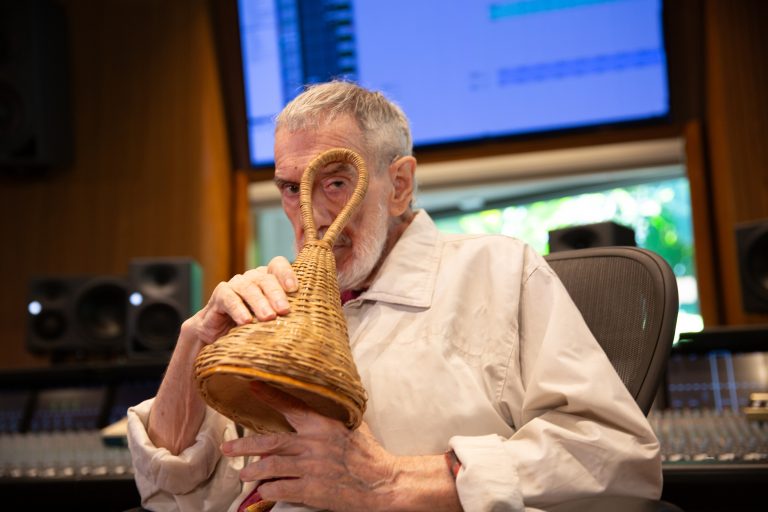
(Our thanks to Maria Bacelar for the cover photo of Airto Moreira.)
Follow Sounds and Colours: Facebook / Twitter / Instagram / Mixcloud / Soundcloud / Bandcamp
Subscribe to the Sounds and Colours Newsletter for regular updates, news and competitions bringing the best of Latin American culture direct to your Inbox.