

Render unto César
25 May, 2026“Music has always been with me,” Chico César says at the start of our interview. Nearly everything in his trajectory can be traced back to that statement. Born in 1964 in Catolé do Rocha, in the sertão of Paraíba, he grew up in an environment where music was part of ordinary life. His mother sang Benditos, devotional Catholic chants; his father sang aboios, those haunting vocal calls used by vaqueiros herding cattle through the hinterlands. Decades later, when his breakthrough live album opened with “Beradêro”, it was no coincidence that the song itself carried the cadence of an aboio.
“I never expected anyone else to sing that song apart from me. I thought it was only about myself, just a song to place me in the world.” Artists including Elba Ramalho and Zizi Possi would soon record it, transforming a deeply personal composition into part of the wider canon of Brazilian song.
Long before national recognition arrived, César’s musical education took place in an unlikely conservatory – a small record and book shop where he began working at the age of eight and remained until fifteen. Because his family lived in the countryside, he stayed in his employer’s house in town while attending a school run by German nuns nearby. “That period was hugely defining for me,” he reminisces. “I don’t think I’ve ever read or listened to as much music in my life as I did then.” César devoured Northeastern music by Luiz Gonzaga, Jackson do Pandeiro and Dominguinhos, but also The Beatles, Giorgio Moroder, Tina Turner and Kraftwerk. “That created an imaginary melting pot in me.”
At the same time, he was already performing. Local dance bands would return to Catolé do Rocha during university holidays, and children were invited to afternoon dances known as assustados. César sang disco songs, Secos & Molhados tracks, funk and soul, winning footballs and toy jeeps in improvised talent contests. At nine, he joined a children’s band called Super Som Mirim, assembled entirely by children without adult supervision. “They wanted someone with a more medium-range voice,” he says. “Someone who could sing Tim Maia and sambas.” Then, at twelve, came the first composition. He had been walking back from selling records door to door when a samba melody emerged almost unconsciously. Convinced it must belong to someone else – perhaps Dona Ivone Lara or Paulinho da Viola – he sang it to adults in the shop and asked whose song it was. “They said, ‘Boy, that song belongs to no one. It’s yours.’” They then recorded the track so he wouldn’t forget his composition. “That was the first time I heard my voice recorded.”
A year later, he entered the song into a local music festival. He performed it entirely a cappella because he did not yet know how to play guitar. Older musicians backstage improvised accompaniment for him. He finished fourth and won his first acoustic guitar as the prize. “I already cared about aesthetics then,” he says with a laugh. The outfit mattered: tight trousers, a marching-band waistcoat, borrowed boots. Like many artists shaped by the visual radicalism of the 1970s, César understood instinctively that performance extended beyond sound. He cites influences ranging from Bob Marley and Fela Kuti to Raul Seixas and Secos & Molhados.
By fourteen, he already knew music would define his life, though he doubted it could reliably sustain him financially. Journalism seemed a pragmatic compromise, and at sixteen he started studying it at Federal University of Paraíba. Around the same period another artistic revelation arrived – Jaguaribe Carne, an experimental collective blending Northeastern rhythms such as maracatu, coco and ciranda with avant-garde composition, concrete poetry and improvisation. “That opened my mind for the second time,” he says. Through the group he discovered Ravi Shankar, Nusrat Fateh Ali Khan and ECM jazz recordings, and became obsessed with Codona, the trio featuring Naná Vasconcelos, Don Cherry and Collin Walcott. “I nearly became an experimental instrumental musician exclusively.” But there was still something in the boy who’d spent seven years in a record shop – he wanted music that communicated with larger audiences. The tension between experimentation and accessibility, sophistication and directness, would become one of the defining characteristics of César’s work.
His latest album, Fofo (2026), revisits songs written during his late teens and early twenties, before national fame arrived. Listening now, the sophistication of the compositions feels startling for someone so young. “Those songs formed the foundation of the artist I became,” he says. “I owed it to those songs, to that young composer between sixteen and twenty, to record some of them.” The project emerged after an intense year of touring to celebrate thirty years since the release of his first album, Aos Vivos (1995), singing accompanied only by his acoustic guitar. Performing more than seventy concerts restored his technical relationship with the instrument. “My fingers became agile again,” he says. “I started remembering those songs – often very complex songs – that I’d left behind after moving to São Paulo and seeking a more communicative language.” The result is an album that reconnects César not only with his younger self, but with a tradition of Brazilian songwriting rooted in emotional risk and lyrical confrontation. He hears continuity between the teenager and the mature songwriter, “a visceral way of writing about love.” He cites the influence of figures such as Waly Salomão, Jards Macalé and Torquato Neto – artists for whom love songs could be abrasive, destabilising and dangerous rather than merely tender. “Contemporary MPB [acronym for the genre called Brazilian Popular Music] often becomes too sugary, too soft, as though we’re afraid to prick people a little.”
National fame arrived in the mid-1990s when Daniela Mercury – then enjoying great popularity with a string of hit axé records – recorded “À Primeira Vista” for her hugely successful album Feijão com Arroz (1996). The song featured prominently in the telenovela O Rei do Gado and became a major hit. “She later told me she kept rewinding that track over and over when listening to my first album,” César recalls. Mercury invited him to Bahia, listened to fifteen additional songs, and ultimately chose “À Primeira Vista”. Its success transformed César from an underground songwriter into a nationally recognised artist. Soon, figures such as Maria Bethânia began recording his compositions. “It opened Brazil to me,” he says. “And later it helped open the world too.”
The transition from obscurity to mainstream visibility was disorientating. Suddenly César found himself backstage beside pagode groups, sertanejo stars and television personalities he had once regarded as belonging to another universe entirely.
“It took away anonymity,” he says. “And it took away certain illusions I had from the underground scene – the illusion that being underground made you special.”
Touring Europe further dismantled his assumptions. Audiences in Belgium and Germany, unable to understand Portuguese, still connected emotionally to “Beradêro”.
“That made me realise a lot of my assumptions were vanity,” he says. “Success gave me a feeling of belonging to the world.”
One moment with Maria Bethânia – regarded as one of Brazil’s most expressive and relevant interpreters – remains particularly important. Upon meeting him, she extended her arms to him and said: “Welcome to Brazilian music. This is your home. Don’t feel like an intruder. You belong here.” Whenever self-doubt resurfaces, César says he remembers those words. Bethânia would go on to record numerous César compositions, among them “A Força Que Nunca Seca”, co-written with a then unknown Vanessa da Mata.
Their partnership began almost accidentally. Da Mata repeatedly left messages asking César for songs until, exasperated but intrigued, he finally invited her to his apartment. After hearing her original compositions, he immediately recognised her talent. “I told her, ‘You don’t need songs from me. You’re a songwriter.’” Later she showed him lyrics scribbled in a notebook for “A Força Que Nunca Seca”. While she went to buy books by poet João Cabral de Melo Neto – whose similarity César detected in the writing and urged her to get acquainted with his work– he composed the melody. Bethânia recorded the song, turned it into the title track of her 1999 album, and helped launch Da Mata nationally.
César’s own discography has often grappled directly with questions of race, class and representation in Brazilian music. Nowhere is that clearer than in the song which gives name to the album Respeitem Meus Cabelos, Brancos (2002), which confronted the racism embedded in commentary about his appearance. The song also reflected broader frustrations with what César saw as an increasingly sanitised version of MPB. He recalls a conversation with a Rio taxi driver who complained that contemporary Brazilian music seemed obsessed with “lofts, white sofas, apartments”. “He said, ‘Your MPB mates are all so clean and polished. It’s like real life doesn’t exist.’” The exchange lingered with César. “We come from artists like Luiz Gonzaga, from songs that confront life directly,” he says. “We can’t become only softness and prettiness.” That concern still animates his reflections on Brazilian music today.
César witnessed another unexpected surge of popularity in 2021, when former Big Brother Brasil contestant Juliette Freire sang “Deus Me Proteja” – from his 2008 album francisco, forró y frevo – on television, sending streams of the song, and César’s wider catalogue, soaring. “Once again it showed me that we control nothing,” he says. “We write the songs, we record them – what happens afterwards, we simply don’t know.” Still, he takes comfort in what remains after viral moments pass. Some listeners stay. They move from “Deus Me Proteja” to his big breakthrough hit in his own voice, “Mama África”, then through the rest of his catalogue. “What matters,” he says, “is building a faithful audience while staying faithful to yourself and your artistic centre.”
Near the end of the conversation, César reflects on the broader generation to which he belongs – artists such as Lenine, Zeca Baleiro, Zélia Duncan, Paulinho Moska and Vitor Ramil. “I’d like people to look at our generation and recognise its importance,” he says. “Without those artists, Brazilian music might have gone somewhere very different.”
Thankfully, they are all still going, taking Brazilian music to places of reflection and elevated beauty.
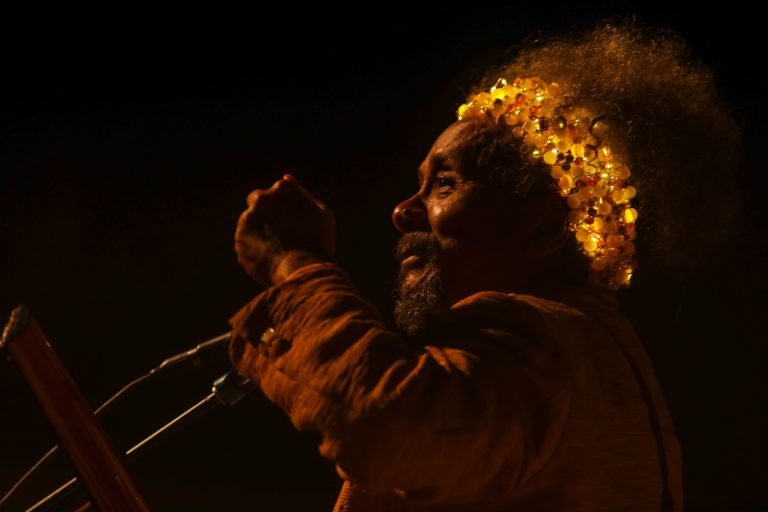
(Photo of Chico César by Anderson Stevens)
Follow Sounds and Colours: Facebook / Twitter / Instagram / Mixcloud / Soundcloud / Bandcamp
Subscribe to the Sounds and Colours Newsletter for regular updates, news and competitions bringing the best of Latin American culture direct to your Inbox.