

Leandro Serizo – Sol Quimérico: A Sounds and Colours premiere
28 July, 2026Sol Quimérico is the new album by Leandro Serizo, a Brazilian singer-songwriter whose work explores the interzone between technology and emotion, the future of human relationships, and spirituality. The tracks on Sol Quimérico transit between progressive rock, metal, MPB and R&B, while also drawing from Afro-Latin traditions and the musical heritage of the Eastern Mediterranean. The influences range from Armenian jazz pianist and composer Tigran Hamasyan to System of a Down, as well as Chico Buarque and Dead Can Dance. It’s also a concept album with its own specific madcap universe where listeners are transported to the year 2222, into a dystopia ruled by the alien empire of Ciborgue Tyrannu. At the margins of this technocratic delirium lies another world: Abutre Estrelar, home to the Abutrons, chimeras born of genetic experiments, half human, half vulture, rejected as aberrations and who worship the chimerical sun. Sounds and Colours spoke in detail to Serizo about his new release and its fascinating concept.
Sounds and Colours: Can you talk about your musical beginnings?
Leandro Serizo: I started out self-taught at 8 years old, exploring sounds on a keyboard we had at home. I ended up playing at a Christian church where my family played. By then I had already fallen in love with music, and that’s when I started writing my first songs. In high school, I began playing at the school’s saraus, which are open-mic poetry and music nights, and that was my first contact with a really diverse cultural scene, with all these people who were already studying art. That school was the main reason I fell for the idea of becoming a musician. So I went on to the Music programme at Campinas State University (Unicamp), graduated with a teaching degree in Music and a bachelor’s in Popular Singing, and I’m now finishing my master’s.
S&C: So, where is Sol Quimérico in your discography?
LS: Sol Quimérico is my second album. Before it I released Saudoso Amarais in 2023, with public funding from FICC Campinas. Saudoso Amarais was my first experience with a self-released record and the whole production chain behind it. On that one I reworked songs I’d written as a teenager. And through playing those shows, I became certain that rock, prog and performance are my real passions on stage. Sol Quimérico comes out of that certainty, but on a much larger scale: 13 tracks, and the first chapter of a trans-media project.
S&C: It’s quite a concept you created for the album. Where did the idea for the concept and the story of the future come from?
LS: Before I fell in love with music, I loved writing and making up stories. I remember my mother’s employer once gave me a box of Brazilian and Portuguese literary classics. I was encouraged to write poetry. Music came right after that.
Having grown up a huge fan of sci-fi films and anime, I always liked the idea of building dystopian, apocalyptic stories. But what made all of it click was the urgency I felt with the fires in the Amazon, one of the greatest environmental disasters of our time. Even living in Campinas, a city very far from there, there was one day when the sky went dark, and it was terrifying. Since I’m in love with Brazilian protest music from the ’60s, I felt I wanted to leave behind a political work inspired by the strength of all those artists who once believed in music as a political tool for social transformation, the way Milton Nascimento, [Gilberto] Gil and [Geraldo] Vandré did.
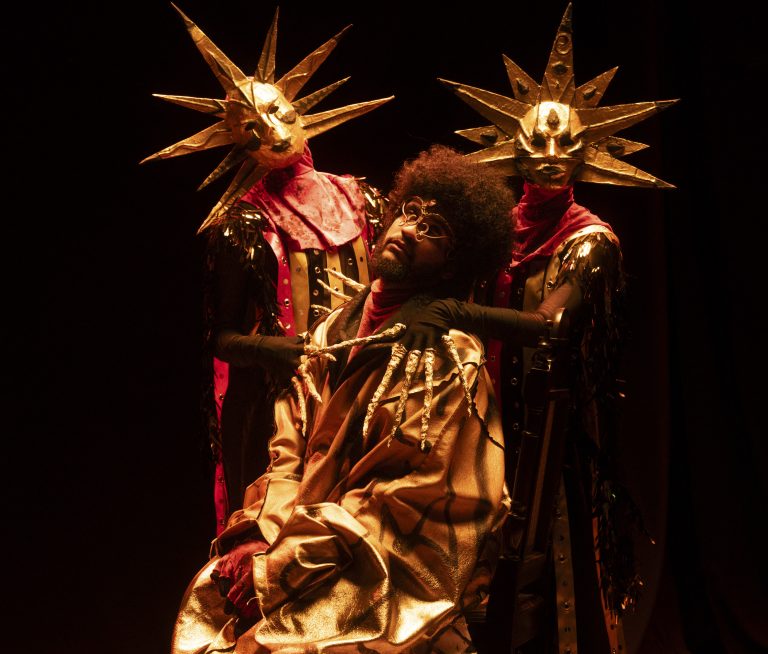
This universe extends beyond music, too. The whole visual identity of the record comes from the same place: absolute black background, a chessboard floor, masked and strange beings. The chessboard evokes the game, strategy, the duel between opposing forces, and it anchors this dystopia in a space outside of time.
S&C: Sci-fi stories are always a comment on society at the current moment. How does the story and concept relate to what is happening now?
LS: This album is about an authoritarian alien government that alienates and controls people. It’s about imperialism. It’s about those who use faith and religion to start wars, to destroy the planet in the name of God and family. Every piece of the story addresses the present. CIBORGUE TYRANNUS rules MΣGΛPΘLIS with a weapon that is a robotic song on an endless loop, one that erased the human capacity to dream. That’s about what digital screens are doing to us. As a music educator, I work with children and teenagers and I see up close what excessive screen consumption is doing to this generation: not just their attention span, but the way each child builds their own identity. Then, “G-HD” (what I call, in Portuguese, “gerado humano digital”) is about humans zombified into automatons, and that’s not an invention of 2222. And the Abutrons, who live in the trash on the edge of the metropolis after being discarded as freaks, are the periphery. They’re the people who build culture in exactly the place where the system said there would be nothing.
Brazil is a deeply divided country, and Bolsonaro’s disastrous government felt like a return to the Dark Ages. Watching the way Trump and Netanyahu are committing horrific crimes around the world is suffocating. So yes, “CIBORGUE TYRANNUS”, the heaviest track on my album, feels incredibly urgent to me. It’s where I managed to channel my outrage over the recent attacks on Palestine and Iran. Miriam Silvestre’s poem, which is woven into the track, was written at the very moment the attacks on Iran were unfolding. These ultra-conservative governments invoke the sacred to justify their assaults and wars, all for the wealth of a privileged few. Environmental catastrophe is political. And I believe rock, at its core, is political, too.
S&C: Why the year 2222? What is the significance of the number 2?
LS: I like to reference the great Brazilian artists who are a source of inspiration for me. There are all kinds of references hidden in words and concepts throughout my record for people to discover. I wanted a story set in a future that wasn’t all that distant. For me, Gilberto Gil is someone sacred in Brazilian popular music. “Expresso 2222” is an incredible song that always gave me a sense of futurism. So that’s where the heart of the idea comes from. It’s much more about Gil than about any specific numerology.
S&C: Are there other concept albums that you’re a fan of and that inspired you?
LS: Construção, by Chico Buarque, for its epic, urban, futuristic orchestral sound. The way Buarque always got past the censors through poetry and theatricality. He is a genius of the arts and I’m a huge fan of his work.
There are also three albums I’m deeply in love with: Cavalo, by Rodrigo Amarante, Água do Céu Pássaro, by the great Ney Matogrosso, and Ave Sangria by Ave Sangria themselves.
Also… My biggest idol right now is the Armenian musician, Tigran Hamasyan. His record The Bird of a Thousand Voices, deeply rooted in tradition, inspires me endlessly with its singular musicality. His poly-metric shifts and poly-rhythms spark this pleasure in me, this urge to study music, to fall in love with sound. I love the extremes of his work, from his most meditative and beautiful pieces, like “Egyptian Poet”, to the mythic fury of “To Negate”, which is my favourite song of his.
I’ve always loved Iron Maiden’s albums, those heroic lyrics full of story. That’s definitely a landmark in my own writing. And finally, Born This Way, by Lady Gaga, was a defining album in my adolescence and in how I understood creative freedom. I grew up in a Christian environment, and listening to “Judas” or “Heavy Metal Lover” in secret was a kind of trance, a glimpse of a freedom I couldn’t yet name. That boldness in placing the sacred and the profane side by side is something I carried into “MARIAKLÖSE† (industrial machine)”, where that same tension between holiness and the underground is the heart of the track.
S&C: You received support from a lot of governmental organisations: the Brazilian Federal Government, the Ministry of Culture, the City of Campinas, the Municipal Department of Culture and Tourism, and the Aldir Blanc National Policy (PNAB) Campinas. How did these specifically help the album? Do you think the album would exist without their help?
LS: Without that support, I wouldn’t have had the means to make an album with this many songs. Across the production of this record, counting musicians, video makers, music videos, and everything I produced, we involved more than 40 arts workers here in my city. For a local artist, that’s quite an achievement. Without the grant, there would have been no way to release the album on this scale. To make it happen, there’s a rigorous, bureaucratic selection process where you write your project, put together a budget, a timeline, and so on. They evaluate all kinds of criteria, including the project’s relevance and feasibility. So I believe public policy makes it possible for artists like me, who come from the periphery, to have a chance to materialize their work, while also supporting the creative economy of our cities. I believe public policy allows thousands of cultural workers to make a living, which is why I’m always overjoyed whenever I’m selected through programmes like these.
S&C: How difficult do you think it is for an independent artist to produce a complex, complicated work like this in Brazil nowadays?
LS: Very difficult, honestly. I think it’s a really critical moment for independent artists in general. I say that because of market saturation. There are so many releases every single day, even more now with AI artists. And there’s an irony there that isn’t lost on me: the robotization I sing about in “2222” is already happening within the music production chain itself. I think people are exhausted and frustrated by the logic of numbers they’re forced to submit to just to be seen. Either you come from a family of artists, the way things often work in the São Paulo bubble, or you fight for your space every single day.
In practice, that difficulty has a very concrete face. The album was recorded between August 2025 and May 2026, across several studios in Campinas because the grant budget was tight. Vocals in one place, drums and strings in another, horns somewhere else, accordions and guitars recorded at home. Then I edited all that material by myself, spending months racing against the grant deadline. That’s the part nobody sees.
On this record, I wanted to follow my intuition, and I decided I wasn’t going to confine myself to a niche or a genre. I made an ambitious, complex work because it had always been my dream to create something filled with hidden messages. But ultimately, it’s about my love for humanity and for this life. So I want to inspire the independent artists who follow me to pursue their own truths. Let’s make space for that.
S&C: It’s a really ambitious sounding album with a huge amount of different influences. How do you manage to make all these different influences and styles into a cohesive whole?
LS: Math rock has been my passion for the last few years, and a lot of what I love is connected to prog rock, metal, and mathcore. But MPB and the popular singing programme at Unicamp shaped the way I sing. I feel those influences are far more present in my voice than any rock vocalist.
Even before forró and Brazilian music, I was already captivated by Balkan themes and Romani music. Arabic music came to me through my experiences with belly dance; at 20, during a process of self-discovery, I found my way to classical music and Indian meditative music. That’s why I created Egrégora Mundana at university, where we researched repertoires from Mediterranean cultures. People always tell me they sense an “Eastern” quality in my sound, and that comes from years devoted to that research. And then there’s Latin music: salsa, Cuban rumba, cumbia. Rhythms I listen to and dance to at a party called Candela here in Campinas.
As for how all of it became one thing: there was a shared compass between me and the producers, Quico Dramma and Granadeiro Guimarães. The cohesion didn’t come from a plan; it came from that shared time, and from the guests too. Kim & Dramma, Cauãzin 019, Graciela Soares, Monaju, Olivia Mônaco: each one brought a different world, and instead of fragmenting the album, they tied it together. Because they all stepped inside the same story.
S&C: Chico Buarque is a big influence on your work, right?
LS: Buarque is a composer and lyricist who inspires me enormously. I got access to his ingenious work when I was in high school. I remember the teacher walking in with a radio and a stack of records. Construção started playing and my world collapsed in that instant. The way those horns went through me. Studying every hidden message, in every play, every album, and the way he outmaneuvered the censors made him, for me, one of the most complete artists in the history of Brazilian music. I grew up in a Christian and very humble family and I didn’t have access to MPB or to popular songs by artists like Chico. I feel that discovering his work made a deep sense of my existence and of the way I see things and want to create.
On Sol Quimérico that influence lives entirely in MΣGΛPΘLIS. It’s the most theatrical and satirical track on the album, and that irony is a direct homage to Chico. I mean his way of saying the harshest things through mockery and allegory. Pedro Juchem’s horn arrangements are a clear reference to that work: it was those horns from Construção that went through me when I was about 16, and now they come back on my own record, telling a different story.
S&C: What’s next for you? Will there be a physical release of the album?
LS: There’s the album release show on August 19th at Gamba Cultural in Campinas. I’ve signed with a label, Vinte7 Records, which is booking shows across the state of São Paulo.
A physical release and a vinyl edition are big dreams of mine, but they’re still far beyond my financial reality. What I’m pursuing right now is the Sol Quimérico book, a blend of poetic writing and comics, created with artists from literature, comics, and the visual arts. I’m looking for funding to make that happen. The album is just the first chapter of this story.
I’m also going to do an artistic residency in Egypt through a Brazilian public funding programme I was selected for. I’ll be studying, up close, the Arabic influences that are already present in Brazilian music and in my own sound. It’s about going back to the source of something I’ve been researching for years.
Follow Sounds and Colours: Facebook / Twitter / Instagram / Mixcloud / Soundcloud / Bandcamp
Subscribe to the Sounds and Colours Newsletter for regular updates, news and competitions bringing the best of Latin American culture direct to your Inbox.