

Dystopian Summer: an interview with Edgar e Os Fita
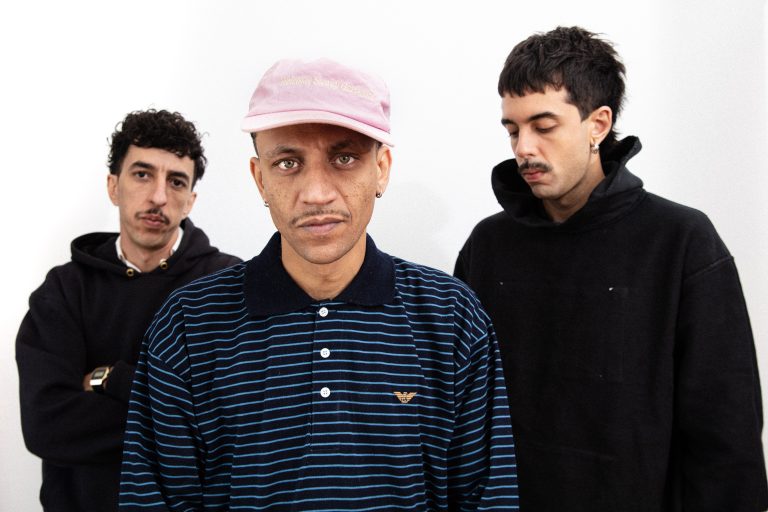
09 October, 2026To prepare for the upcoming election in Brazil, I’ve been reading Rio de Janeiro: Extreme City by Luiz Eduardo Soares, a book that portrays a city far from the picture-postcard version and instead shows Rio to still be in the grip of its violent past. Likewise, this recent encounter between São Paulo rapper, performer, and visual artist Edgar and the Rio de Janeiro-based production duo Os Fita (Abel Duarte and Cainã Bomilcar) has resulted in the collaborative album Faz Frio Mas É Verão (“It’s Cold, But It’s Summer”), an electrifying head-on collision between rap and left-field club electronics, spanning jungle, UK garage, dub, jersey club, gabba and, of course, baile funk. Faz Frio Mas É Verão reframes Rio de Janeiro as the symbolic backdrop for a tropical dystopia. The city’s imagery of sand, sweltering heat, sensuality and hedonism, is constantly at odds with its innate coldness, alienation and emotional collapse. The album constructs an intense, ultra-modern portrait of Brazil’s most famous metropolis, where irony, tension, desire, violence and euphoria coexist in a permanent state of excess and instability. Musically, the project distorts, fragments and rearranges Edgar’s flows amidst buzzing interference and hyper-kinetic electronics that subvert the traditional logic of pop structures. It’s another genre-defying release from friends of Sounds & Colours, Outra Música, which is quickly building up an intriguing catalogue. I spoke with Edgar along with Os Fita about the new album.
Sounds & Colours: How did this collaboration come about?
Edgar: The project began precisely with a collaboration with rappers from Serbia; I was there doing an artistic residency. That’s when Os Fita came together for the first time, we’d already performed at festivals across Brazil, each with our own solo projects, but this was the first time we collaborated. In 2024, while producing an album called Universidade Favela, we started working together again on tracks, one of which was selected for the album. Since the production process is always a mix of madness and abundance, it inevitably leads to different paths to follow. That’s how it begins: observing, gathering and reorganizing the world around us.
S&C: The title of the album is an interesting concept, what’s the meaning behind it?
Edgar: “It’s Cold, But It’s Summer” is an ode to Rio de Janeiro, the marvelous city that remains beautiful and inspiring even amid architectural ruins and political upheaval. One of Brazil’s most enchanting and unique cities, it has the potential to become an autonomous state due to its political influence and military might. The controversy that permeates the city also permeates its citizens and is becoming an integral part of our culture; no two Brazilians are alike, and even less so the Cariocas [those born in Rio de Janeiro], an ambiguous phrase that illustrates the city’s many layers: even with a warm heart, one’s hands remain cold. Despite difficulties accessing healthcare and education, drugs and weapons are readily available; living in a favela facing the sea, in direct contrast to a luxury condominium. Feeling cold in the middle of summer is a subversive nuance that attempts to show that not everything is as it seems.
S&C: You are originally from Guarulhos, a satellite city of São Paulo; how does it compare with Rio de Janeiro?
Edgar: I was born in Guarulhos, but I left when I was 15 and went to Bahia. In 2021, I began living in Rio de Janeiro; and I returned to São Paulo in 2024, and have been splitting my time between Guarulhos and Rio de Janeiro ever since.
Rio de Janeiro is so unique that it culturally influences the behaviour, speech, gait, hairstyles and clothing of people from the outskirts of other states. There’s an invisible bridge we call the Rio-São Paulo bridge; we’re completely different from one another, even when we try to make the same musical genre. This album is more of a tool for understanding the different layers and multiple facets that the people of Rio de Janeiro carry in their hearts or in the form of voices in their heads. It is simply a dystopian interpretation with a specific focus on the contrast between the outskirts and the city centre, which transforms into dynamic and satirical poetry about a country that lives Carnival out of season.
S&C: The title track could almost be a commercial tune, yet you “spoil” (or enhance) it by ending it with distorted gabba. What were the ideas behind that?
Abel Duarte (Os Fita): I don’t really like the idea of calling it “commercial,” because I think it’s far from being that. I believe the production and arrangement try to capture the imagery of contradiction, duality, opposition and contrast that the lyrics evoke.
The lyrics open with lines about an idyllic landscape, a view of the sea, nature, and then, immediately after, the next line shatters that vibe with the image of a character holding a gun at the top of the hill. Beyond the lyrics, the song’s structure itself plays with these codes and helps build that meaning, that feeling. In other words, while the first half is more beautiful and colder, featuring the beauty of Ana [Frango Elétrico]’s voice and a more melodic, sung chorus, it all explodes in the second half into an instrumental, somewhat gabba section. It’s a much hotter, more aggressive part where Kiko [Dinucci]’s distorted guitars kick in with full force. That section represents the heat, the chaos of a summer under a 50-degree sun. I think the musical arrangement attempts to structurally translate the ideas of the lyrics: it’s cold but it’s summer, the little boat at sea, the ipê tree, and the .38 calibre in hand.
S&C: There’s a heavyweight list of collaborators, and many familiar faces to the pages of Sounds and Colours: Ana Frango Elétrico, Jup do Bairro, Kiko Dinucci, Crizin da Z.O. and Tantão (of Black Future). What did these collaborators bring?
AD: First of all, I want to talk about the privilege we had in being able to collaborate with these incredible artists. Obviously, they are artists whose work we follow and admire deeply—we’re genuinely huge fans. I feel like each of them fits like a glove on their respective tracks and really helped shape the album as a whole.
Early on in the album’s process, as we started exploring different vocal timbres and processing for Edgar, we realized this would be a record where we wanted a lot of different voices to appear.
Crizin [da Z.O.] was the first one to record. We follow his work a lot, and we move in similar circles. Right from the start, the album took on shapes and themes that heavily cross over with his work. So naturally, we thought of him and invited him to the track. He sent back these absurd lyrics, full of crazy yet perfectly relevant imagery, so much so that the track ended up being named after one of his lines: “Casacão e bermudinha” (Big coat and little shorts).
For “Bonde Maconha Dinheiro”, we wanted to bring a party energy, but with an irreverent, mocking vibe, and Jup [do Bairro] came to mind immediately. Edgar already has a partnership and friendship with Jup, and we (Os Fita) had always talked with her about doing something together. So the timing was perfect for us to join forces. She brought a badass energy to the track and led the way for us to finish the production.
When Edgar recorded the chorus for “Popó Matou Bambam”, which goes “Sun, I need more sun…”, we had just finished recording an improv session with Tantão [from Black Future], where he had spent hours singing about the sun. We were blown away by the cosmic connection of the two of them talking about the sun in the same week, in separate recording sessions. So we didn’t have a choice; we had to combine both sets of lyrics into a single track.
On “Faz Frio Mas é Verão”, when we started recording the song, we thought a softer voice would fit the chorus melody perfectly, but it was also important that this voice brought a sense of strangeness. Ana Frango Elétrico came to mind instantly, and I think they did it brilliantly. They brought a strange beauty to that chorus, something both dense and simple. It worked wonderfully as a duet with Edgar; their vocal timbres matched perfectly.
Finally, Kiko Dinucci came into the picture exactly when we decided the song’s arrangement needed to explode into an aggressive end. We wanted a guitar to drive that explosion and create that contrast with the first half of the song. Enter Kiko, who is a guy we admire so much, a genius of our music scene who has a highly original language on the guitar. It dialogues with punk but has a very groovy, deeply Brazilian characteristic, which fits perfectly with the track.
S&C: Which track do you think has a particularly interesting production story?
Cainã Bomilcar (Os Fita): I’ll talk about “Engenheiros do Apocalipse.” This is the only track on the record that came out of a provocation from Edgar, when he suggested a specific sample. It was the first song we produced for the album.
The song started as a trap-funk track, with an aggressive tuim – that sharp, synth sound – which led Edgar to write in a very direct and brutal way about the tensions he was seeing and experiencing in Rio. When he showed us the lyrics, we recorded them over a beat with a slower, more spacious feel, but to us, that beat simply couldn’t match the impact of the lyrics.
We kept that original beat for the final section of the track, when he describes an explicit sex scene taking place on the streets of the city. It’s a more humorous section of the song, but he continues to throw out these acidic verses, criticizing big tech companies and their role in the escalation of the climate crisis. For the rest of the track, though, we decided to double the tempo and create what comes closest to a jungle track on the album, with lots of sharp cuts and rhythmic changes designed to emphasize the lyrics. And I think all of those developments that happened through our dialogue with him are what ultimately gave the record its identity.
S&C: Talk about the different characters that can be found in Rio portrayed in the album.
CB: These characters are present throughout the entire album, whether they are created through Edgar’s writing and performance as an MC, or through processing and manipulation during post-production.
There’s the “playboy” who thinks he’s “from the ghetto”, trying to present himself as someone from the streets, and plays with tools like Auto-Tune to appropriate the aesthetics and fashion of the favelas in an attempt to distance himself from his own reality. Also there’s the young delinquent who uses voice processing to avoid being recognized, etc. Edgar himself shifts away from other phases of his career when he sings the lines “ódio na veia e no olhar, fica dificil de acreditar que esse é o mesmo, mesmo Edgar” (hatred in his veins and in his eyes, It’s hard to believe you’re hearing the same Edgar) in the song “Me Deixa Em Paz”.
Ultimately, I think that if we explained all of these characters in detail, the album would lose a lot of its mystery, fun and richness. I think it’s more interesting to let listeners dive deeper into the many different lyrical personas that inhabit the record.
You can listen to the album below and a vinyl edition is scheduled for December 19th:
(Photo of Edgar & Os Fita courtesy of Marcelo Mudou.)
Follow Sounds and Colours: Facebook / Twitter / Instagram / Mixcloud / Soundcloud / Bandcamp
Subscribe to the Sounds and Colours Newsletter for regular updates, news and competitions bringing the best of Latin American culture direct to your Inbox.