

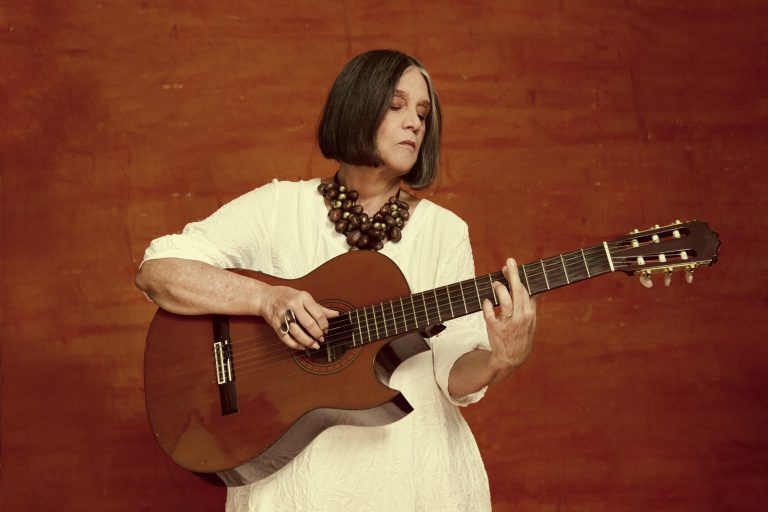
A Sounds and Colours interview with Joyce Moreno
13 October, 2026The honour of speaking to a musician of Joyce Moreno’s calibre, and whose work is so dear to me, is immense.
The singer, songwriter and musician became known simply as Joyce when taking part in 1967’s II Festival Internacional da Canção [II International Song Festival], which took place in her hometown, Rio de Janeiro. Her song, “Me Disseram” [“I’ve Been Told”], opened with the lines “Já me disseram / que meu homem não me ama” [“I’ve already been told / that my man doesn’t love me”]. The political weight of a 19 year-old woman talking about her man in a song written by herself and not by a man speaking on her behalf, as was commonly done by male composers back in the day, was too much for a country under military dictatorship to handle.
Whilst she was booed when performing and criticised by part of the media, she was considered a feminist by others. Moreno’s audacious attitude and extraordinary talent as a musician represents a watershed moment in Brazilian music, propelling an important array of women composers in the coming years, such as Fátima Guedes and the late Angela Ro Ro.
Never Too Soon is the title of her 45th album, coming out on 30th October, in a recording career that officially started with 1968’s self-titled release, Joyce. From 2009’s Aquarius, released in partnership with the late — and great — João Donato, she adopted her husband’s surname, Moreno. Tutty Moreno is also her longtime collaborator and the two of them co-produced the new album, which continues Joyce Moreno’s musically and lyrically sophisticated discography. It includes a superb ensemble of musicians, as per other albums released in partnership with the likes of Toninho Horta, Naná Vasconcelos and Dori Caymmi, playing in the collaborative spirit that shines through in Moreno’s music.
Two singles have been released to mark her latest release. “Aldeia De Ogum”, first recorded on her landmark album Feminina (1980) and which had a resurgence in underground clubs decades later, has been re-imagined, maintaining its rhythmic vigour but with a groovier bass. The second single is the exquisite, English-sung jazzy ballad “4:08”, co-written with American pianist, composer and memoirist, Robin Meloy Goldsby. A highlight of their work together is another gorgeous ballad, which gave its name to the album Slow Music (2009), nominated for Best MPB [Brazilian Popular Music] Album in the 2010’s Latin Grammys.
Moreno and I had a lovely chat over camera, where we discussed her most recent artistic endeavour; her upcoming European tour; her longtime personal and professional relationship with Tutty Moreno; her friendship with Brazilian independent-music heroes, Luhli and Lucina; and stories which date back to Noel Rosa, one of the most important and influential samba composers. Many thanks to Joyce Moreno for her generosity during our interview — and for her beautiful music.
Sounds and Colours: And what an immense joy and honour to be speaking with you. Never Too Soon is the title of your new album. What does this expression, “never too soon”, reveal about this collection of songs and the moment in which this album is being released?
Joyce Moreno: I think it reveals many things. First of all, when I didn’t yet imagine that this would be a good title for the album, I had already written the song, and the lyrics are by an American writer called Robin Meloy Goldsby, who lives in Germany. She’s a songwriting partner of mine, and we have several songs together through these partnerships in English. When I thought this would be a good title, at first I thought about it in a rather personal, slightly selfish way. I thought, I’m 78 years old, and there’s so much ageism happening in the world today that for someone from my generation to say, “It’s never too soon”, is very, very powerful, I think. But then I started thinking about the issues facing the world as well, you know? We’re all very, very much in never too late mode, you know? And I think, in the most optimistic way possible, it’s never too soon. Let’s start now. There are many things to fix in the world.
S&C: As you yourself mentioned, you’ve been pursuing this career for quite some time — how lucky we are?! You’ve been working with music for more than five decades. I’d like to know how and when, roughly speaking, the guitar, singing and songwriting entered your life.
JM: I think songwriting has been there since I was born. As far back as I can remember, I was always making up songs in my head and singing along with them. The guitar came in when I was 14, when I plucked up the courage to pick up my brother’s guitar whenever he went off to university or work and so on. I’d pick up his guitar and experiment, trying to copy the chords I saw him and his friends playing at home. And they were already bossa nova chords, so I started with what perhaps people think is the most difficult thing. It was never difficult for me, because that’s where I started. I never started with rock or those things with two or three chords. They were always these dissonant, more complex chords. I think all of that gave me material for my songwriting to become more sophisticated and so on. But I remember very clearly that at school, whenever I had to memorise something, I would put it to music and then arrive at the exam with everything memorised in my head, because it was in the form of music in my head.
S&C: And singing?
JM: Singing is also something very natural, from childhood, from when I was very little. I was that little girl whose brother played the guitar very well. Although he didn’t become a professional musician, he was a professional for a while, then he went on to have a career — he qualified as a lawyer and went to work at Banco do Brasil, so he had another life. But when he was younger and still playing, doing balls and so on — he was also a dance-hall musician — he always played the guitar very well, and he always liked accompanying me. I used to sing at little family parties — those Noel Rosa sambas, Dorival Caymmi, things like that when I was really just a child. So that was the music of my childhood. Then came bossa nova, which was the music of my adolescence, and then I started creating my own things.
S&C: Joyce, so it seems to me that, let’s say, the transition from the hobby of playing guitar and composing to it becoming a job didn’t take very long. If that was around the age of 14 and, as far as I understand, it was at 16 that you started doing it more professionally… Is that right?
JM: More or less, because Wikipedia always mentions my first recording, which wasn’t actually a professional recording. Roberto Menescal was a very good friend of my brother’s and he was producing an album by a composer from Minas Gerais called Pacífico Mascarenhas, who had asked him to create a fictitious group that didn’t actually exist, supposedly representing young people in Minas who made that kind of music. It was a lie — it wasn’t anything like that. He was a young composer from Minas Gerais at the time, but this group, Sambacana, didn’t exist. It never existed. It was Roberto Menescal’s group, and they played and recorded the backing tracks. He would have loved to have Os Cariocas, a wonderful vocal quartet, singing the songs, but I think the budget didn’t stretch to it. So Menescal had to put together a vocal quartet of beginners, and I was chosen at 16 — 15 going on 16 — as the first voice in that quartet. But that was it. It didn’t go any further. I would really begin my career in 1968 with my first album. In ’67, the Song Festival brought attention to me as an artist, as a composer and so on, partly because it was unusual to have a woman songwriter speaking in the first person and so on. So that’s when my career really began. But that event when I was 15 or 16 was just a one-off. It wasn’t a career, or my own album.
S&C: Right. Is what motivated you to become a singer, songwriter and musician still what motivates you to carry on doing this work after all this time?
JM: Yes, completely. Because when you have something you want to express, whatever the form of expression or art, it just bubbles away inside you. So you need to get it out somehow. So what I put out into the world when I started composing — my very first guitar chord already brought a first song, and I immediately started writing — was about those first romances, the beauty of the city of Rio de Janeiro, those kinds of things. And nowadays it’s about everything around me. It’s other people’s lives that I hear about, people telling their stories, people talking. There’s so much material for one to write about. We composers are always chroniclers of everyday life, aren’t we? So it’s not so much about me anymore, but about the world. That’s it. And then all of that stays there, and we have to get it out. And there’s the love of music, obviously, because inside me there isn’t just a songwriter, but a musician who loves playing, who loves exchanging energy on stage with other musicians. All of that motivates me enormously.
S&C: As a listener, that’s very clear in your work. It’s beautiful to hear you put it into words, because it really shines through in your music. And I wanted to ask what your relationship is with these three elements in your life. Do you play, sing and compose to live, or do you live to sing, play and compose?
JM: I think it’s all one thing, isn’t it? And I think you can change the preposition, can’t you? Because I used to live from it. Nowadays, making a living from it is more difficult with these platforms that… They’re a robbery, aren’t they? It’s armed robbery. It’s terrible.
But there’s that too. There’s the daily bread. I mean, music has always put food on the table here in this house. It has always been something very important in our lives. But there’s also living for it. That’s something else. I feel that my life and my experience as an artist are about serving music. I don’t want to use music; I want to serve music. And if I can do that, I’m happy.
S&C: This new album of yours is produced by you and your husband and long-time partner, Tutti Moreno. And I’d like to know, because I have these images in my head of the two of you creating things at home and in the studio and travelling. What’s the most enjoyable thing, and what’s the most difficult thing, about working with someone you’re so close to?
JM: Well, that depends very much on who you live and work with, doesn’t it? In our case, when it comes to music, we have never, ever, ever had any issues like that. Everything has always been very shared, very discussed, resolved together, and we think very similarly, so it’s good. It’s very good. There’s no conflict in that respect. There may be conflict about any other subject, but this is a subject that really is, well, a fundamental, non-negotiable part of our lives. We really are together because of an ideal, I would say. Next year, we’ll have been married for 50 years, and that ideal has never changed. It has always been about creation, music, art, bringing the best of ourselves, playing, doing our best. And that is non-negotiable. I see couples who work together and sometimes there are issues of ego or things like that. That has never happened with us either. One of us is always very, very happy about the other’s achievements, very proud, and that’s also very important, because it gives strength to both sides.
S&C: And what a pair, eh? Well, a curiosity of mine, Joyce. Which album by another artist moved you and changed your ideas about how music could be made, and why?
JM: Oh, there were many, many albums. I grew up in a very musical household; everyone in my home loved music. So, as I told you before, from childhood I was fed the best Brazilian music, the sambas of the 1930s, Noel Rosa, Dorival Caymmi, singers like Elizeth Cardoso, and so on. And then João Gilberto arrived when I was about ten years old, and for me it was a revelation. I see all my contemporaries talking about Chega de Saudade (1959). For me it wasn’t Chega de Saudade, which I already knew, actually. But when I heard him — when I saw him on television, playing “A Felicidade” by Tom Jobim and Vinicius de Moraes on the guitar — I went to my bedroom to pray. I was ten years old and I went to a Catholic school, so I went to pray. I asked God to let me learn how to do that. I wanted to be — I wanted to sing and play like that man. I wanted to compose like Tom Jobim; I wanted to write like Vinicius de Moraes. It was a slightly ambitious life plan for a child. But that’s what came to me at that moment. And from there, we carried on.
S&C: Wow, I’m moved. What a beautiful story. And a vocation from such a young age. Beautiful. And looking at your own work, at your discography, is there an album, or perhaps more than one, that you could point to as a turning point, a paradigm shift in your career or in the way you make music?
JM: Yes, without a doubt. I would say, above all, for me, the real paradigm shift was Feminina, in 1980. Because it was an album where I finally had control over what I was doing. I had a wonderful producer, José Newton, who didn’t interfere with anything. He was fantastic. “I didn’t say anything because I knew she knew what she wanted.” And that is the great producer: the person who knows when they don’t need to interfere or give their opinion. But on Feminina, the songs — it’s a 100 per cent original album, all the songs are mine. The lyrics, apart from two, are mine as well. All the basic arrangements are mine. I played the guitars, I did the backing vocals with two other people, as well as organising and singing alongside them. Anyway, I chose all the musicians I wanted to play on it. So it was an album that I practically produced. I just didn’t sign my name as the producer, but I practically produced that album because all the creative decisions were made by me. That was so good that, for me, it became the standard. “I only want to work like this.” I had recorded before, but after that album I said, “I don’t want anything else. I only want to work with this freedom of decision, this freedom of choice and this power to control what my work is going to be.” That was very important to me.
S&C: You know, it’s just occurred to me, thinking about your previous answer about going to pray after hearing João Gilberto. I’m thinking about your song “Todos os Instrumentos”, which kind of sums up this whole story, doesn’t it? About the craft.
JM: Yes, in a way. Art in general, really, because it talks about the dancer’s body, the singer’s voice, doesn’t it? And it’s all of that. It’s in the photographer’s eye. I would even say it’s in the journalist’s ear, for example. I was a journalist, so I know how that works, and I think that’s somewhat present in my music as well. Because when we’re composing, or when we’re reporting something, you’re listening to the other person. That’s also very important. I think all of these are instruments that we use for expression and for sharing with other people.
S&C: How wonderful. And there’s Gal Costa’s recording of that song, and your recording, which is beautiful as well. And thinking about that photographer’s eye, unless I’m mistaken, the cover of Feminina was made by [the late] Luiz Fernando Borges da Fonseca, Luhli and Lucina’s partner.
JM: Exactly.
S&C: And that also made me think that somewhere I’ve seen Luhli say that she is somehow related to Noel Rosa — that she had some family connection to Noel Rosa.
JM: The family connection is as follows. Noel Rosa’s birth — that disastrous birth that mutilated his face because he was delivered with forceps — was carried out by Luhli’s grandfather. But, well, legend has it that her grandfather was a young doctor at the time, and that’s another story. But his name was Dr Heleno Brandão. And then, about 20 years later, he delivered Tom Jobim, whose birth went very well, evidently. Legend has it that the person who made the mistake was actually an assistant and the senior doctor — I don’t know who it was — but he ended up taking the blame because he was the youngest doctor on the team. There’s this story too. I don’t know, I don’t know the details, but that’s the connection. It’s a family from Vila Isabel that has this story in its history.
S&C: Ah, how lovely! I’m thinking about these great artists as a duo [first Luli e Lucinha, then Luli e Lucina; Luli eventually also changed her name spelling to Luhli], and then in their solo careers… that album that Luhli released in 2006 with a collection of her songs that she re-recorded is a gem, isn’t it? Every track is a diamond on that album.
JM: Yes. Luhli was my friend from adolescence. I knew Lucina separately as well; I knew the two of them separately. Lucina was also a schoolmate, and then we met again at the festivals, where she was in Grupo Manifesto, with Gracinha Leporace and so on.
We became very, very close friends. And then, a few years later, this very original and creative family came into being, didn’t it?
S&C: Yes. And thinking about new ways of doing things, breaking with paradigms — what an inspiring family, isn’t it? When we think about new families and the world we live in, 50 years later or more, how much this family is still an example of new possibilities for family structures…
JM: It’s true. And Luhli used to say this a lot: in the 1970s, which was such a crazy decade, everyone was doing everything — sex, drugs and rock ’n’ roll all the time — it was a very wild period. And their situation [as a throuple with Luiz Fernando Borges da Fonseca] was scandalous to people. Because they were a family [with kids] and because it wasn’t a mess, you know, like it was perceived to be. She always mentions that.
S&C: They were the squares to some people.
JM: People were very shocked by it because it was a love between three people and, well, it was a different story. And as that song [“Paula e Bebeto”] by Bituca and Caetano says: “Qualquer maneira de amor vale a pena” [“Any way of loving is worthwhile”]. As long as there is love… Love is something that is in very short supply. You go to the cinema and turn on the television and see things, and you see violence, violence, violence, and then a breast appears on Facebook. Look, once, on Facebook, someone reported a photo of me with Tutti. It was a photo from our 30th wedding anniversary, and we were kissing. And this photo was considered inappropriate. My God, how can that be? But if it’s shooting, punching and explosions, that’s allowed, isn’t it? It’s very strange, very strange.
S&C: That’s why it’s important that we are talking about love once again [as her song “Mais Uma Vez, Mais Uma Voz” states], isn’t it?
JM: Yes, always.
S&C: Joyce, looking at this wonderful body of work you have, what do you hope for? What is your wish? What is your intention for your work to bring to listeners when they hear it?
JM: Well, I think I’ve actually managed to achieve that, because I receive so many responses, so much feedback from people. When I perform, someone always comes up to me and says something like, “Wow, your music saved me today because I woke up feeling terrible, and I put on one of your albums and it saved my day.” That’s happened to me about 500 times. There was this couple who built a guesthouse — I don’t know where — and got themselves into debt. This happened in England. They got completely into debt, and when everything seemed lost, when they were going to lose everything they had saved to create that boutique hotel, they would put on one of my albums and it would lift their spirits. There were some women in Finland, where it stays dark all day at a certain time of year, and they have to get up in the morning to go to work in that darkness. They would put on my album and somehow feel happy; it gave them some energy. So that kind of response is really what I hope my music can offer people. Peace, joy, well-being, a good feeling — something good.
S&C: Well, as a listener of yours who also uses your music to bring myself into energetic alignment, I can say that’s exactly what it does. I also really like listening to the sound of those Tibetan bowls that make that beautiful sound. And for me, your music is more or less there, at that frequency of aligning one’s energy, you know? That level of beauty.
JM: Yes, and without even intending to, actually. Because sometimes I’m writing something that’s even quite harsh, but I always try to do it in a lighter way, because I think, as my grandmother used to say, “There’s enough bitterness in life as it is.” So we carry on, don’t we?
S&C: Absolutely! And I think, for example, of festive songs such as “Banda Maluca”. What a delicious thing that is! What joy! That’s definitely one of the songs I turn to if I need to get myself up and approach life with some joy. Thank you so much!
JM: I think so! How lovely! Well, then you’re going to like Never Too Soon, because it’s an album full of songs like that. Absolutely full of them. Of course, it closes with a denser song, “4:08”, which has lyrics by Robin and is about insomnia. That’s something more intense. But all the other songs are very, very light, generally speaking, talking about good things.
S&C: And with a great band accompanying the music as well, right? It sounds beautiful.
JM: Yes, always. Always an excellent band.
S&C: I had the pleasure of listening to the album last night.
JM: Ah, how lovely! So you’ve already heard it.
S&C: I have. I thought it was excellent. And the artwork is beautiful too, isn’t it? What a wonderful photograph, what beautiful artwork. Congratulations.
JM: There we go. Thank you. And congratulations to Elisa Maciel [for the artwork photography] and to Alessandro Renaldin [for the sleeve design] as well, because they were responsible for that part of the artwork. I just had the role of approving or rejecting it. But I really liked it; I approved it very much.
S&C: And to bring us to a close, is there anything you’d like to say that I haven’t asked you about, or that you think is important to express or put across at this point in the interview? You’re coming to perform in the UK very soon, aren’t you? It could be something about the concert, about the album, about life, about whatever you like.
JM: Well, about the show, I’d say: don’t miss it, it’s going to be great. We’re going to perform this new repertoire and we’ll also do the classics, which people always love. So I’ll be there with the band, it’s going to be really great, and we’re expecting everyone [to join us]. I think it’s going to be really wonderful. And, about life, what I have to say is this: Lula 13.
Joyce Moreno’s European tour for her album Never Too Soon is scheduled for November 2026, with London on Sunday 15 November, followed by Manchester and Edinburgh. The tour also includes dates across continental Europe and Ireland. Tickets can be purchased online.
(Photograph of Joyce Moreno courtesy of Elisa Maciel (@elisabdm))
Follow Sounds and Colours: Facebook / Twitter / Instagram / Mixcloud / Soundcloud / Bandcamp
Subscribe to the Sounds and Colours Newsletter for regular updates, news and competitions bringing the best of Latin American culture direct to your Inbox.