

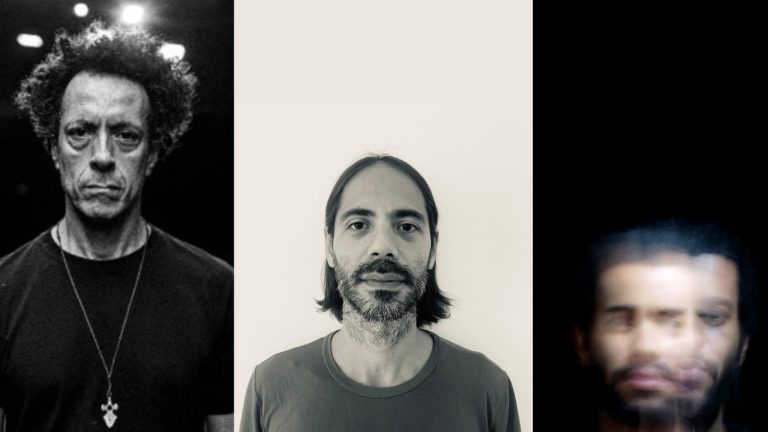
M.Takara – Xaxim: A Sounds and Colours Interview
03 October, 2026Mauricio Takara is one of the most restless and inventive figures in contemporary Brazilian music. In the late 1990s Takara made his mark on the independent scene by founding the band Hurtmold. With the group, he helped define a sound that blended jazz and post-rock with the groove of Brazilian rhythms, becoming a touchstone for Brazilian instrumental music. Under the moniker M.Takara, he has produced a solo discography that serves as a true laboratory for experimentation. In his live shows, he splits his time between drums, vibraphone, samplers and mixers, creating sonic layers he defines as “Resilient Music” – a sound that adapts and transforms according to the environment and the people around him. This philosophy has led to collaborations with key figures from the American post-hardcore scene, such as Joe Lally and Brendan Canty (Fugazi).
Versatility is a key word to describe his work. This is the same musician who has collaborated with the favela rap of Sabotage, the delicate artistry of Vanessa da Mata, the powerful presence of Naná Vasconcelos, and the full-on assault of Rakta. Furthermore, he has built a strong connection with Chicago’s avant-garde scene, notably through the São Paulo Underground project alongside trumpeter Rob Mazurek.
This new release on the Desmonta label is at times reminiscent of the jazzier side of Hurtmold’s catalogue. “Prisma/loqueci” reminds me of On the Corner-period Miles Davis, a loose funk, a driving groove and horn blasts over the top. Not so much a soundalike, but it’s in the atmosphere and context of an open dialogue between jazz, hip-hop and the pulse of African percussion. He remains one of those rare artists who honours the past while shaping the future of Brazilian music. I spoke to Takara by email about this new release.
Sounds & Colours: How did this project come about and what was the initial inspiration to record Xaxim?
Mauricio Takara: For some time, I have been composing music heavily based on rhythmic cells, overlapping claves, time signatures, where all the key elements (rhythm, melody, harmony, and timbre) originate from the drums and percussion, sometimes incorporating electronic elements as well. In 2025, I began wanting to expand this concept into a more band-oriented format featuring a few melodic instruments, to introduce an element of improvisation, while still maintaining the essence of percussion as the foundation of the musical orchestration.
S&C: Why the title Xaxim, a plant native to the Mata Atlântica?
MT: Actually, it came about because of the song of the same name, the melody of which was composed with the xaxado rhythm in mind. That’s where “Xaxim” came from. In the end, the rhythm changed a bit, but I kept the name because I think it’s a very beautiful word with a lovely rhythm.
S&C: There are two collaborators on this EP, Guizado and Esdras Oliveira. Who are they and why did you choose to play with them?
MT: I’ve known both of them for a long time. Guizado is a very active trumpeter in the São Paulo scene, and I’ve played with him on various projects over the past 20 years.
Esdras played a crucial role when I first started composing more percussion-only music. For a few years now, we’ve been developing a rhythm-focused practice and body of research together. He is a highly versatile and focused musician who brings a wealth of possibilities to a live line-up, and he was also instrumental in the making of this EP.
The initial idea was to propose a weekly practice session while I was in São Paulo, so we could exchange ideas and explore possibilities together. It went really well, eventually evolving into this EP and a live performance line-up.
S&C: A lot of recordings under your own name are more electronic and loop-based. What caused this move towards a jazz-based sound?
MT: It’s been a while since I slightly changed the way I use electronics in my work. Now, I try to use them more as a response to what I’m playing, rather than the other way around. But I think the essence remains very much the same.
S&C: I hear a southern African influence with a marimba-like sound in “Linha Reta” (and “Prisma”); is this deliberate?
MT: It wasn’t intentional, but I’m constantly listening to and researching music from various places. As I mentioned in the previous question, this research, focused more on rhythmic composition, has had a very strong influence; it includes a lot of music from West Africa, Indonesia, and across Southeast Asia, as well as a great deal of Brazilian music.
S&C: You’ve been based in Berlin, yet this was recorded in São Paulo. What brought you back to Brazil to record?
MT: I come back to Brazil whenever I can. I think this work really took shape there largely because of the people involved, namely Guizado and Esdras.
I feel that this music has a certain simplicity and a highly repetitive rhythmic sound; it required that kind of intensive practice, involving a lot of personal interaction, to strike the right balance between precision and looseness. I think I tend to find that more in São Paulo, given the musical nature of the place and the fact that it’s where I grew up.
S&C: Has being in Berlin influenced your music making a lot?
MT: Definitely. Berlin has an incredibly active music community, with people from all over the world, and it’s much more open than I imagined it would be before I went there. Being part of that has been very inspiring and motivating. Last year, I played with an Indonesian Gamelan group, which was also a very unique experience.
S&C: This is an EP, so are there plans for an album?
MT: There are two more songs from that same recording session that will be on a solo album featuring guest artists, which I’m going to release next year. But the idea is to keep composing and performing, and perhaps even expand the lineup a bit more.
S&C: Will you play any shows to promote this release?
MT: For now, only in Brazil. In December or January.
You can listen to Xaxim below:
Follow Sounds and Colours: Facebook / Twitter / Instagram / Mixcloud / Soundcloud / Bandcamp
Subscribe to the Sounds and Colours Newsletter for regular updates, news and competitions bringing the best of Latin American culture direct to your Inbox.