

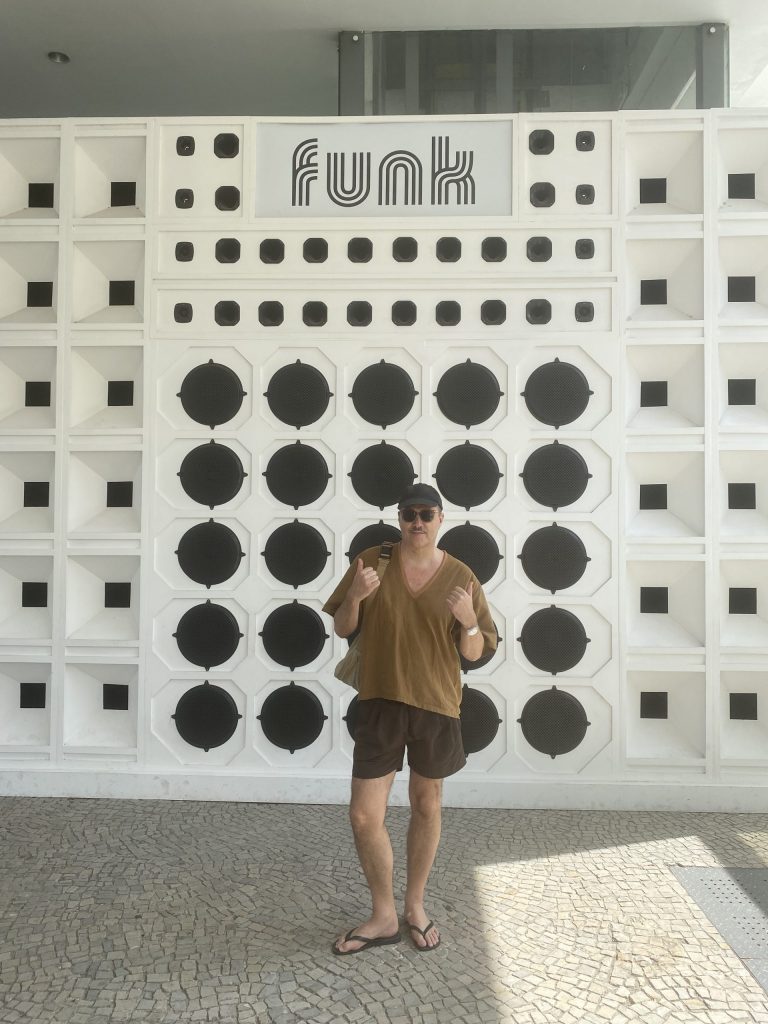
It Began in Ipanema: An interview with Daniel Haaksman
23 June, 2026My history with DJ, producer, journalist, and label boss Daniel Haaksman goes back to over 20 years ago when we were sitting in a restaurant in Copacabana and I was pitching him the idea of a Brazilian post-punk compilation that he ended up putting out under the name Não Wave on his fledgling label Man Recordings. Man recordings has since gone on to release music made in or influenced by the global south for over 20 years, primarily funk carioca and its offshoots. Now Daniel has just written a new book in which he explores both the history and present of Rio de Janeiro through fifty of its songs. Spanning more than a century, the songs featured in It Began In Ipanema reveal how a city tells its story through sound. I spoke to Daniel about the book and his own history with the city.
Sounds and Colours: So, can you explain your connection and history with Rio de Janeiro?
Daniel Haaksman: My connection with Rio started in 2004 when I first went to look for funk carioca on the street markets of Rio. A friend who had studied in Brazil had previously brought me some funk CDs and I was so blown away by the music that I decided to fly to Rio to check out the music myself. My first visit led to my compilation Rio Baile Funk: Favela Booty Beats. Ever since I’ve travelled to Rio circa twenty times. I’ve worked with many carioca artists, released countless Rio records on my label Man Recordings. Musically it´s the most exciting city for me; every time I visit, I discover new records and new artists.
S&C: How did you make your selection from Rio’s vast repertoire of music for the book?
DH: Everyone knows “The Girl from Ipanema” or “Chega De Saudade”. But to avoid the postcard views I was interested in songs that revealed aspects of the city the classics tend to leave out. There’s, for example, “Sala De Recepção” by Cartola, which reflects on the importance of the dense social networks and a sense of collective life in a favela that is rare in the postcard quarters of Ipanema and Copacabana. Or “Copacabana Saida” by Junior Mendes, which reflects the exciting atmosphere and sense of freedom of Copacabana nightlife in the early 1980s. Or Quarteto Em Cy’s “Santo Amaro” from 1976, with its rising and falling vocal lines, which beautifully illustrate the geographical and social ups and downs of a favela through music. What I wanted was a portrait of Rio that balanced the familiar with the unexpected, the landmarks everyone recognises alongside the stories hiding in plain sight (or on forgotten, dusty records or obscure Mp3s). In that sense, the book follows the logic of a good DJ set. The classics are there, but they’re not left alone to do all the work, the real revelations often arrive in the records nobody knew.
S&C: Tell me about some other interesting tracks which you think specifically avoid the clichés of Rio.
DH: There’s a couple. For example, “Eu Sou O Rio” by Black Future, which is a great document of the twilight life of late 1980s Rio, when the Brazilian military dictatorship lost its grip and the Rio bairro of Lapa became an experimental zone in which boundary-crossers like Fausto Fawcett and Black Future maneuvered new musical collisions. Or DJ Edgar´s “Flamengo” from 2007 in which he masterfully deconstructs the Hino De Flamengo anthem of the famous Rio football club on his MPC sampler into a baile funk banger that still shakes dancefloors. And there’s “Barra, Shopping, Gasolina E Celular” by Ivo Meirelles, which reflects the hollow materialistic life of the new middle class which emerged during Lula’s first government in the Rio suburb of Barra.
S&C: Why choose Ipanema as a starting point? Why not Praça Onze where the first samba “Pelo Telefone” was composed, for example?
DH: For many non-Brazilians, particularly those who came of age in the 1960s and ’70s, their first musical encounter with Brazil arrived in the form of “The Girl from Ipanema”. It is one of the most played songs of all mankind, and few songs have been more effective at turning a real place into an international fantasy. Through the beach of Ipanema and the sound of bossa nova, Brazilian music entered the global consciousness and Rio provided a soundtrack that proved remarkably difficult to escape. The city became synonymous with elegance, sunshine and effortless cool, an image tourism boards usually spend fortunes trying to manufacture. The title of the book is therefore slightly misleading, though not entirely by accident. Of course, “Pelo Telefone” was the first official samba, but outside of Brazil hardly anybody knows it. For gringos, it began in Ipanema, but Rio’s true musical laboratory has been and still is the favelas.
S&C: For all its beauty, Rio de Janeiro is a city where politics, public security, organised crime and culture are all intertwined in a way that it’s impossible to separate them. Do you think you’ve approached this political reality in your book?
DH: I only briefly touched on the political situation in Rio. During my research, I honestly found few good songs on the complexities of local Rio politics which might have given an outsider some insight. The chapter on “Interlúdio Chico Buarque” by Putodiparis deals with the brutality of the drug trade, and the chapter on “Rap Das Armas” by Cidinho E Doca deals with gun violence in the favelas. In the chapter about MC Bob Rum’s “Rap Do Silva”, I deal with the ongoing discrimination against funk culture in Rio and the harsh social realities of life in the favela.
S&C: You have managed to sneak a few Man Recording releases into the book. “Eu sou o Rio” by Black Future I can understand, it’s a vital link between samba and post-punk, but how would you explain “Alemão” by MC Gringo; is that really an essential Rio track?
DH: For me, “Alemão” is an important Rio song. I’ve been following MC Gringo’s story for a long time. He was one of the few gringos who got involved with funk over 20 years ago and he was actually the only MC that dared to perform with his heavy Swabian-German Portuguese accent at the Calderão Do Huck TV show. You can still see it on YouTube! MC Gringo was even supported by the biggest male voice in funk, Mr. Catra, and basically the only foreigner that made a small career in the rock-hard funk scene of Rio. That’s why I consider him an important figure and his song “Alemão” embodies it. MC Gringo´s story also showed that it’s still very difficult for foreigners in Rio to gain a foothold in the local cultural scene. During my many visits to Rio, I was always surprised that, despite its enormous size and global reputation, the city has a very small international community, and hardly any foreigners that stand out as cultural figures.
S&C: Which are your personal highlights from the book, the chapters that were a particular delight to write, or maybe where you learnt something new?
DH: I learned a lot about Rio music and history while doing research for It Began In Ipanema. Often, and thanks to translation programs, for the very first time, I actually understood the lyrics of some songs that I had already liked before. As with many non-Brazilians, I always perceived the lyrics as sound, not with a meaning. As a DJ I often played Ed Motta’s “Daqui Pro Méier” from 1997 because it is a great Brazilian disco-funk track. Only during my research did I realise he sang about a taxi ride from the bairro of Leme through the whole city of Rio ending in the bairro of Méier. Also, I didn’t know about the suite “Saudades Do Brasil” by Darius Milhaud, which he wrote in 1917 in cold Denmark after living in Rio for a while. It’s a beautiful stroll through different parts of Rio, one of the first gringo compositions in which a foreigner’s impressions of the cidade marvilhosa was musically interpreted. I also used to play “Aquele Abraço” by Gilberto Gil a lot as a DJ; only through the book research did I realise it’s a love letter he wrote to Rio De Janeiro fleeing the military dictatorship.
S&C: Finally, do you have a secret recommendation for the first time visitor to Rio?
DH: During Rio’s summer, I love to hang at Alalaô kiosk at Arpoador. Since opening in 2021 it has hosted art exhibitions, live music and performances as well as architectural interventions right on the beach front. Most beach kiosks in Ipanema or Copacabana sell drinks with a view, Alalaô tries to make the view part of the program. Consequently it’s often jam packed with an eclectic mix of people. There’s some bohemians from the South Zone, surfers, tourists and curious passers-by. It´s a great spot, especially for first time visitors.
Tune in tomorrow when we will post an exclusive taster from the book.
It Began in Ipanema is published by Sorry Press and is out on June 25th. And here is a Spotify link to accompany it.
Follow Sounds and Colours: Facebook / Twitter / Instagram / Mixcloud / Soundcloud / Bandcamp
Subscribe to the Sounds and Colours Newsletter for regular updates, news and competitions bringing the best of Latin American culture direct to your Inbox.