

Sound & Colours Album première: Uma Festa no Centro do Vazio by João Carvalho
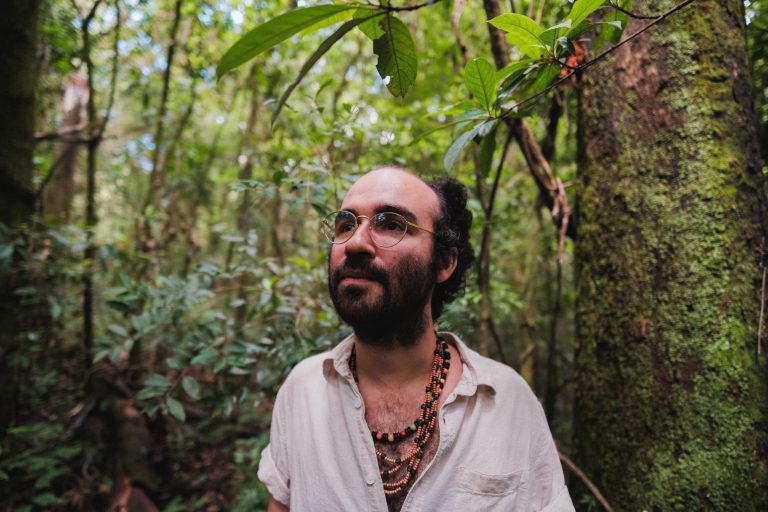
17 June, 2026Imagine a mix of Radiohead and Milton Nascimentos’ Clube de Esquina and you have Uma Festa no Centro do Vazio, João Carvalho’s first solo album of songs since the pandemic. It’s also the first under his own name, as Carvalho has a history of playing experimental music under the moniker Sentidor, and with the band El Toro Fuerte and electronic alt pop act Rio Sem Nome. The album’s title is a paraphrase of the poem às vezes parece, by Roberto Juarroz:
“Sometimes it seems like we’re at the center of the party / However, at the center of the party there is no one/ at the center of the party there is the void/ But at the center of the void, there is another party.”
Carvalho’s new project is the result of a series of journeys through the countryside of south-eastern Brazil, working with riverside communities and other traditional peoples affected by the large mining companies in Minas Gerais and Espírito Santo, and of a deep immersion into the imaginary elements of creation myths.
With an abundance of rock and alternative folk influences, the album ventures into a deep exploration of acoustic guitars and Brazilian songwriting traditions. Between pain and pleasure, death and life, chaos and organization, these themes are interwoven with the histories of the places where the album was composed, such as the village of Itaúnas, on the border between Bahia and Espírito Santo, where, after a slow geological process intensified by human action, the original village lies buried beneath the sand dunes.
Produced in collaboration with Bernardo Bauer (MOONS, Desastros) and Felipe D’Angelo (Moons, Lô Borges) at Estúdio Cais, A Party at the Center of the Void features a wide range of collaborators, such as Fernando Motta and Fábio de Carvalho, who shares vocals and guitars with João in El Toro Fuerte, along with new partnerships, such as with Clara Bicho, Ciro Trevisan (Lovestain, Pequeno Céu), and Jovana Trifonovic (Minas Gerais Philharmonic Orchestra).
The influence of Lô Borges and Milton Nascimento, made all the more evident by the participation of Felipe D’Angelo, who has been Lô Borges’ pianist in recent years, dialogues with other central influences on the album, such as the spiritual jazz of bands like Metá Metá and Alice Coltrane, as well as Brazilian classics like Tom Jobim and Los Hermanos.
You can listen to the album below.
Follow Sounds and Colours: Facebook / Twitter / Instagram / Mixcloud / Soundcloud / Bandcamp
Subscribe to the Sounds and Colours Newsletter for regular updates, news and competitions bringing the best of Latin American culture direct to your Inbox.