

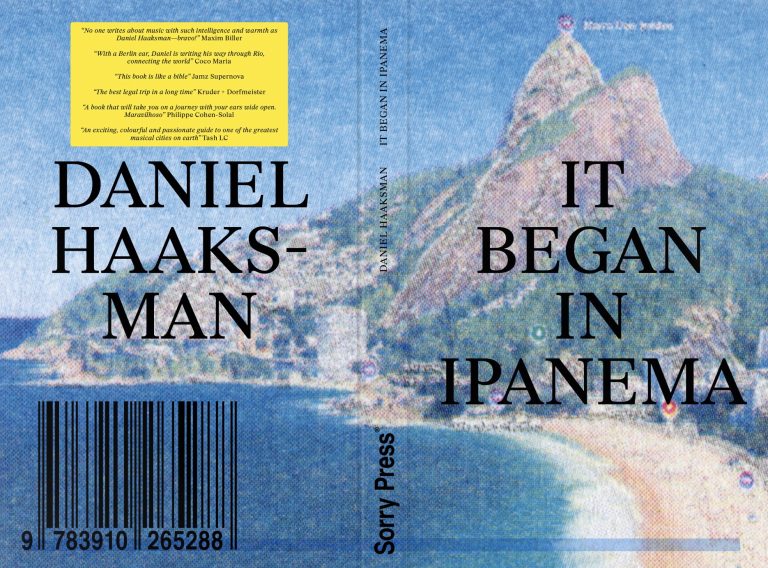
Sounds & Colours presents an exclusive preview from Daniel Haaksman’s new book, It Began in Ipanema
24 June, 2026Following on from our interview with DJ, producer, journalist, and label boss Daniel Haaksman, here is an exclusive extract from his forthcoming book where he looks at one of Giberto Gil’s most important songs from his long and illustrious career.
A subtle embrace: Gilberto Gil “Aquele Abraço” (1969)
When someone in Rio says “Aquele Abraço,” they mean more than a warm hug. It is a gesture of solidarity. Gilberto Gil, who turned these words into one of the most important songs in Brazilian pop history in 1969, sent not only a greeting with “Aquele Abraço,” but hope and subtle criticism back to a country that had just forced him and many other artists, intellectuals, and political thinkers into isolation. The song became a hymn of praise to Rio de Janeiro.
By December 1968, Brazil had become a different country. With AI-5, the infamous Institutional Act Number 5, the military government had largely suspended freedom of the press, freedom of expression, and civil rights. Artists were imprisoned. The censorship authority banned the performance and sale of important literary and musical works. The public movements of artists were monitored. Gilberto Gil, then just twenty-six years old, was also arrested. Less for a specific crime, but for his role in the cultural movement known as Tropicália. It was what went down in the history books in Europe and the US as “1968”.
In Brazil, the year of change in political articulation in view of the military dictatorship came as a riot of colour. Since street demonstrations were hardly possible, young people staged a musical Carnival that exploded onto the Brazilian cultural scene with electric guitars, samba, and avant-garde poetry. Caetano Veloso, Gilberto Gil, Gal Costa, and Os Mutantes combined The Beatles psychedelia with Bahian drums and declared pop culture a weapon against the leaden heaviness of the military dictatorship. What many considered sacrilegious, mixing samba with electric guitars, was in fact a poetic revolt against purity laws and cultural isolation. Tropicália meant that Brazilian music could be rooted in traditions, but similarly could also contain hybrid elements and provocation. Tropicália, a term coined by the artist Hélio Oiticia, was less a style than a promise that music could reinvent a nation with irony and the freedom to experiment. Of course, the movement was a thorn in the side of the regime, too critical and Westernised. Together with Caetano Veloso, Gil was placed under house arrest and eventually forced into exile.
Before leaving for London in 1969, he wrote “Aquele Abraço”. The song was his way of saying goodbye to Rio, to Brazil. But despite its sad occasion, the song was a defiantly optimistic one, full of rhythm, with local colour, references to places, and anecdotes about Rio, which in its lightheartedness defies the seriousness of the situation.
Gil begins the song as a kind of radio presenter. First, he welcomes some fellow musicians, today considered some of the giants of Brazilian music: Dorival Caimmi, João Gilberto, and Caetano Veloso. Then he makes it clear: “O Rio de Janeiro continua lindo” ( “Rio de Janeiro is still beautiful”), a phrase that has become almost proverbial today. Gil adds: “Rio de Janeiro, fevereiro e março,” a reference to the summer months, the time of Carnival, but also to a time of political tension. It is a song about a city that keeps its beauty, even beneath the surface of dictatorship. And throughout the song, he remains in the city: “Alô, alô Realengo, aquele abraço!”, a greeting to a working-class neighbourhood in western Rio. And immediately afterwards: “Alô torcida do Flamengo”, a greeting to the passionate fans of the city’s most famous football club. Gil lists places, names, neighbourhoods, local scenes, and acts as an urban guide through a Rio that is still vibrant despite the dictatorship. What Gil describes here is the Rio of the suburbs, the poor neighbourhoods, and the artists. Realengo, Bangu, Caxias, all these places are the lifelines of the city, and Gil sings about them with a smile that everyone who lives there understands.
His voice is anything but neutral. It is rhythmic, warm, inviting. You can sense that this man, even though he originally comes from Salvador de Bahia, knows the city from his own experience. The groove of the song follows the samba as well as the rhythm of life in the city. The song is also a cartography of memory. From afar, Gil looks back on his experiences in Rio, which at that time was physically inaccessible to him, but all the more present in his heart. The words are like a return flight through the medium of poetry. The refrain “aquele abraço” repeats like a mantra, an echo that reverberates from exile back to the city. The song also has a clever, cryptic political message. In the midst of military repression, Gil sent a song out into the world that could formally pass as harmless. If you don’t understand the lyrics, the song seems cheerful, almost carnivalesque. It is a party song and does not come across as a protest song. But there are subtle hints between the lines. The song thrives on double meanings. Those who just sway along hear samba, but listening closely one recognises a sarcastic undertone, the warmth of the embrace as a cover for bitter criticism.
“Aquele Abraço” belongs more to the second wave of Tropicália, less psychedelic and experimental, but classic and folksy, yet with the same subversive spirit. Musically, the song is based on samba, but also on marchinhas, the light, humorous songs of Carnival. Gil uses musical codes that are loved by the masses and hides his personal message within them: lightness as resistance. As soon as it was released, “Aquele Abraço” became a hit, in Rio, and later throughout Brazil. Despite, or perhaps because of, its gentle irony, it became an unofficial song against the dictatorship. People sang it in bars, at parties, at demonstrations, because it gave them hope. And, of course, because it celebrated Rio without denying reality. And Gil? He returned to Brazil in 1972 and became Minister of Culture under President Lula in 2003. The song remained his trademark. To this day, he often closes his concerts with this song. It is his musical handshake, his everlasting greeting.
It Began in Ipanema is published by Sorry Press and is out on June 25th.
Follow Sounds and Colours: Facebook / Twitter / Instagram / Mixcloud / Soundcloud / Bandcamp
Subscribe to the Sounds and Colours Newsletter for regular updates, news and competitions bringing the best of Latin American culture direct to your Inbox.