

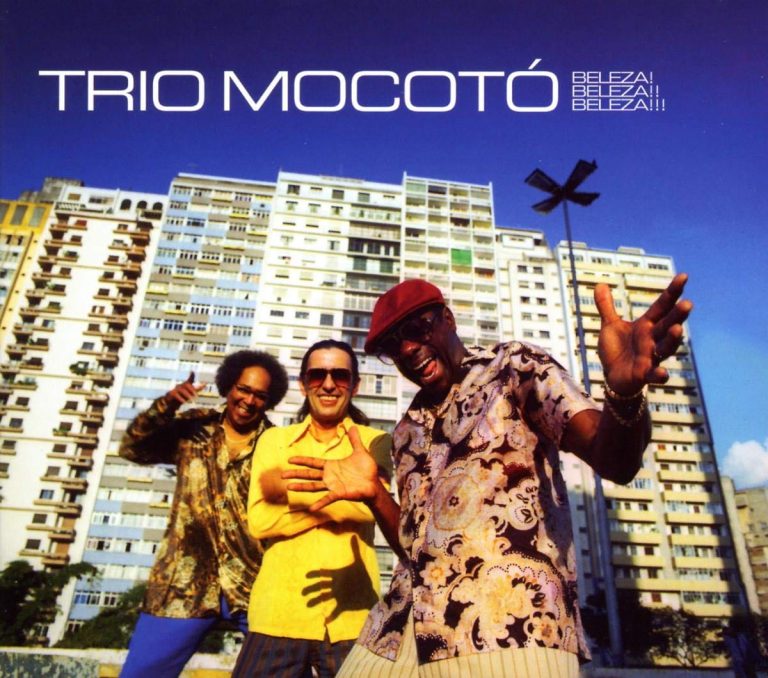
The day Dizzy Gillespie recorded with Trio Mocotó in Brazil
25 April, 2026After a few minutes’ delay, Dizzy Gillespie arrived smiling at 3:15 PM at Eldorado Studio in São Paulo. He greeted everyone, took off his shoes, asked for a minute, went to a corner, placed both hands on the floor and stood on his head. For 30 minutes he meditated with his legs in the air. While the trumpeter, and one of the creators of bebop, performed his ritual, Trio Mocotó awaited him for the session. “It was a very strange day,” says João Parahyba, one of the Trio’s members. “But it was also incredible.”
It was August 1974. The day before, Dizzy had seen João (percussion), Nereu Gargalo (pandeiro) and Fritz Escovão (cuíca) play at O Jogral. He was impressed and invited them to record an album together the next day. The proposal seemed unusual, but they accepted immediately.
After his ritual, Dizzy returned to his normal position and said, “Let’s go.” Also with him were Earl May (bass), Mickey Roker (drums), Al Gafa (guitar), and Mary Stallings (vocals). “It was live and in colour,” observes Parahyba. “It should be called ‘We Went Out Playing.’ It was right there and then.” Of the six tracks, only two originated from Gillespie’s improvisation (“Dizzy’s Shout/Brazilian Improvisation” and “Rocking With Mocotó”). “Samba” and “The Truth,” which open the album, are by pianist and composer Michael Josef “Mike” Longo, Dizzy’s musical partner on the album The Earth Is But One Country. Singer Mary Stallings performs “Evil Gal Blues,” composed by Leonard Feather and Lionel Hampton and made famous by Dinah Washington. “Behind the Moonbeam” was written by guitarist Al Gafa, who also plays the solo.
After recording, the jazz musician took the master tape to Rio de Janeiro. His intention was to show it to Sony Music executives for a possible release. But they didn’t reach an agreement. Dizzy had a falling out with the record label that represented him at the time, got angry, and put the record away.
“That was the biggest lie of my life,” says João Parahyba. “It’s a record that even today few people know and think it’s a legend. It’s not on streaming services either, but it’s possible to find it on YouTube.”
The story was only proven after the Swiss producer (and Dizzy’s manager) Jacques Muya found the master recording and decided to release it. “One day he called me and said, ‘Look, I have a master recording here of Gillespie and Trio Mocotó.’ Then Jacques brought it to Brazil, negotiated with a Brazilian record label, but ended up having a falling out with the people there.” Following this negotiation, Dizzy Gillespie in Brazil with Trio Mocotó was released on CD in 2010 by Groovin’ High and Biscoito Fino. The curious thing is that the Trio wasn’t informed about the release, which quickly disappeared from the shelves, reigniting the myth of the Brazilians’ partnership with one of jazz’s greats.
“I have a (CD) with me,” Parahyba reveals. “But they released it and then shelved it, didn’t put it on the internet [streaming] and didn’t do anything else. It was a glory for me when he [Jacques] arrived here. A very kind old man, he was Dizzy’s best friend and kept all his copyrights. He accompanied Dizzy during his cancer treatment.” “A beautiful story.”
Rare, timeless, and a work of art of jazz and samba, the album was held back for almost 40 years. 2026 will mark 52 years since its recording. João Parahyba offers hope that it may be reissued, at least for access on digital music platforms. “Now, my son Janja Gomes and Estúdio Medusa, along with his partner, are trying to negotiate with the record label, at least to put it on streaming so everyone can listen.” This is a way to reaffirm the genius of Trio Mocotó in jazz. “At the time, many people listened, but nobody knew it would be shelved and disappear again,” reflects Parahyba. “I spent 40 years talking about it, and the jazz musicians in Brazil were like: ‘Oh, that’s a lie, man.'” I said, “We didn’t play with him, we shared a record.” After almost 40 years, they managed to prove it, yet they still doubt it because it doesn’t physically exist. However, even unofficially, it’s there for anyone who wants to listen.
“Even I was in a record store and I talked about it with the guys and they said it didn’t exist. I said it did. Then they searched on YouTube and found it.”
Follow Sounds and Colours: Facebook / Twitter / Instagram / Mixcloud / Soundcloud / Bandcamp
Subscribe to the Sounds and Colours Newsletter for regular updates, news and competitions bringing the best of Latin American culture direct to your Inbox.