

On The Margins
02 June, 2026An excellent selection of albums for you this month, including some disassembled MPB, unconventional percussive improv, doom-laden goth dramatics, unorthodox field recordings, and some scintillating violins. All recommended listening for the discerning listener.
Juçara Marçal & Thais Nicodemo – Dessemelhantes (YB Music)
By far the most experimental and innovative voice in Brazil, on this recording Marçal is accompanied by Nicodemo who plays the prepared piano, scattering pieces of paper, tin cans, clothes-pins, and metal plates across the instrument’s strings, while Marçal’s vocals surge over the notes in an impressive and oppressive performance. The songs are interpretations from artists based around Marçal’s universe and it’s the tension created between the words, percussive noises, electronic effects, and dissonances that guide the singer and pianist in their approach. For example, “Cavaquinho”, originally by Rodrigo Campos, becomes nuanced and sprightly, then augmented with electronic loops at the end. “Eu Lacrei” by Negro Leo, is disorientating through the use of voices laden with effects, contrasting with the clarity of the piano notes that expand and contract at every moment.
Barulhista – Música para dançar sentado (Self-released)
The composer Davidson Soares from Minas Gerais has been releasing music since the Myspace days. He produces an excellent mix of electronics with human warmth, acoustic atmospheres, and some post-rock guitar textures. The opening track “debaixo de um corpo que caiu do rooftop” functions as a kind of “traumatic archaeology” with the voice of a far-right politician ranting in the distance. “Extremamente Medicados” uses a rhythmic structure built from noise, sounding as if MPB had been disassembled in an electronics lab by Boards of Canada and then reassembled by someone who hasn’t slept for three days. The melody drifts un-moored, creating a mood of dreamy unreality.
Luise Volkmann & Kiko Dinucci – Canto de Olho (Power House Records)
Volkmann and Dinucci recorded their first album Enxame in 2023 in São Paulo. They toured Europe as a duo in summer 2025, with the tour climaxing at Cafe Oto in London, and then they went straight into the studio in Cologne. Volkmann uses her alto saxophone to intertwine her improvised jazzy phrases around Dinucci’s punkily strummed samba guitar lines. Occasionally he chants quotes from traditional Yoruba songs dedicated to the Orixás, repeating the phrases in an hypnotic mantra. What you end up with is two musicians coming together to find a common language, and then taking flight in a fluid, universal esperanto.
Bruno Berle – Sem Fronteiras (Far Out Recordings)
Berle’s third studio album was recorded across London, São Paulo, Minas Gerais, Germany and Maceió, and co-produced alongside his longstanding musical partner Batata Boy. He’s managed to create quite a community of like-minded artists in Nyron Higor and Phylipe Nunes Araújo, all of whom are now based in São Paulo and contribute to each other’s albums. In some ways like the Clube Da Esquina movement they operate with a free-exchange of ideas, writing songs with and for each other. Berle continues playing his beguiling style of gentle songs, strummed on a nylon-stringed guitar, with small touches of a Fender Rhodes, and a melancholic delivery of his words. In contrast, “Amor Inteiro” has a cathartic Afrobeat vibe and there are touches of Autotune amongst the synthy swirls on “Ideais Mágicas”.
Victor Negri – Sem (Stray Signals)
Victor Negri now records under his own name, after a decade of making music as Arubu Avua. Sem is built upon layers of wobbly guitar loops, samples, glitchy electronics and field recordings, with the recordings beginning in Lisbon and then finished in Campinas, Brazil. The eight tracks gradually unfold in interesting ways, some simply fold into themselves to terminate in distortion and feedback, and others seem to stand still, as if about to make tentative steps towards an unknown destination. Overall there is a feeling of disorientation, reacting to the current state of things with droning blasts or the numb acceptance of a simply plucked note.
Maria Portugal – EROSÃO Percussion Trio (Fun in the church)
I saw Maria Portugal performing with Fred Frith at a jazz festival quite a few years ago, and it was a spellbinding performance of improv using unorthodox sounds. EROSÃO Percussion Trio is another Brazil/Germany joint effort which blends her Brazilian musical roots with free improvisation and electronic experimentation. Portugal invited percussionists Burkhard Beins and Emilio Gordo from Berlin’s Echtzeitmusik (real-time music) scene to employ a traditional drum set with other unconventional instruments, including non-pitched percussion like bowed cymbals, metal objects, wood, straws, and chains. Nonetheless, it’s very accessible and there are renditions of Brazilian classics: “Pulsar” by Caetano Veloso and Augusto de Campos is rendered in delicate taps, and “Correnteza” by Tom Jobim and Luiz Bonfá is translated into a running stream of percussive patters.
Buhr – Feixe de Fogo (Sound Department)
Buhr, previously known as Karina Buhr, knocked off their surname to align with their non-binary identity. Living in Recife and as a drummer they found themself part of the original mangue beat movement. I see that their film debut was in the film Meu nome é Bagdad, to which I contributed the English subtitles. This is their first album in seven years, made in collaboration with producer and multi-instrumentalist Rami Freitas. Being such an intense performer, Buhr could never make a dull album. The title track has contributions from both Arto Lindsay and Fernando Catatau of Cidadão Instigado, creating a rising maelstrom of guitar skronk to the rolling percussion. There are also guitar contributions from Edgard Scandurra, an 80s post-punk survivor from the Jam-inspired Ira!, and one of Brazil’s most respected rock guitarists. The music is still rooted in Recife, with dub reggae overtones, maracatus and even a forró, though a highlight is “Demotivacional” with Russo Passapusso from BahianaSystem.
QMAR – Orações Oferecidas a Estranhos (Self-released)
QMAR consists of Paula Rebellato (Rakta) and Cacá Amaral (Rumbo Reverso), both active participants in the São Paulo experimental scene. The project originated from free-improvisation sessions and this debut was recorded and produced by the duo themselves in their home studio. From its dramatic title (Prayers offered to strangers) to its mix of 80s goth post-punk songwriting with post-rock textures, the album is full of tension like all good gothic romances. The listener can envision windy moors, ruined abbeys and long flowing robes, though “Necromancia” is krautrock repetition with wild noises and disembodied voices.
Kartas – Lado H (Municipal K7)
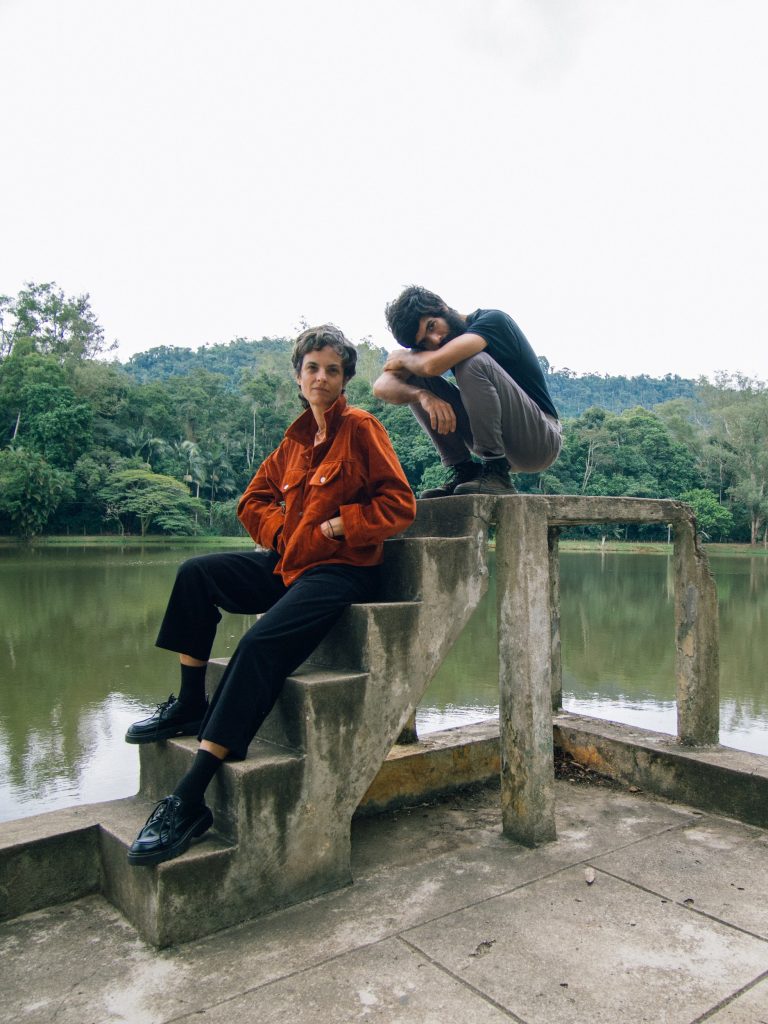
Kartas are a couple (Marcela & Zozio) from the small city of Piraí, situated in the Atlantic Forest, in the state of Rio de Janeiro. They live there with their children, and it’s where they record. Calm lakes outline the forest landscape, a result of floods in 1967, thus living with tragedy and regeneration informs the sound of Lado H. The music is a blend of free jazz, unorthodox field recordings, spoken poetry and traces of melody interspersed with live improvisations, and there’s a host of contributors, many of whom have featured in these pages. At times it sounds like This Heat, a loose post-punk groove with strange overlaid noises: “H2” is aquatically disturbing, and finisher “H4”” is all-out free jazz skronk.
Animal invisível – S/T (Nublu Records)
Guitarist Guri Assis Brasil began his career in Porto Alegre as a member of the band Pública. Since 2010, living in São Paulo as an on-hand studio- and stage-musician, he has collaborated with big names from Criolo to Luiz Melodia. Brasil also participated in the instrumental project La Cumbia Negra, conceived by legendary producer Carlos Miranda, playing a fusion of Latin and Brazilian rhythms. Animal invisível was created during the covid pandemic and these instrumental compositions move between jazz, 70s funk, soul, samba, psychedelia, and a touch of rock, bringing together all Brasil’s influences accumulated throughout his career. His guitar is the central instrument of the album but it’s the arrangements that pop out at the listener, with strings reminiscent of the work of Arthur Verocai (a huge influence on this new generation of São Paulo musicians; just listen to “Que Delicia é Viver” and how its optimism is translated into effervescent violins).
Ottopapi – Bala de banana (Seloki Records)
The solo project of São Paulo artist, designer and producer Otto Dardenne, co-founder of Seloki Records. The songs are short and direct, the everyday neuroses of living in São Paulo, with its wild contradictions, provide the lyrical content, where love, obsession, humour and paranoia learn to coexist. Musically, the title track “Bala de Banana” is straight from the C86 book of whimsical indie-pop, with a sing-song chorus and childishly nostalgic lyrics. Elsewhere it hovers between grungy garage rock and indie-sleaze pop, embracing immediacy and rough edges.
Alabastro – udendè (Gop Tun)
A recent highlight from the Gop Tun stable. The album is an intersection of jazz, house, and Afrobeat, held together by disparate samples ranging from Nina Simone to Al Jarreau, all while adopting the aesthetic influences of artists like Air and Fela Kuti. udendè marks the pinnacle of years of sonic research, which began in 2006 under the mentorship of Mestre Leitieres Leite at the Academy of Bahian Music. The album reflects the influences of southern Bahia, where Tazzio co-founded the BEATZADA collective in Trancoso. It all adds up to a tasteful blend of jazzy house with the added interest of Brazilian percussion and some soulful trumpet playing.
Follow Sounds and Colours: Facebook / Twitter / Instagram / Mixcloud / Soundcloud / Bandcamp
Subscribe to the Sounds and Colours Newsletter for regular updates, news and competitions bringing the best of Latin American culture direct to your Inbox.