

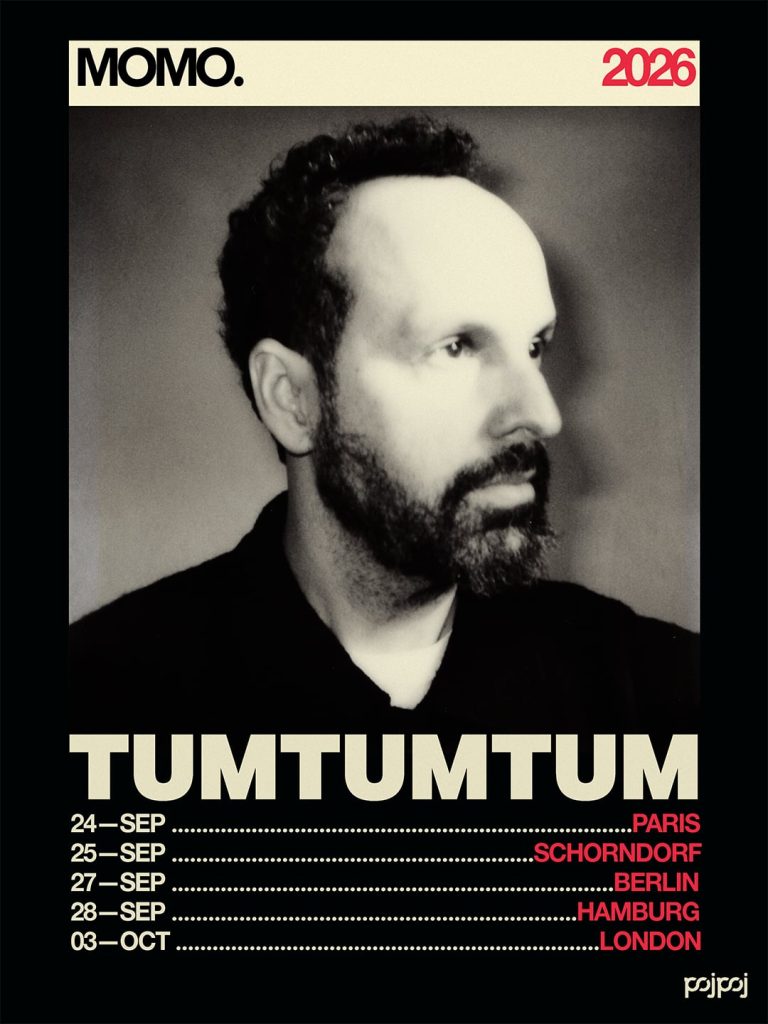
MOMO.’s Back in Town
19 June, 2026I first met Marcelo Frota, the London-based Brazilian singer-songwriter known in the music world as MOMO., when drafting the publicity for his first London album, Gira. The album was chosen by Mojo magazine as one of its Top 10 world music albums of 2024 – and of course made the Sounds and Colours New Year’s Honours list.
His eighth album, Tum Tum Tum, is released today on Agogo Records. A lot of water has flown under the bridge since our first meeting and I caught up with MOMO. recently on his return from a family trip to Fortaleza in Brazil’s North-east. Chatting to MOMO. is as easy as it is difficult to interview him. Difficult because he sweeps you along in a tidal wave of enthusiasm, so you have to check surreptitiously that you’ve covered all the structured topics prepared beforehand. We did.
I start our chat by asking him about the trip back to Brazil. It was his first visit in two years and 15 years since his last visit to the Nordeste. “Fortaleza’s where my dad moved back to from Rio,” he tells me. “It’s where my grandma used to live and where I spent a lot of my childhood. It was the first time since she passed away. My grandma gave me my first acoustic guitar. She visited us in Rio and took me to this very old shop downtown, where all the samba people went to buy their instruments. I have a picture of me as a very small kid and the guitar looks gigantic. When I used to visit her, I would bring my guitar and I would do serenades for her; play lullabies for her on the terrace outside her bedroom.”
MOMO. always likes to keep busy and typically he mixed business with pleasure during the trip. “I did some recording there with Régis [Damasceno], a friend who lives in São Paulo, who’s been playing with me since my first album. He plays bass on Gira and Tum Tum Tum, and he was there visiting his family, so I said ‘Let’s meet up and play.’ He had a drummer, so we could jam and do some recording.”
Which leads neatly to his recording process on Tum Tum Tum, an album characterised by its delicious sense of spontaneity. “For so many years,” he reveals, “I’ve been, like, in my room with a guitar, starting composing a song – such an introspective way of doing things. But with Gira, instead of the more intimate singer-songwriter, being at the Total Refreshment Centre [in Stoke Newington] with so many nice people, I invited them to join me. We usually started with the rhythm section – percussion, drums, bass – which gives me the pulse.
“I did the same with Tum Tum Tum. I invited Thomas [Broda], who toured last year with me on drums, and Jim Le Mesurier, the percussionist who plays with Orchestra Mambo International: me and them in the studio, using the same process, with a few ideas, but nothing formed – and no lyrics. No bass; that came after. If you listen in headphones, you can hear me sometimes guiding the band, calling the parts (chorus!). For the musicians, it’s not ideal because they don’t get to do a rehearsal, so sometimes you lose a bit of the tightness. But on the other hand, you get more of the spontaneous feel. And then I invited friends who have been working with me to collaborate – and on the lyrics as well. So it’s more of a collaboration. And the sound has got more universal in a sense: more like an invitation – not to my very specific unique world [laughs] – but to something more about instinct and less cerebral.”
I steer MOMO. towards some of the specific collaborations – with Marcos Valle, for instance, on “Morena”. Serendipitously, MOMO. had just caught him in concert in London. “I hadn’t seen him in about 20 years. We performed on stage together; he invited my band [Fino Coletivo] to be on his DVD at that time… When I was recording ‘Morena’, I thought we needed some electric piano for the arrangement – to give a little bit more groovy, jazzy feel. It was because of the sound; I heard his sound on the track. Marcos’ album [Túnel Acústico] was on the same Mojo list for 2024 and we started chatting on Instagram… I said, ‘Hey, would you like to contribute on this song?’ and he said yes. And he gave a little twist to the melody of the chorus. Man, he was very committed to my music, so responsive. He even made a video talking about the track. Such a very nice guy; a big inspiration.”
MOMO. had seen Marcos Valle in concert with fellow London-based Brazilian expat, singer Nina Miranda, whose contribution to “Canto de Aldeia” celebrates their friendship. “I sent it to her with the arrangement and she came up with this melody and the lyrics,” MOMO. explains. “I wrote the Portuguese lyrics with my friend and long-time collaborator, Wado. Nina came up with the part that almost goes to folk, like Fairport Convention.” I suggest that it reminded me a little of the Scottish indie-pop group, Belle and Sebastian. “Oh my God! Love it. I listened so much to Tiger Milk in the early 2000s. Someone told me it’s a little bit ‘90s, the new album. So… Nina made her part in her home studio just before she went off to Brazil. In the lyrics, she talks about her childhood in Brazil. That’s why she brings in [his young daughter] Leonora and me being a father. It has such a nice rural, bucolic vibe.
“What’s nice in the album, there’s a bit of everything as well. The song in English [‘Dream of Samba’], it’s even kind of psychedelic, like The Beatles. This is the music I love as well. I listened so much to folk and music from the ‘60s and ‘70s: Captain Beefheart, Strawberry Alarm Clock. I listened to this a lot.”
Did he, I wonder, have a favourite track on Tum Tum Tum? ‘Not really. For me, they [the eight numbers] all make sense together. I see the album almost as one track. You have your ups and downs in terms of rhythm. I’m passionate about albums. It’s like a book: you don’t fall in love with a single chapter… I need to give people everything; the whole album. Solo tracks, they don’t make much sense.”
I mention the album’s closer, “Tranquilo”, a personal favourite. “I knew that I wanted to end the album with an introspective song: voice and guitar ideally. I was searching for a Brazilian classic to cover. And then I opened one of my old computers. I always finish a song [if he starts writing it]. So I have lots of lost material. And I found this one, a track I recorded in Lisbon in 2015. A friend wrote the lyrics and I wrote the melody and the harmony. It’s like a 2 or 3am recording session. I lived in the historic section of Lisbon and loved doing music after midnight. It’s when I got enthusiastic about things; the productive world comes down [laughs]! I felt I wanted to add something just to give it some glue and I remembered this guy [a friend of the head of Batov Records] and I said, ‘Do you want to try some takes [on baritone sax]?’ He sent me like five takes and I chose the best one. I didn’t re-record the voice; it’s from 10 years ago.”
To compliment the release of Tum Tum Tum, the Swedish label Ajabu! is re-issuing his fourth album, Cadafalso. It offers an opportunity to compare and contrast the old MOMO. with the new. His debut solo album of 2006, A Estética do Rabisco, was recorded in his bedroom at his parents’ home in Rio, with friends dropping in to play and collaborate in much the same way that his two London albums have been made. It was championed by Peter Margasak of the Chicago Reader and well received in Brazil. On the first three albums, MOMO. reveals, “I put myself in the persona of a folk-musician, lo-fi with lots of effects. This folk guy with a beard, a little bit hippie [laughs]. I broke with this persona on Cadafalso. It’s just me in a solo context without the effects and stuff. It’s the naked version of me, with a guitar, no reverb, on all eight or nine tracks – recorded in one session. Cadafalso [meaning scaffold] is a metaphor for being exposed, waiting for the judgement of people and critics. It’s very dark, the album… I always remember that I started doing music to have some fun as a counterpoint to life; I’m enjoying so much again making these new albums. These two that I’ve made in London, they’re so joyful… My mum would always tell me, ‘You should do more joyful music, pop or something.’ Now that she’s passed away, I’ve changed my style – and she never heard Gira.”
So what’s next? MOMO. the doer will be starting work soon on a new project, which is already there on his computer. And there’s a short European tour coming up at the end of the summer with a small version of the band that played on the new album. “I’m going to try things: I’m thinking of putting in some horns using a sampler to bring some layers. I’m not against anything to be honest. If it sounds good, it sounds good.”
I’m happy to tell you that MOMO.’s new album certainly does sound good. Like Mojo’s reviewer who gave it four stars, my only problem, however, is that it should be longer. Maybe next time.
Follow Sounds and Colours: Facebook / Twitter / Instagram / Mixcloud / Soundcloud / Bandcamp
Subscribe to the Sounds and Colours Newsletter for regular updates, news and competitions bringing the best of Latin American culture direct to your Inbox.