

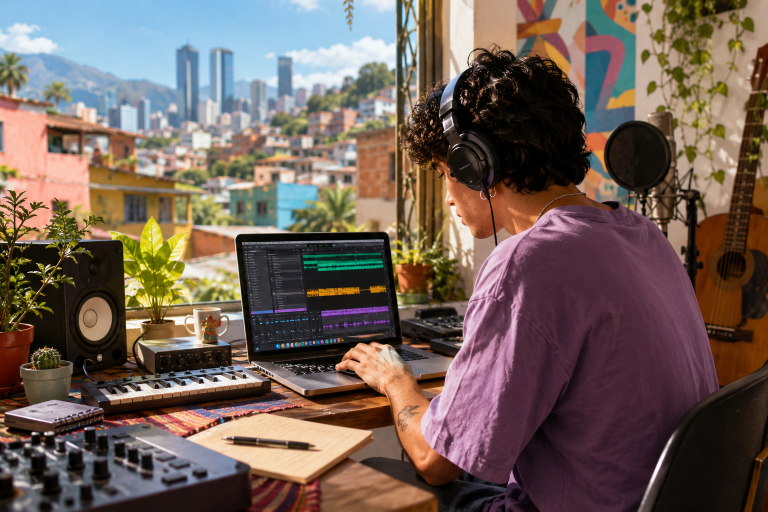
AI Music Production Is Tearing Through Latin America’s Underground Scenes
08 June, 2026Music production used to demand pricey studios and properly trained engineers. That wall is crumbling fast across Latin America. Artificial intelligence tools now handle beat creation, mixing, and mastering for a tiny slice of traditional studio costs.
Underground artists in Mexico City, São Paulo, and Bogotá have jumped on these tools at full speed. The trend is opening music creation to more people while also stirring debate around cultural authenticity and disappearing studio jobs.
How AI Production Tools Really Operate
Modern AI music software studies thousands of existing tracks to recognise patterns in rhythm, harmony, and song structure. A user types a basic prompt — “reggaeton beat with dark atmosphere” — and the system spits out multiple variations in seconds.
Some platforms now tackle full mixing and mastering, balancing levels and applying compression automatically. The results are not flawless, though they are absolutely workable. For musicians running on tight budgets, that unlocks creative options that simply were not around three years back.
Access Barriers AI Is Wiping Out
Traditional studio recording across Latin America has dealt with structural hurdles for decades. The table below compares the old setup with the 2026 landscape.
| Barrier | Traditional Studio (pre-2023) | AI-Powered Production (2026) |
|---|---|---|
| Hourly studio cost | 30–80 per hour | 0–15 per month (subscription) |
| Required technical skill | High (engineering degree or apprenticeship) | Low (basic computer literacy) |
| Time to complete a single track | 20–40 hours | 2–6 hours |
| Access to professional mastering | Additional 100–300 per track | Included in subscription |
| Geographical limitation | Must be near a city with studio facilities | Anywhere with internet connection |
Those differences explain why adoption has exploded so quickly. A musician sitting in a small Colombian town can now produce tracks sounding competitive with releases coming out of Bogotá or Medellín. The old gatekeepers have lost a huge chunk of their grip.
Democratisation Across Entertainment Sectors
Lowering entry barriers reshapes entire industries. The payid casino platform spotted this pattern in interactive entertainment years ago. Casino online platforms slashed minimum deposits, letting casual users jump in without massive upfront spending.
Online payid casino Australia players now access features once reserved for big spenders. Pokies online evolved from physical machines locked inside venues into mobile games playable practically anywhere. The comparison with music production is dead obvious. Once tools become cheaper and easier to use, participation widens and fresh voices break through.
Consequences Already Showing Up in 2026
The AI production boom has already created visible changes across Latin American underground scenes. Those shifts affect musicians, audiences, and traditional studios alike.
| Higher output from independent artists | Musicians now drop singles monthly instead of yearly, growing audiences through constant visibility rather than occasional releases. |
| Blurring genre boundaries | AI tools blend regional styles like cumbia, forró, and dancehall effortlessly, creating hybrid genres older production workflows struggled to handle. |
| Reduced demand for entry-level studio engineers | Routine recording and mixing work now handled by AI has wiped out some roles while creating demand for AI-focused specialists. |
These outcomes are not entirely good or bad. More music reaches bigger audiences, though traditional career paths for studio professionals have narrowed considerably. Underground scenes gain fresh energy while formal studio employment shrinks.
Which Artists Gain the Most
Not every musician benefits equally from AI production tools. Early adopters tend to share traits that maximise the technology’s strengths.
- Solo performers without bands – AI supplies drum tracks, bass lines, and backing harmonies that would otherwise mean hiring extra musicians.
- Artists in remote regions – Distance from major recording hubs no longer decides production quality.
- Genre experimenters – Fast iteration allows unusual combinations without expensive studio time ticking away.
- Self-releasing musicians – No label approval needed for production decisions; artists stay fully in control.
These four groups have driven adoption across cities like Recife, Barranquilla, and San Salvador. Their success stories push others to experiment too. The technology spreads mainly through peer networks rather than formal advertising.
What Traditional Studios Are Doing to Stay Alive
Professional studios have not vanished entirely. Some adapted by shifting their value away from equipment and toward experience. The surviving studios now focus on services AI still struggles to imitate. That includes premium acoustic recording for orchestras and percussion ensembles.
Some studios also specialise in vintage analog processing that musicians still view as culturally authentic. Others lean heavily into production consultation, shaping artistic direction instead of simply handling technical work.
Studios surviving purely on bargain pricing have already been wiped out. The ones offering genuinely irreplaceable human expertise are still booked out weeks ahead.
Follow Sounds and Colours: Facebook / Twitter / Instagram / Mixcloud / Soundcloud / Bandcamp
Subscribe to the Sounds and Colours Newsletter for regular updates, news and competitions bringing the best of Latin American culture direct to your Inbox.