

How Latin Dance Follows the Drum
29 May, 2026Latin dance doesn’t ask you to follow it. It pulls you in whether you’re ready or not, and that pull starts with the drum.
This isn’t a metaphor. Watch someone hear a conga pattern for the first time and you’ll see it happen physically. The shoulders move before the brain registers anything. That’s not cultural exposure doing that. That’s rhythm, and rhythm in Latin music is a specific, technically demanding thing that most outsiders underestimate.
What the drum actually does
In most Western pop music, the drum keeps time. It tells you where the beat is. In Cuban son, salsa, Afro-Brazilian candomblé, Colombian cumbia, the drum doesn’t just mark time. It carries conversation. Multiple drums play interlocking patterns simultaneously, and the dancer’s job is to find a path through all of them.
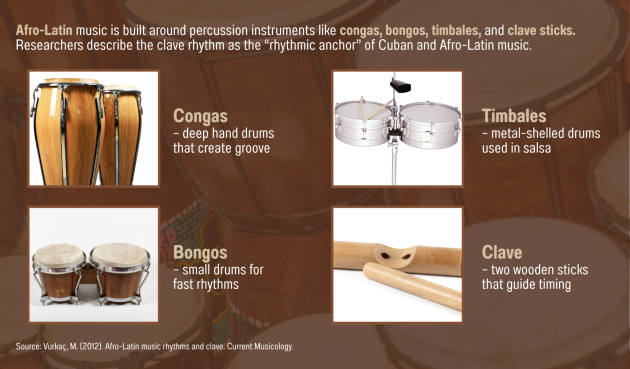
In salsa, the clave is the structural backbone. It’s a two-bar pattern played on a pair of hardwood sticks, and every other instrument in the ensemble orients itself around it. But underneath the clave, the conga player is doing something different. And the timbale player is doing something else again. Three rhythmic voices, none of them identical to the beat you’d tap your foot to. The dancer has to make a choice about which one to inhabit.
Most beginners inhabit the wrong one. They find the obvious downbeat and plant there, which is why beginner salsa looks stiff. Advanced dancers find the space between the beats. That space is where the drums leave room.
The African root is not decorative
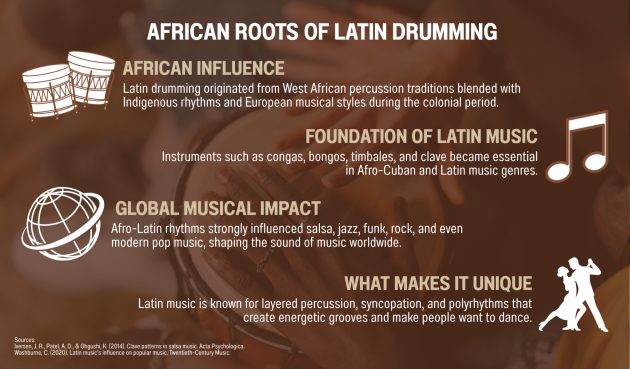
Latin rhythms come from West and Central African percussion traditions brought to the Americas via the slave trade, layered onto Spanish and Indigenous musical structures. This isn’t background information. It explains everything about why the drums function the way they do.
Yoruba, Fon, and Kongolese percussion ensembles were built on polyrhythm, multiple independent rhythmic lines played at the same time that create a composite texture no single musician is playing alone. When those traditions mixed with Spanish guitar and European harmony in Cuba, Puerto Rico, and Brazil, the polyrhythm didn’t disappear. It adapted.
In Afro-Cuban rumba, the quinto drum improvises over the other drums exactly the way a jazz soloist improvises over a rhythm section. The rumba dancer responds to the quinto. This is a real-time call and response between drummer and dancer. You cannot understand the dance without understanding what the drum is doing, and you cannot understand the drum without knowing it’s in conversation.
Cumbia is a different case
Colombian cumbia has a simpler percussion structure than salsa or rumba, but that simplicity is doing a lot of work. The tambora, a double-headed drum, plays a steady pattern that lands slightly behind where a European listener expects it to. That slight drag is intentional. It creates a relaxed, almost rolling feel that the cumbia step reflects directly. The dancer’s weight shift happens on that lazy beat, not ahead of it.
This is why dancing cumbia to a metronome feels wrong, even when the metronome is technically correct. The timing lives in the interpretation of the beat, not the beat itself.
What happens when you practice at home
A lot of people learning Latin dance work with recordings. That works fine until it doesn’t. Recordings compress the rhythmic information. You hear the result of the drum ensemble, but you lose the spatial separation between instruments that you’d feel in a live room.
Some dancers and instructors use drum machines to isolate individual parts. Strip out everything except the clave, and suddenly you can hear what the conga is doing relative to it. Strip out everything except the timbale, and you hear how the cascara pattern sets up the phrases. This kind of focused listening is easier with tools that let you control sound individually.
An electronic drum set from Drum Center of Portsmouth gives you another way in: playing the patterns yourself. Even a few hours learning to hold a clave rhythm or a basic conga tumbao changes how you hear those patterns in a song. You stop hearing “the drums” as background and start hearing individual voices. That shift is hard to explain until it happens, and it happens faster than most people expect.
What practice actually looks like
The dancers who understand Latin rhythm best are usually the ones who spent time around live musicians, or who played the percussion themselves. Not to any professional standard. Just enough to know what it takes to hold a pattern steady while something is happening over the top of it.
That experience changes your relationship to the music. You stop waiting for the beat and start living inside it. Which, when you get down to it, is what Latin dance has always been asking you to do.
Follow Sounds and Colours: Facebook / Twitter / Instagram / Mixcloud / Soundcloud / Bandcamp
Subscribe to the Sounds and Colours Newsletter for regular updates, news and competitions bringing the best of Latin American culture direct to your Inbox.