

Why Latin America’s Most Radical Art Is Happening Outside the Capitals
29 May, 2026For decades, the story seemed simple. If you wanted to find the pulse of Latin American art, you went straight to the capitals. Mexico City. Buenos Aires. Bogotá. São Paulo. Santiago. That’s where the museums stood tall, where curators gathered with tiny glasses of wine, where grants circulated through the same familiar circles. Big cities meant visibility. Visibility meant legitimacy. End of story.
Except… not anymore.
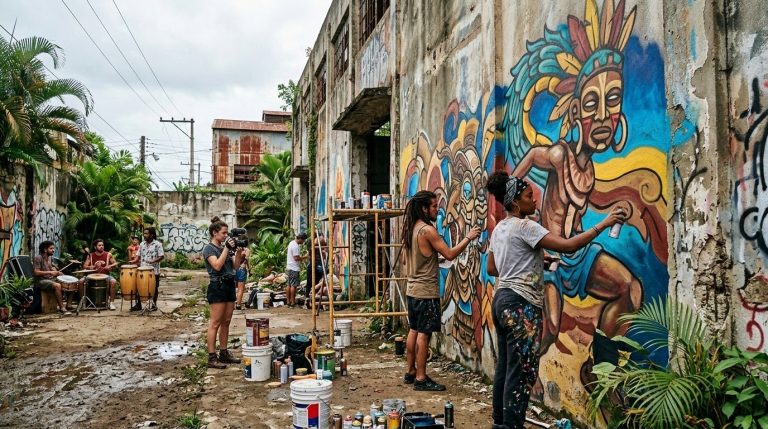
Now some of the boldest, strangest, most emotionally charged art in Latin America is appearing far from those cultural headquarters. It’s showing up in desert towns in northern Chile, in Afro-Brazilian communities outside Salvador, in jungle-border collectives near the Amazon, and in forgotten industrial cities where abandoned factories have become studios almost by accident. Sometimes the work barely enters the gallery system at all. It spreads through WhatsApp videos, pop-up performances, pirate radio, murals painted overnight, or tiny festivals that feel half like protests and half like neighborhood cookouts. As one local organizer jokingly called the scene, “Sòng bạc 1xbet” — chaotic, risky, loud, and impossible to ignore.
And honestly, that shift says a lot about the region itself.
Because capitals, for all their glamour, can become predictable. They absorb rebellion fast. A radical gesture lands on Friday and appears in a museum brochure by Tuesday. Smaller places move differently. They still have friction. Tension. Space to fail. Space to annoy people. Weirdly enough, that’s often where art becomes alive again.
The Capitals Got Expensive — and a Bit Too Comfortable
Let’s start with the obvious thing nobody likes to admit: major art capitals became hard to breathe in. Literally and creatively.
In cities like Mexico City or São Paulo, rising rents pushed many younger artists out long ago. Studio space shrank. Independent venues disappeared. The same neighborhoods once packed with underground energy slowly filled with boutique hotels and coffee shops selling drinks that cost half a day’s wage elsewhere. You’ve seen this pattern before; it happens everywhere from Berlin to Brooklyn. Art scenes become successful, then polished, then oddly cautious.
What’s fascinating in Latin America is where displaced artists went next.
They didn’t just relocate to cheaper neighborhoods nearby. Many left the capitals altogether. Some headed toward mid-sized cities with strong local identities — places where Indigenous traditions, regional music, agricultural economies, or migration histories still shaped daily life in visible ways. Others returned to hometowns they once escaped.
And something unexpected happened there.
Without constant pressure from galleries, collectors, or institutional gatekeepers, artists started experimenting more freely. Installations became rougher. Performances became political again. Video art got messy, personal, and local in a way polished urban art often avoids.
A mural in Oaxaca might reference Zapotec cosmology and cellphone towers in the same breath. A sound artist in Medellín could mix reggaetón basslines with recordings from former conflict zones. In coastal Ecuador, artists have turned flood debris into sculptures that look fragile enough to collapse if you stare too long. That fragility matters. It mirrors real life.
The work doesn’t always travel well internationally — and that’s partly the point.
Far From the Center, Local Memory Gets Loud
Here’s where things get interesting.
Many capital cities in Latin America were designed, historically speaking, as centers of control. Colonial administration, financial power, elite education — it all concentrated there. So when artists move outward, they often reconnect with stories those capitals pushed aside for generations.
You can feel this especially in regions with strong Indigenous or Afro-descendant cultures.
In southern Mexico, for instance, community-based art projects often blur the line between ritual, activism, and contemporary installation. The artists involved may not even describe themselves primarily as “artists” in the Western institutional sense. Sometimes they’re organizers, teachers, weavers, radio hosts, farmers. The categories overlap. That overlap creates work that feels less market-friendly but more rooted in lived experience.
And you know what? Audiences respond to that authenticity. Even if they don’t fully understand every reference, they sense when something carries actual weight.
The same thing is happening in parts of Brazil outside Rio and São Paulo. Collectives in the northeast have built entire artistic languages around regional music traditions, Black spiritual practices, and histories of drought, migration, and resistance. Their work often feels warmer and angrier at the same time — a difficult combination to fake.
There’s also less pressure to perform cosmopolitanism. That matters more than people think.
In capitals, artists sometimes create with international approval hovering over their shoulders. Will this travel to Europe? Will curators in New York “get it”? Outside those circuits, artists can be more specific, more stubborn. Ironically, that specificity often makes the work stronger.
Like cooking with local ingredients instead of trying to impress tourists with a global menu. The flavor sharpens.
The Internet Broke the Old Geography
Twenty years ago, artists outside capitals faced a brutal problem: invisibility.
You could make groundbreaking work in a remote town and almost nobody outside your region would ever see it. Gatekeepers controlled access. Critics controlled narratives. Big-city institutions decided what counted.
That monopoly cracked apart.
Now a collective in rural Colombia can post a performance online and reach viewers in Seoul, Lagos, or Berlin overnight. A photographer in the Peruvian Andes can sell prints directly through Instagram. Tiny festivals stream events globally with shaky Wi-Fi and borrowed projectors. Is it chaotic? Absolutely. But chaos can be productive.
Social media flattened cultural geography in strange ways. Not completely, of course — inequality still shapes everything — but enough to create new routes for attention.
And because audiences online crave work that feels raw or emotionally immediate, artists outside capitals often stand out more. Their environments haven’t been over-filtered yet. Their references don’t feel focus-grouped. There’s texture there. Dust, noise, contradictions.
Oddly enough, some younger artists now see capitals as restrictive rather than liberating. That would’ve sounded absurd in the 1990s.
A lot of this shift also reflects exhaustion with polished global art language. You know the type: sterile installations with vague statements about identity, memory, capitalism, systems. Important themes, sure — but repeated so often they lose oxygen.
Outside the capitals, artists frequently approach those same themes through direct experience rather than theory-heavy abstraction. The result hits differently. Sometimes less refined, yes. But also harder to ignore.
So… Are Capitals Losing Their Cultural Power?
Not exactly. Mexico City still matters. Buenos Aires still matters. São Paulo absolutely still matters. These cities remain crucial hubs for funding, archives, museums, publishing, and collaboration. They’re not disappearing.
But they’re no longer the only places where artistic legitimacy is produced. That’s the real shift.
The map became multipolar. Messier. More democratic, maybe.
In fact, many curators now travel outward precisely because they suspect the freshest ideas aren’t sitting inside elite districts anymore. Smaller cities and peripheral regions offer unpredictability — and contemporary art feeds on unpredictability like fire feeds on oxygen.
There’s a deeper emotional layer here too.
Latin America has always wrestled with uneven development. Wealth gathers in capitals while rural regions and secondary cities get overlooked, extracted from, or romanticized. So when radical art flourishes outside those centers, it quietly challenges that hierarchy. It says cultural intelligence doesn’t belong exclusively to metropolitan elites.
That’s powerful. Political, even when nobody says it directly.
And honestly, some of the most memorable work emerging from the region right now carries exactly that energy: not polished certainty, but restless invention. Art made close to ordinary life. Art that still smells like the street after rain, or sounds like motorcycles rattling past open windows.
Maybe that’s why it feels urgent again.
Not because it’s trying so hard to be radical, but because it hasn’t been fully absorbed yet. The edges still cut a little.
Follow Sounds and Colours: Facebook / Twitter / Instagram / Mixcloud / Soundcloud / Bandcamp
Subscribe to the Sounds and Colours Newsletter for regular updates, news and competitions bringing the best of Latin American culture direct to your Inbox.