

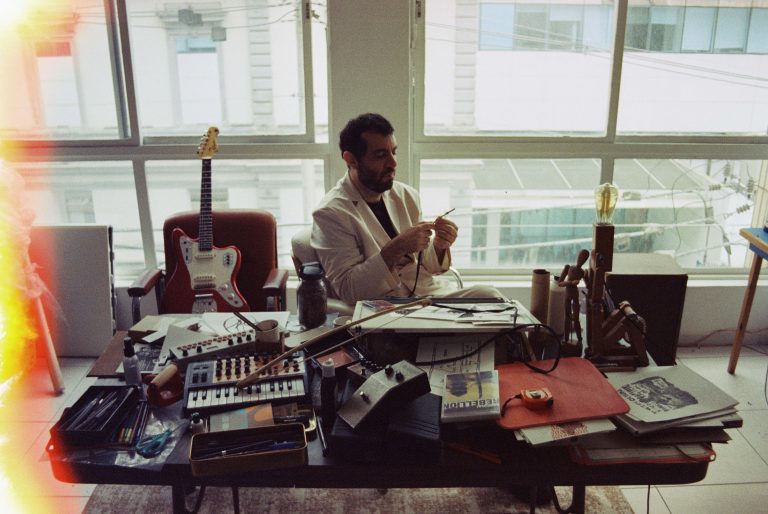
Kiko Dinucci – Medusa: A Sounds and Colours interview
09 September, 2026Six years after the release of Rastilho (2020), musician, composer, and producer Kiko Dinucci returns with his latest studio album, entitled Medusa. It’s described by Dinucci himself as “an album of love, ghosts, and beasts”. Dinucci is one of the most influential and inventive figures in contemporary Brazilian independent music, moving fluidly in the inter-zone between punk, samba and experimental music.
The album evokes a swarm of upfront guitars applied to the Brazilian songbook, samba, and the 1970s romantic ballads of Roberto Carlos, while remaining anchored in the post-hardcore sound of the nineties. To describe the album’s sound, Dinucci has invented the word Exugaze, a kind of Brazilian shoegaze, moving away from his acoustic steel-stringed strumming sound and into more abstract territories. There’s not even recognisable guitar in “Faca da Palavra”, which becomes a deliberate drone using a rabeca bow. At the same time, the delirious lo-fi romanticism of “Como foi?” destroys any romantic feeling, making fun of its over-sentimentalism in a burlesque manner. I spoke to Dinucci about the making of this remarkable record.
Sounds & Colours: What was the starting point and initial inspiration behind Medusa?
Kiko Dinucci: It all began with an album I started recording in 2024 that went completely wrong, a creative shipwreck, an aesthetic mess. I had to admit defeat and halt the sessions. Then, the idea struck me to make a record reinterpreting the work of Noel Rosa, which sounds almost like an affront to the more conservative wing of the samba scene: a guy from São Paulo playing Noel on an electric guitar. That blend of homage and irreverence made me want to take a chance on the idea. I recorded a song called “Pela Décima Vez” in that style; I really liked the result and played it to Cadu Tenório, one of the album’s collaborators. He remarked that it had a Dream Pop and shoegaze vibe. I’d never listened to much Shoegaze, I’ve always preferred American alternative bands that emerged from the punk/hardcore scene, like Hüsker Dü, Dinosaur Jr., Minutemen and Sonic Youth. But I started paying attention to My Bloody Valentine specifically, and I became fascinated by the radical way Kevin Shields explores the guitar. I began testing the format with my own new songs and liked the outcome.
S&C: Tell us a bit about how the album was created; how did you choose your collaborators?
KD: I recorded at least 70% of the album in my small home studio, my salinha, which was a very solitary process. I started worrying that the work might become too self-absorbed, so I thought about inviting people to intervene and bring something fresh for both me and the audience. Juçara Marçal, for instance, a lifelong sister to me, experimented with vocal samples, adding a whole new colour to the record. Cadu Tenório introduced elements from electronic music culture that brought a lot of newness to my sound. Lucas Pires and Gustavo Infante brought the sonic texture of analog tape. I think every collaborator, whether in composition or arrangement, contributed things I couldn’t have achieved on my own.
S&C: You’ve just mentioned Juçara Marçal. I see that she’s credited as “Director” on the album; could you expand on her role in the recording process?
KD: I invited Juçara to help me with the album back in 2024. She was the one who suggested I interpret Noel Rosa’s work using guitars. When I began developing the Medusa album in a shoegaze style, she contributed many ideas and helped guide the production process. Ultimately, she also collaborated on the arrangements for “Loira Palmer”, “Claudia”, “Frota e Eu”, and “Segundo Eterno”, treating the voice as an instrument, as texture or noise, an approach not often found in Brazilian song albums. Juçara deeply explores these alternative ways of using the voice; I view her as an instrumentalist. Her collaboration was pivotal, especially through our day-to-day conversations amidst our other professional commitments. I feel a strong artistic affinity with Juçara; meeting her was truly a defining moment in my life, and we have constantly fueled each other’s creativity throughout our shared artistic journey.
S&C: The album draws from artists like My Bloody Valentine, Sonic Youth and even veteran crooner Roberto Carlos. How did they influence its sound?
KD: Although the record references the alternative rock of the 80s and 90s, I always wanted it to have a sound that could only be created in Brazil. So, there is a strong influence from popular song, samba, brega music and Roberto Carlos. I am incapable of purely emulating American or British music; doing so would feel like a defeat. I like the antropofagia [cultural cannibalism] concept: devouring external influences and refashioning them in a Brazilian way. It’s a sort of “beneficial flaw” that can result in something original and interesting.
S&C: I was expecting a “Rastilho 2” type of album. Compared to your previous work, what are the main sonic differences on this album?
KD: I have a personal dogma, which is to always try to make an album that is contrary to the previous one. This has always happened on my journey. But I don’t plan too much either. I remember that after Rastilho I considered making an album playing steel stringed acoustic guitar and samples of construction noises. It seemed like an interesting idea to me, but I never came close to realizing it or trying it out. Life takes new directions and this influences the work. 2025 was a very difficult and challenging year for me, ending a relationship, the deaths of my father and friends. This is directly reflected in Medusa‘s songs and sound.
S&C: There’s a lot of “noise” out there; I’ve noticed a lot of recent Brazilian recordings using noise, even social media has embraced noise, with the “Listening to a Merzbow album everyday” account, do you think noise has become more acceptable? Do you want to defy your audience’s expectations?
KD: I remember in the 90s when grunge exploded. I turned on the radio and I didn’t know what was indie or major anymore, everyone was very similar aesthetically. In general, in Brazil, I still feel resistance from the market due to noise or simply loud guitars. If you look at Brazilian music from all previous decades, the guitar is always low and the singers’ voices are very loud, at the front. The band often just serves as a pleasant and comfortable carpet for the singer to embrace and walk on. The assumed “noise” is not much part of the industry in general. But on the other hand we have rhythms like funk, brega funk and other rhythms that come from the ghetto that can be very noisy, claustrophobic, neurotic and not the noise of the guitar. Perhaps guitar noise is conservative compared to these musical styles. But what we call MPB hates loud guitars; it makes sense, because in the 60s there was even a demonstration against the electric guitar. I believe that within this Brazilian song culture, Medusa could be an anomaly. The guitar is way ahead of everything, including the voice, although I think the lyrics, melodies and voices on the album are important. In the 80s when Sepultura started recording in the studio, the technicians went crazy, they had never heard a guitar so loud and distorted. Nowadays it’s super normal.
S&C: “Claudia, Frota e Eu” references Sonic Youth’s “Madonna, Sean, and Me” [From the 1986 album EVOL]. Could you explain this reference to a foreign audience?
KD: Yeah, I was thinking about a couple that was very “pop” and just as toxic as the Madonna/Sean relationship was. I told Negro Leo about the theme, and he wrote the lyrics. I had a lot of fun with this song. I imagined Dinosaur Jr. playing it. And the lyrics have nothing to do with those real-life figures; the melody is kind of Jovem Guarda [60s Brazilian pop]. Before the choruses, there are drum fills typical of electronic brega music, but then no drums come in at all. It’s a mix of things combined in a somewhat schizophrenic way. That’s how I bring some identity and a signature sound to the song, beyond that external influence.
S&C: The Risco label is releasing this album. Is there a reason you changed labels?
KD: I gravitated toward Selo Risco because I have friends who’ve released material with them, artists like Arnaldo Antunes, Sophia Chablau, Cidadão Instigado, Maria Beraldo and Vitor Araújo. I felt this album had an affinity with their roster. It’s my noisiest record, yet at the same time, there’s an almost orchestral beauty to the guitars, and also a pop sensibility to these love songs. For instance, I think the chorus of “Cão Perdido” sounds like Arrocha or Piseiro; maybe that’s just me imagining things, but I believe I’m constantly flirting with popular music. As we say in Brazil: “a bit of drugs, a bit of salad”. I like that clash of noise and beauty, of the experimental and the pop; I learned that from Sonic Youth when I first heard a copied cassette of Daydream Nation. Even though Selo Risco has some big names, it’s an alternative label, far from being a major label. We view the partnership as a true collaboration. I have always covered 100% of the costs for my previous albums. Having a partner label to share the expenses and relieve the burden of all the work I used to do alone has been a really rewarding experience for me.
S&C: How does this album set the tone for what’s next?
KD: I want to play a lot of shows for this album. I’ll also keep doing all my other side projects. Those projects introduce me to new people and might point me in a new direction for the future; ideally, one where I can experiment with something I’ve never done before and bring something fresh to the audience and, first and foremost, to myself.
You can listen to Kiko Dinucci’s new album here on Bandcamp:
Follow Sounds and Colours: Facebook / Twitter / Instagram / Mixcloud / Soundcloud / Bandcamp
Subscribe to the Sounds and Colours Newsletter for regular updates, news and competitions bringing the best of Latin American culture direct to your Inbox.