

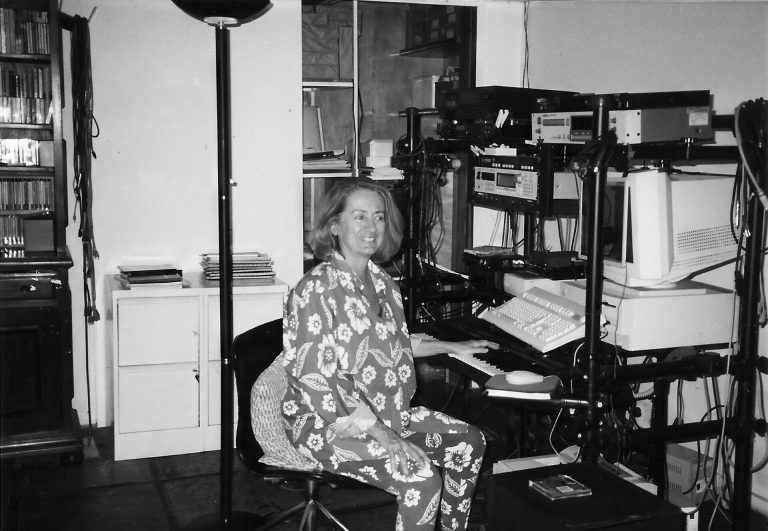
The Circular Universe – Jocy de Oliveira: An interview with director Dácio Pinheiro
24 August, 2026The Circular Universe is a new film that documents the extraordinary life of Brazilian electro-acoustic and multimedia artist Jocy de Oliveira. The documentary gives an insightful overview of her life, which includes working with Stravinsky, Xenakis, and Stockhausen, her own idiosyncratic anti-bossa nova and her ‘post-operas’ with experimental electronics.
At 90 years old, de Oliveira is still composing today. However, in a reflection of the changing face of culture in São Paulo, the new opera she was working on has just been cancelled by the Teatro Municipal de São Paulo, following changes in the institution’s leadership, with the new administration having an anti-identitarian and more conservative cultural vision for the programme.
Despite this, the documentary is coming to Europe with the following dates confirmed:
September 24th at Sinema Transtopia, Berlin
October 18th at the XenophoniX AvantJazz Festival, Copenhagen
October 23rd at the SemiBreve Festival in Braga, Portugal
The first week of November at In-Edit Festival, Barcelona.
Further screenings are to be confirmed for France and London.
I spoke to the documentary’s director, Dácio Pinheiro, about the film and the process of making it.
Sounds & Colours: A simple question: Why Jocy and why now?
Dácio Pinheiro: In 2017, I met Jocy for the first time, through a close friend and longtime collaborator, the musician Paulo Beto. At the time, we had started developing a documentary project about electronic music called Eletrônica:Mentes (Electronic:Minds). Since the subject opened up many possible musical directions, we decided to focus the research and narrative on the pioneers of electronic music in Brazil, in contrast with younger artists producing experimental electronic music today, from musicians nostalgic for analog equipment to those working with more advanced technologies.
During the research process, I came across Jocy de Oliveira and became fascinated by both her life trajectory and her creative energy. The documentary was released during the pandemic, but it was still screened at festivals such as IndieLisboa and In-Edit Brasil. After finishing the film, I was left with a strong desire to make a documentary entirely dedicated to Jocy. So, after 2020, Paulo Beto and I began developing this new project together. In 2022, we received our first support from the São Paulo State Department of Culture, and towards the final stage of production we also partnered with SescTV. It took us four years to complete the film.
It felt perfect that the documentary was finished close to Jocy de Oliveira’s 90th birthday. Perfect timing. The film had its world premiere at the latest edition of IndieLisboa, where it screened in the competitive section Indie Music. During June, the film had its Brazilian premiere at In-Edit Brasil, and was also presented at Sala São Paulo during a special event celebrating Jocy’s 90th anniversary. Over two days, the programme featured a new opera composed by Jocy alongside special screenings of the documentary. By the end of June, the film also participated in CineOP – Ouro Preto Film Festival, one of the most important festivals in Latin America dedicated to archive-based cinema.
I felt this was the right moment to make a film about Jocy because many of the ideas present in her work – technology, experimentation, multimedia performance, the body, the voice, and the role of women in the arts – feel incredibly relevant today. Although she has been a pioneering figure for over six decades, much of her work remains relatively unknown outside specialist circles, particularly in Brazil.
At 90 years old, Jocy continues to create and rethink her own work with remarkable vitality. The film became not only a portrait of an artist, but also an opportunity to revisit an important chapter in the history of experimental music and media art in Brazil through someone who actively lived and shaped it.
I was also personally fascinated by the freedom of her artistic practice, which constantly moves between music, theater, electronics, literature, and visual arts without respecting traditional boundaries.
S&C: Can you expand on the meaning of the title?
DP: The title The Circular Universe reflects both Jocy’s artistic philosophy and the structure of the film itself. Throughout her life and work, ideas, sounds, memories and artistic encounters constantly reappear in different forms, creating a sense of continuous movement between past, present and future. Jocy often says that she has been doing the same thing since childhood, everything keeps transforming, growing and taking on different forms of expression, storytelling and realization, but, in the end, it is always the same impulse, the same story being told.
The title also evokes the cyclical nature of artistic creation in her work, the dialogue between acoustic and electronic music, memory and reinvention, performance and archive. The film itself moves through different moments of her life almost as if navigating constellations connected across time.
S&C: I see the documentary is produced by SESC (Social Service for Commerce). How important were they to the making of the film?
DP: SescTV was a key partner in the post production of The Circular Universe – Jocy de Oliveira. In addition to providing financial support through co-production, its involvement gave the project the stability and creative freedom needed to develop a film centred on experimental music, archives and cultural memory, themes that are often difficult to fund within more commercial structures.
SESC was already an enthusiast of Jocy de Oliveira’s work; they had previously produced and presented some of the composer’s operas, and in 2008, SESC released a DVD box set featuring some of Jocy’s major operas.
In Brazil, SESC plays a very important cultural role in supporting independent artistic production and preserving artistic memory. They have consistently created space for projects linked to music, contemporary art, theatre, education and documentary cinema. Their long-standing commitment to cultural experimentation has made them the ideal partner for a film like this about Jocy de Oliveira, an artist whose work has always challenged conventions and pushed artistic boundaries.
S&C: How did you select which of Jocy’s pieces to include in the film from Jocy’s vast catalogue of works?
DP: It was an intense process. We edited and re-edited the film several times until we arrived at something we were happy with. I had conducted several other interviews, but in the end I felt it was more important to let Jocy reflect on her own life story in her own words.
Selecting which works to include was one of the film’s greatest challenges, given that Jocy’s artistic output is so vast and multifaceted. Rather than creating a chronological portrait, I sought to follow my instinct and, much like the title itself, create a dialogue with her work and with the non-chronological nature of the events. We focused on works that could reveal the evolution of her artistic thinking and the recurring themes that permeate her entire career.
We were particularly drawn to pieces where she explores the relationship between voice, technology, theatricality and the female presence, central elements in her work. Some compositions were also chosen because they connect directly to important moments in her life, as well as to her exchanges, correspondence and encounters with artists such as John Cage, Luciano Berio, Messiaen, Xenakis and Stravinsky.
Many of her operas and multimedia performances also offered striking visual and sonic possibilities, in which music, space and image become inseparable. Ultimately, the film became less an attempt to summarise her catalogue and more a journey through her artistic universe.
This is my fourth documentary based mainly on archive material, and in previous projects I often struggled to track down the footage, either because it hadn’t been properly preserved, or because I knew it existed but the tapes had been lost or recycled. With Jocy, the experience was completely different.
We are enormously grateful for the generosity of Bernardo Palmeiro, who worked with Jocy for many years and documented many of her performances. He was instrumental in helping us find everything we needed to tell this story. Together, they have carefully preserved and organised an extraordinary archive over several decades, including videos, photographs, programmes and concert catalogues.
An excellent introduction to de Oliveira’s work is this collection compiled by one of the documentary’s producers, Paulo Beto (aka Anvil FX).
Follow Sounds and Colours: Facebook / Twitter / Instagram / Mixcloud / Soundcloud / Bandcamp
Subscribe to the Sounds and Colours Newsletter for regular updates, news and competitions bringing the best of Latin American culture direct to your Inbox.