

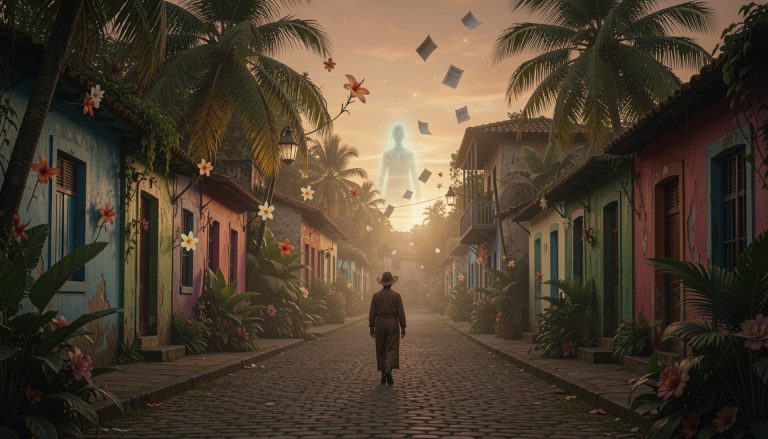
From Gabriel García Márquez to Modern Cinema: How Magical Realism Lives On
18 August, 2026A woman ascends into the sky while folding laundry. A dead relative returns for dinner. Nobody screams. Nobody asks how it happened. Life simply continues. This quiet logic made Gabriel García Márquez one of the defining voices of magical realism, a tradition that still shapes cinema almost six decades after One Hundred Years of Solitude appeared in 1967.
The appeal of this storytelling mode now reaches far beyond literature. Contemporary audiences are surrounded by visual entertainment that blends familiar formats with imaginative worlds, from film and television to American slots online. Yet magical realism has a more specific purpose. For García Márquez, the fantastic could make history, memory and political violence visible.
Macondo Changed the Rules
García Márquez did not originate the term magical realism, but his work became one of its defining expressions. When he received the Nobel Prize in Literature in 1982, the Nobel committee praised his combination of the fantastic and the realistic.
His 1967 novel follows seven generations of the Buendía family in Macondo. The town is fictional, yet its history reflects real experiences of Colombia and Latin America. War, political repression and collective memory exist alongside ghosts and impossible events.
The supernatural is never presented as an interruption. It belongs to everyday life.
The novel’s global influence remains enormous. Netflix says One Hundred Years of Solitude has sold more than 50 million copies and been translated into more than 40 languages.
What Happens When Magic Moves to Film?
Cinema changes the equation. A writer can describe an impossible event in a calm sentence. A filmmaker must decide what the audience sees and whether the event should look real.
This is where magical realism and fantasy begin to diverge. Fantasy usually establishes a world where supernatural forces follow their own rules. Magical realism keeps the surrounding world recognizable. The extraordinary appears within it without demanding an explanation.
Guillermo del Toro explores this boundary in The Devil’s Backbone (2001) and Pan’s Labyrinth (2006). Set in Spain in 1944 under the Francoist regime, Pan’s Labyrinth follows Ofelia into a mysterious world of fauns and fairies while political violence surrounds her.
The film is often discussed alongside magical-realist cinema, although del Toro has also described it as a dark fairy tale. Its fantasy does not erase history. It gives Ofelia another language for understanding violence.
Other filmmakers have adapted the principle in different ways:
- Like Water for Chocolate (1992) connects extraordinary events with food, desire and family tradition.
- Uncle Boonmee Who Can Recall His Past Lives (2010) allows ghosts and reincarnation to enter ordinary Thai life.
- Beasts of the Southern Wild (2012) uses fantastical imagery to explore childhood, poverty and disaster.
- Bird (2024), directed by Andrea Arnold, uses magical realism within a contemporary British social setting.
When “Magical” Becomes a Problem
There is a danger in treating magical realism as an exotic visual label. If folklore or supernatural imagery becomes detached from its cultural context, the result can turn into decoration.
In García Márquez, magic exists alongside political violence, historical memory and colonial legacies. The strongest filmmakers preserve that connection. A ghost can carry memory. A creature can embody fear. A fantasy world can expose realities that ordinary language struggles to express.
That is why Pan’s Labyrinth remains so powerful. Its monsters matter because of the historical violence surrounding them.
Netflix Brings Macondo to the Screen
For decades, One Hundred Years of Solitude was considered difficult to adapt. Its generations repeat names, its chronology loops back and its narration treats miracles as calmly as domestic events.
Netflix released the first eight episodes on December 11, 2024. The series was filmed entirely in Colombia with support from García Márquez’s family.
The production involved more than 900 people, around 150 artisans and over 850 local suppliers. Netflix estimates that it contributed more than 225 billion Colombian pesos to Colombia’s economy.
The adaptation concludes in August 2026:
- Part Two premiered on August 5 with seven episodes.
- The Grand Finale arrives on August 26 as episode 16.
- The complete adaptation contains 16 episodes.
The Magic Is Still About Reality
Magical realism survives because it can express things conventional realism cannot always capture. It can make memory visible and give shape to trauma.
García Márquez made the extraordinary feel ordinary. Contemporary filmmakers have taken that principle across cultures and genres. What survives is not a fixed formula of ghosts or miracles, but the freedom to make reality stranger without making it less true.
That is why Macondo still feels alive on the screen.
Follow Sounds and Colours: Facebook / Twitter / Instagram / Mixcloud / Soundcloud / Bandcamp
Subscribe to the Sounds and Colours Newsletter for regular updates, news and competitions bringing the best of Latin American culture direct to your Inbox.