

South America Travel: The No-Nonsense Guide to Planning Your First Trip
10 August, 2026South America is bigger than most first-time visitors expect. The continent covers roughly 17.8 million square kilometres and stretches across 12 countries and one overseas territory. That scale is the whole challenge. Get the route, the timing and the budget right, and this becomes the trip of a lifetime. Get them wrong, and you burn days on buses you never planned for.
This guide is opinionated on purpose. It tells you where to go, when, and how much to spend, without the glossy filler.
Why South America travel rewards slow planning
Distances here are deceptive. A flight from Bogotá to Buenos Aires takes longer than London to New York. Overland routes look short on a map but climb through the Andes at walking pace. Plan for fewer countries and deeper stays.
Most travellers follow the Andean spine, moving north to south or the reverse. That corridor links Colombia, Ecuador, Peru, Bolivia, Chile and Argentina in one logical line. It is the simplest way to see the highlights without doubling back.
The best places to visit in South America
You cannot see everything in one trip, so prioritise. These are the anchors most itineraries are built around.
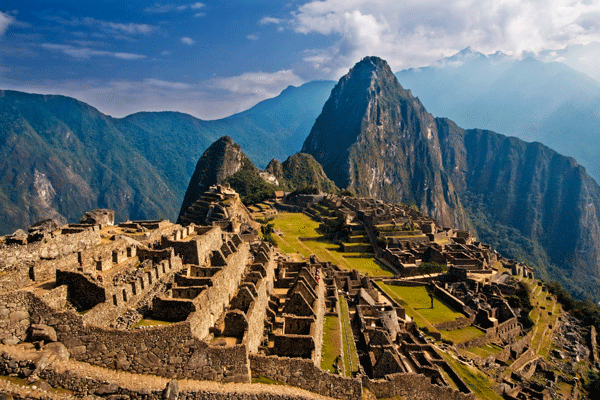
Machu Picchu, Peru. The 15th-century Inca citadel sits at about 2,430 meters and remains the continent’s signature sight.
Patagonia, Argentina and Chile. Glaciers, granite towers and long-distance treks split between two countries.
The Amazon, Brazil, Peru or Ecuador. The world’s largest rainforest, best reached by riverboat or jungle lodge.
Rio de Janeiro, Brazil. Beaches, samba and the Christ the Redeemer statue above the bay.
The Galápagos Islands, Ecuador. The volcanic archipelago that shaped Charles Darwin’s thinking on evolution.
Cartagena, Colombia. A walled colonial city on the Caribbean coast with the continent’s most colourful old town.
For a wider shortlist across the continent, this rundown of the best places to visit in South America is a useful starting point before you lock in a route.
When to go
Seasons flip below the equator. Southern summer runs from December to February, which is peak time for Patagonia and Buenos Aires. Book those months early because prices climb fast.
The Andean dry season, roughly May to September, is ideal for Peru, Bolivia and the Inca Trail. The Amazon is a year-round destination, though water levels change what you can do. If you want Rio’s Carnival, aim for February and reserve months ahead.
How much does it cost?
Budgets swing wildly by country. Bolivia, Peru and Ecuador are gentle on your wallet. Chile, Uruguay and much of Brazil cost noticeably more.
As a rough daily guide for a mid-range traveler:
Budget countries (Bolivia, Peru, Ecuador): around 40 to 60 USD per day.
Mid-range (Colombia, Argentina): around 60 to 90 USD per day.
Higher cost (Chile, Brazil, Uruguay): 90 USD and up per day.
Internal flights are the hidden line item. On a multi-country trip, budget for two or three, because the overland alternative can cost you a week.
Staying connected across borders
Connectivity is where a lot of trips stumble. Local SIM cards mean new paperwork in every country, and roaming bills add up quickly when you cross five borders in a month.
A regional data plan solves most of it. An eSIM from Holafly installs before you fly and activates the moment you land, so navigation, ride apps and maps work from the airport. That matters most in remote stretches of Patagonia or the Amazon, where finding a shop is not an option.
Safety and practical basics
South America is far safer than headlines suggest, but big cities demand street smarts. Keep valuables out of sight, use registered taxis or ride apps, and stay alert in crowded transit hubs. Petty theft is the real risk, not the dramatic stuff.
Altitude is the other quiet threat. Cusco, La Paz and the Bolivian highlands sit high enough to cause sickness. Arrive slowly, hydrate, and give yourself a day before any serious hiking.
Frequently asked questions
How long do I need for South America?
Two weeks covers one region well, such as Peru and Bolivia. For a proper multi-country trip along the Andes, plan four to six weeks.
Do I need a visa?
Most South American countries allow US passport holders to enter visa-free for tourism, usually for up to 90 days. Rules change, so confirm each country before you book.
Is it better to fly or take buses?
Long-distance buses are comfortable and cheap, but distances are huge. Mix both: buses for short hops, flights for the long jumps between regions.
What is the single biggest planning mistake?
Cramming in too many countries. Travellers who slow down and pick two or three regions almost always enjoy the trip more.
Do I need to speak Spanish?
It helps enormously, since English is limited outside tourist centres. Brazil speaks Portuguese, so learn a few phrases there too.
Plan the route first, then the season, then the budget. Do that, and South America stops feeling overwhelming and starts feeling like the adventure it should be.
Follow Sounds and Colours: Facebook / Twitter / Instagram / Mixcloud / Soundcloud / Bandcamp
Subscribe to the Sounds and Colours Newsletter for regular updates, news and competitions bringing the best of Latin American culture direct to your Inbox.