

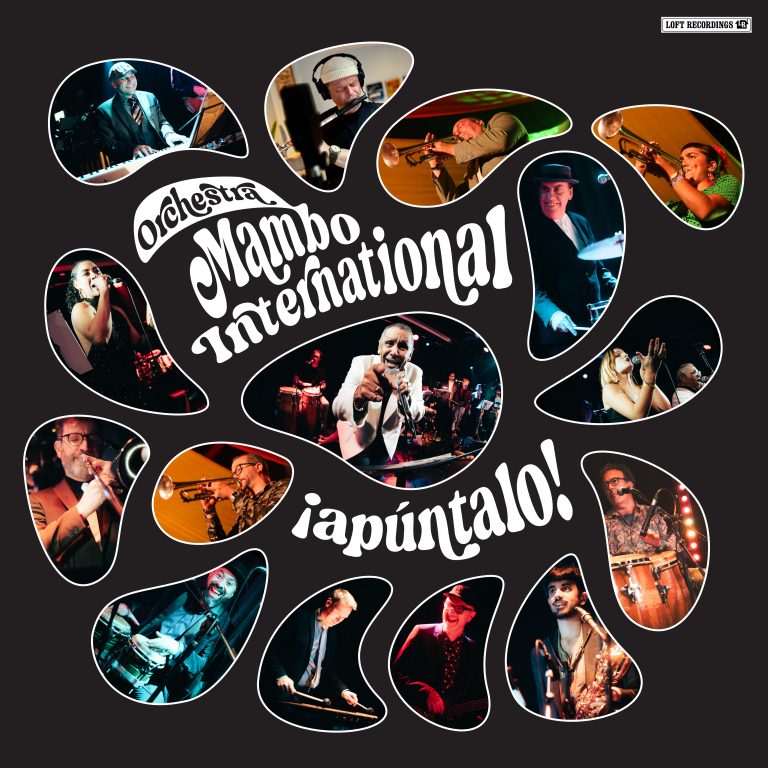
The Mambo Calls: Inside Orchestra Mambo International’s ¡Apúntalo!
19 September, 2026Mambo has travelled a long way from the streets and clubs of New York and the Caribbean. These days, you can find it taking shape in West Yorkshire. Orchestra Mambo International grew out of a one-off Latin night in Manchester in 2022, but what began as a tribute to Tito Puente quickly became something much bigger: a multinational orchestra bringing together musicians from Cuba, Colombia, Brazil, Venezuela, Spain and the UK.
At the centre of it is Jonny Enright, a musician whose route into Latin music began with Yorkshire brass bands, classical training and a life-changing encounter with Manny Oquendo’s Conjunto Libre. Alongside DJ and record collector Lubi, Enright has spent the past few years turning that obsession into a living, breathing band. Their debut album, ¡Apúntalo!, is the result. It is deeply rooted in the history of mambo and New York salsa, but it is also unmistakably the work of musicians making something new in Yorkshire. We recently caught up with Jonny to get a full picture of this amazing project straight from its primary source:
Sounds and Colours: Let’s start from the beginning of the project. You and Lubi were driving along the A650 between Shipley and Bradford when the idea for Orchestra Mambo International began taking shape. What were those conversations actually like? And what made you think, “Right, we need to start a mambo orchestra”?
Jonny Enright: It began as a one-off project rather than something we had carefully planned. The Blues Kitchen in Manchester asked Lubi to put together a band for a Latin night in November 2022, and we decided to play the music of Tito Puente.
I already had some of the music from previous projects, so we assembled a great band, including my old friend Carlos “Pachanga” Peña on vocals. I think we were billed as something like “DJ Lubi’s Mambo Allstars”.
The Manchester gig was a real success, and we all loved it, so we followed it with a show at the Brudenell Social Club in Leeds, which sold out. What stood out was the mix of people in the audience: dancers, jazz heads, Latin music fans, younger people discovering the music for the first time, and people who simply enjoy quality live music. Tito Puente’s music is so universal and welcoming, and the audience really responded to this.
It felt like the right time to make it a proper band. We wanted a name that reflected the make-up of the group, with musicians from Cuba, Venezuela, Brazil, Colombia, Spain and the UK, so we called it Orchestra Mambo International.
The music we were playing and the reactions we were getting inspired me to start writing original music for the band. I wrote and co-wrote the songs for the album, working closely with Carlos and Jimmy Le Messurier where the songs called for it. Carlos and I wrote “Mambo Te Llama” (“The Mambo Calls You”), which we released as a 45 on ATA Records in May 2024. It nearly sold out on pre-order and received fantastic radio support, including from Gilles Peterson and Cerys Matthews on BBC 6 Music.
S&C: Your route into Latin music wasn’t exactly conventional. You came through Yorkshire brass bands and classical training, while Lubi came through DJing, record collecting and digging. Do you remember the record, musician or moment that made Latin music feel like something you needed to pursue rather than simply something you enjoyed listening to?
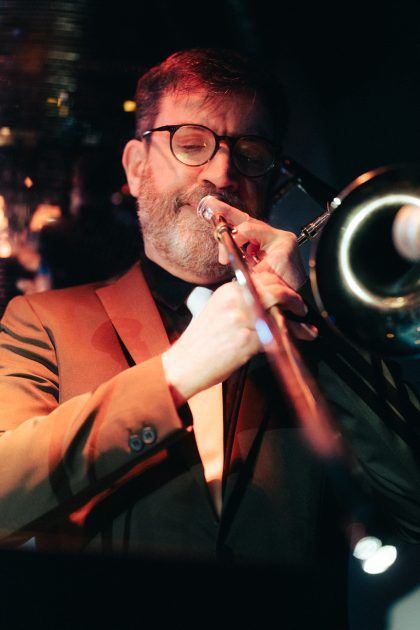
JE: The defining moment for me was seeing Manny Oquendo y Conjunto Libre at the Clapham Grand, around 1992. Their horn section had five trombones, including Jimmy Bosch. It was incredible, and Conjunto Libre quickly became my favourite band.
I loved Jimmy Bosch’s playing, and I learned his solos and started coming up with horn moñas (riffs) in his style. Years later, it felt like a real full-circle moment when my first band, Grupo X, had the chance to back Jimmy on several UK visits as a solo artist.
By then, I was studying at the Royal College of Music. I had just joined La Clave, one of the leading Latin bands on the London scene at the time, led by Orchestra Mambo International’s timbalero and fellow songwriter, Jimmy Le Messurier. I was already deeply into the music, but seeing Conjunto Libre live sealed it for me.
S&C: Interesting! So you spent years digging into the history of mambo, son, salsa and the New York Latin scene, and then you found yourself working alongside musicians who had been part of that history, including Joe Bataan and Jack Costanzo. Was there a particular moment when you realized that the music you’d spent years studying had become something you were physically inside?
JE: My Latin musical education has come largely through being in clubs and seeing how people react to the music, listening on repeat to tracks I really like, transcribing loads of tunes for the bands I have played with, and playing alongside talented, generous musicians from all over the world.
I’ve been fortunate to work with artists such as Joe Bataan and Jack Costanzo. I learned a great deal from both of them, not only from their music, but also from their hard work and single-mindedness in choosing their own path and sticking to it.
I can’t think of a particular moment when it clicked, and there’s always so much more to learn, but it’s just been a gradual process where I’ve become confident enough to find my own voice within that style.
Writing and producing this album was probably the clearest expression of that. I wrote or co-wrote all of the material, then arranged and produced it with the orchestra in mind. It felt as though years of listening, transcribing, performing and leading bands were pouring into the new songs.
Releasing it through my own label, Loft Recordings, has been part of that process too. It means taking responsibility for the whole thing, from the first musical idea through to the finished record, but I’ve got a great team around me and lots of people to chat to for advice, including Lubi, Jimmy and our bass player, Simon Edwards. My family keep me grounded. And living in West Yorkshire, you can’t get too big for your boots.
S&C: There’s something fascinating about Orchestra Mambo’s geography. The music has deep roots in Cuba, Puerto Rico, New York and the wider Caribbean, yet this particular orchestra has grown out of Yorkshire and brings together musicians from Colombia, Cuba, Brazil, Venezuela, Spain and the UK. What’s your take on musical traditions that travel this far from their historical centres?
JE: For me, it feels completely natural. This music has always travelled, evolved and brought people together, and our band reflects that, with its international lineup.
The important thing is to respect its roots: to listen, learn the language, understand where it comes from and play it properly. But we also want to share its joy as widely as possible. I hope the music on the album has soul and depth, with plenty going on in the arrangements, while still being exciting, welcoming and made for people to enjoy together.
That is why we are taking the orchestra to new places on our album tour. We want people beyond the usual Latin and jazz audiences to experience a full mambo orchestra: the rhythms, percussion, brass and energy of it all, whether they come to dance, listen closely or simply have a great night out.
S&C: Absolutely. On another note, Carlos “Pachanga” Peña is 72, while the orchestra also includes a much younger generation of musicians. What have you seen happen between those generations that couldn’t really be taught in a classroom or written into an arrangement?
JE: This is one of the most special things about the band for me. I got my own break with La Clave at 20 and learned a lot from playing with older musicians, so I have always wanted to give talented younger musicians opportunities, and Lubi feels the same.
Young musicians such as trumpeter Olivia Cuttill, baritone saxophonist Gustavo Andrade and coro singer Romy Taylor bring freshness, energy and fearlessness. They are all already making names for themselves and leading successful projects in their own right.
Playing alongside more experienced musicians brings a different kind of learning: to do with feel, perspective and the ability to react in the moment. Carlos brings a lifetime of experience, having toured as a corista with Oscar D’Leon and much more, but he is incredibly youthful himself; he would probably say he has more energy than anyone in the band. It’s a really exciting combination, and that’s something you can’t write into an arrangement.

S&C: With ¡Apúntalo!, there seems to be a strong desire to make the music something people participate in rather than something they simply observe. What do you think happens when Latin music is treated as a living social experience rather than as something to be preserved behind glass?
JE: We are really keen to bring people into the music rather than present it as something distant or exclusive. I was very proud when we played Glastonbury Festival last year: the Glasto Latino tent was packed on both nights, and most of the audience had probably not heard of us or been familiar with this particular style of music before. But they really responded, cheering the solos, dancing, singing along and giving the band so much energy.
That is what this music is about for me. It is sophisticated and full of history, but it also makes you feel good. The audience is part of the experience: their dancing, cheering and response changes the atmosphere in the room, and the band feels that.
We want to respect the tradition, but not treat it as a museum piece. The best way to keep this music alive is to play it with real commitment, write new music within that tradition, and invite people in to share the joy of it.
S&C: You once mentioned buying Orquesta Novel’s Que Viva El Son Montuno at Mr Bongo in London in the mid-90s. What’s a record you’ve lived with for decades that still reveals something new every time you put it on?
JE: Sonido, Estilo y Ritmo by Manny Oquendo’s Conjunto Libre (Montuno Records, 1991). The title means Sound, Style and Rhythm, and that pretty much sums up the six tracks on the album, with beautiful arrangements of classics like “Qué Humanidad”, “Estoy Como Nunca”, and “Llora Timbero”. It’s music for dancing, but there’s lots of detail in the arrangements, with jazzy harmonies and mambos that take the songs off into new places.
The playing is top-notch with Jimmy Bosch firing on all cylinders over rich trombone moñas and Dave Valentín’s virtuosic flute playing conversing with Manny Oquendo’s timbales, with amazing playing from Andy and Jerry González (bass and congas). It has a real sense of joy, but there’s something deeper and majestic in the rhythms that really gets me every time I listen.
S&C: You’ve spent a lot of time mentoring younger musicians. Gustavo Andrade, Víctor Estévez and Olivia Cuttill are now part of this wider story. At what point does the relationship change from “I’m teaching this person” to “this person is teaching me something”?
JE: Right from the start, really. I learn as much from them as they do from me.
I can help with things such as phrasing, articulation and the finer details of the style, but when they start playing, they bring an exuberance and excitement that is genuinely inspiring. Gustavo, Víctor and Olivia are all hugely talented, well-trained musicians in their own right, and they are not afraid to ask searching questions, which definitely keeps me on my toes.
For the more experienced members of the band, their energy reminds us how it felt when we were starting out. It is a lovely thing to see, and it gives us a good spirit as a band.
S&C: You grew up around Halifax and Bradford, learned your craft through British brass bands and classical music, and eventually found yourself leading a multi-national Latin orchestra and playing places like Glastonbury. If someone had told teenage Jonny that this was where the road was heading, what part of the story would he have found hardest to believe?
JE: I was always keen on the idea of leading my own band. Aside from my classical music activities, in my teens I had a New Orleans jazz band that played in local pubs. We only had six tunes, so we’d rotate them and give them different names, hoping nobody would notice.
I loved the idea of being part of a horn section, like the ones I saw on Top of the Pops with bands such as Dexys Midnight Runners and The Specials. I thought that would be a good thing to get into at some stage, but I never would have imagined that I would discover Latin music or that it would become such a central part of my life.
I did have to pinch myself when we were recording the album and had brilliant musicians like Carlos Peña, Claritzel Miyares and Chip Wickham in my studio. That was definitely a thrill, and I had to make sure I concentrated and pressed record at the right times!
S&C: Amazing! To finish this great interview with a bit on recorded music, you’ve spent decades digging through records, so I’m curious about what your ears are actually chasing these days. What are a couple of artists or records you’ve been listening to a lot lately, whether they’re new or 50 years old?
JE: Whilst I’ve been writing and producing our album, I’ve been listening to loads of classic New York salsa for inspiration. One record I’ve had on a lot is Siembra by Willie Colón and Rubén Blades (Fania Records, 1978). I just love the performances, and Willie Colón’s arrangements go off in all sorts of unexpected directions, but never get in the way of the songs. Rubén Blades sings them so beautifully.
I like a good song, and I really like Olivia Dean’s album The Art of Loving, which is packed full of them. She’s a brilliant performer, and there’s something so positive about the album. It’s good to listen to different styles and just enjoy good music, rather than always analysing everything.
¡Apúntalo! is ultimately a record made to be heard in motion. There are deep arrangements, years of musical history and serious musicianship under the surface, but Orchestra Mambo International never loses sight of what makes this music so powerful in the first place: people coming together, dancing, listening and responding to one another. If Jonny Enright’s story tells us anything, it is that musical traditions do not stay in one place. They travel, they change, and they find new people willing to carry them forward.
¡Apuntalo! is out today via Loft Recordings. Listen to it on Bandcamp, give it a proper spin, and catch Orchestra Mambo International on their UK tour this autumn.
Follow Sounds and Colours: Facebook / Twitter / Instagram / Mixcloud / Soundcloud / Bandcamp
Subscribe to the Sounds and Colours Newsletter for regular updates, news and competitions bringing the best of Latin American culture direct to your Inbox.