

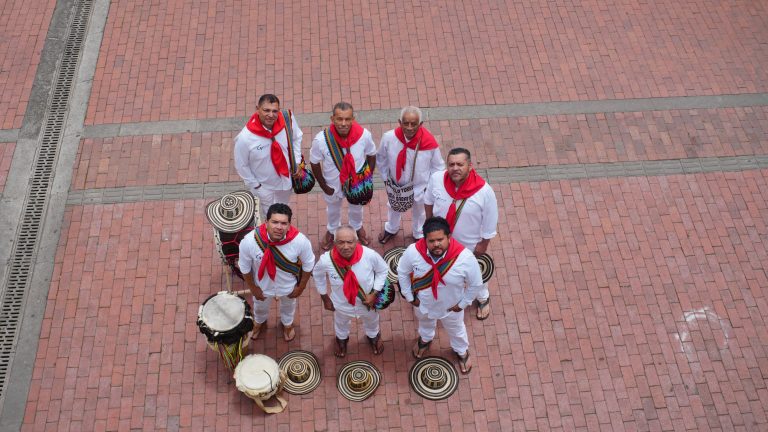
Los Gaiteros de San Jacinto, Fruko & Carmelo Torres – “Magdalena Ruiz”: A Sounds and Colours single premiere
09 September, 2026“Magdalena Ruiz” is the first single from an album that comes out next month. Madre Cumbia is an intriguing collaboration that brings together the ancestral custodians of Colombia’s oldest cumbia traditions, the architect of modern tropical music and the country’s greatest living accordionists.
Latin Grammy Award-winning Los Gaiteros de San Jacinto represent one of Colombia’s oldest continuously performed musical traditions. Active since the 1940’s, their music preserves the ancestral dialogue between gaitas, drums and voice that predates the commercial recording industry and has become synonymous with the very origins of cumbia. As custodians of an Afro-Indigenous musical heritage, they remain the definitive link to the genre’s birthplace.
Fruko hardly needs an introduction. He has been called “a one-man tropical orchestra“ and few musicians have left a greater imprint on Colombian popular music. Often described as the Quincy Jones of Colombia, he served as the visionary producer behind the golden era of Discos Fuentes, an era that helped define the sound of modern tropical music through so many groundbreaking recordings.
Latin Grammy-nominated Carmelo Torres carries forward the accordion tradition born in Colombia’s Caribbean plains. As the direct heir to the cumbia sabanera lineage shaped by pioneers such as Andrés Landero and Aníibal Velasquez, Torres is widely regarded as one of the last great acordeonistas gruesos—a powerful, deeply rhythmic style rooted in the same musical communities where cumbia first flourished. Recently, he portrayed Gabriel García Márquez’s character Francisco El Hombre in episode 4 of Netflix’s One Hundred Years of Solitude.
The single is a celebration of San Jacinto and one of the great songwriting traditions of the Colombian Caribbean. San Jacinto is inseparable from Los Gaiteros de San Jacinto, but it also produced the song’s legendary composer, Adolfo Pacheco, one of Colombia’s great songwriters, whose repertoire moved between vallenato, cumbia and the traditional music of the Montes de María. A schoolteacher, lawyer and public servant who remained deeply connected to the civic and cultural life of his region, Pacheco was recognised by the Festival de la Leyenda Vallenata in 2005 for his extraordinary contribution to Colombian music by naming him Rey Vitalicio, “King for Life”.
“Magdalena Ruiz” is more than a portrait of a legendary dancer; it is Pacheco remembering an entire world through her. He tells us what the viejos y gaiteros remember: Magdalena’s white smile, the sensuality and grace of her movement, and the way a gathering changed the moment she arrived. The song’s extraordinary line, “Si no llegaba Magdalena, se enfriaba de la gaita el son,” suggests that without her, even the sound of the gaita grew cold. When Magdalena arrives, everything comes alive: the musicians, the dancers, the drinking, the young men and women, the elders, the opening of the circle “La Rueda”. And when Pacheco sings “Ahora la evoco en mi cantar” — “Now I evoke her in my song” — he is not only summoning Magdalena’s memory; through her, he is summoning cumbia itself. Magdalena is the spirit of the music, a deity implored to connect the community.
Here’s a private link so you can stream the single now on Soundcloud.
At the centre of the world depicted by the song is the rueda de cumbia, the traditional circle in which cumbia becomes a communal ritual rather than simply a musical performance. The musicians occupy the musical centre while dancers move around them in a circle, traditionally with women carrying candles and moving with long skirts as the drums and gaitas propel the rueda forward. The form embodies the intertwined African and Indigenous foundations of Colombian cumbia, alongside European influences that entered its dress and social environment. Percussion, gaitas, movement, courtship, fire and community all exist within the same space. There is no hard division between performer and audience: the musicians create the music for the dancers, while the dancers give the music its physical life. La rueda is cumbia experienced as a living social ritual. She represents the dancer as an essential participant in cumbia—the person capable of transforming sound into celebration.
If this whets your appetite for more, as it certainly does mine, the vinyl edition of the album is out on 20th October, while the digital download release occurs on the 10th December.
(Cover photo of Los Gaiteros de San Jacinto with Carmelo Torres courtesy of Alan Pulido.)
Follow Sounds and Colours: Facebook / Twitter / Instagram / Mixcloud / Soundcloud / Bandcamp
Subscribe to the Sounds and Colours Newsletter for regular updates, news and competitions bringing the best of Latin American culture direct to your Inbox.